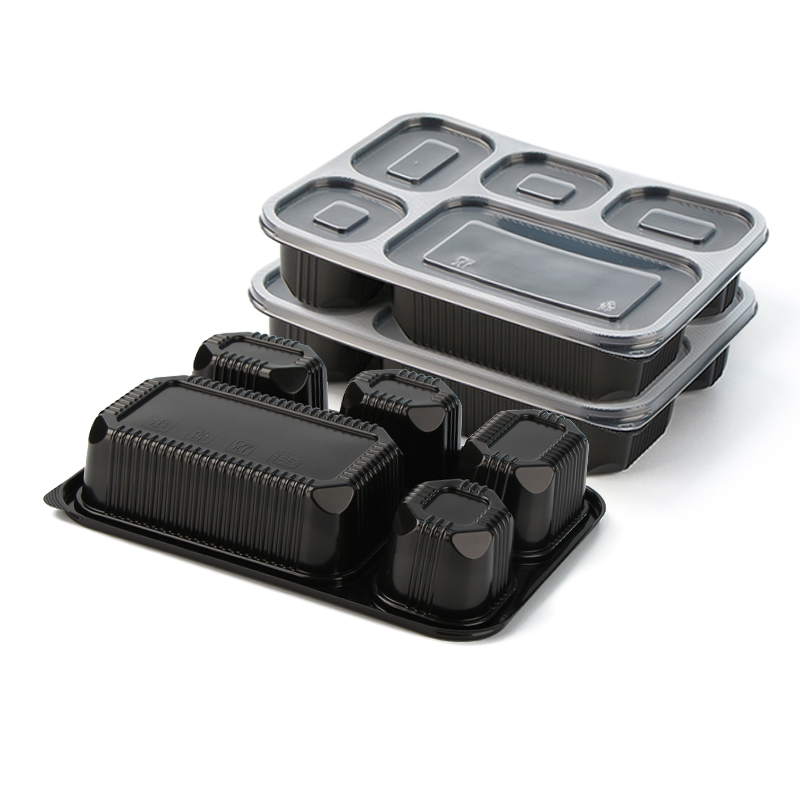

Meal Prep Boxes for Business: A Wholesale Buyer's Complete Guide
Walk into any commercial kitchen running a meal prep operation and you will see the same thing: stacks of containers, lids snapping on at the pace of the line, and a logistics manager counting units against the day's order volume. Meal prep boxes are the last thing the customer sees before they eat — and the first thing your team handles every morning. They are not an accessory. They are the physical backbone of your operation.
The market numbers tell part of the story. HTF Market Insights values the meal prep containers market at roughly USD 3.7 billion in 2025, on track to reach USD 7.6 billion by 2033 as demand from meal-delivery services and fitness-focused lifestyles compounds. Within that, DataHorizon Research tracks the reusable segment at about USD 2.8 billion in 2024, projected to climb to USD 4.9 billion by 2033 at a 6.4% CAGR, with North America holding roughly 40% of the reusable market. Technavio adds a third lens, projecting the US food storage container market to add USD 2.51 billion in incremental growth through 2030.
But numbers alone do not explain why a cloud kitchen operator and a fitness meal-prep brand will both spend hours debating which container to order at 50,000 units. The reason is simpler: the box you choose shapes how fast your kitchen runs, how many complaints your customer-service team fields, and whether your brand sticks in a subscriber's mind after the third delivery.
Why Meal Prep Boxes Are Now a Strategic Business Decision
The Market Is Moving — And Faster Than You Think
Three data points, from three independent research firms, all point the same direction. HTF Market Insights puts the meal prep containers market at USD 3.7 billion in 2025, heading to USD 7.6 billion by 2033. DataHorizon Research tracks the reusable subset at USD 2.8 billion in 2024, projected to USD 4.9 billion. Technavio estimates the US food storage container market alone will grow by USD 2.51 billion between 2025 and 2030.
Those are not abstract forecasts. Behind each percentage is a commercial kitchen expanding its delivery radius, a fitness brand adding 500 subscribers in a month, or a corporate lunch program replacing an in-house cafeteria with outsourced meal service. Three business tracks are scaling at once — cloud kitchens running delivery-only operations, macro-based meal-prep brands building subscription models, and corporate catering programs feeding office teams. None of them can afford to treat container procurement as a casual purchase.
A kitchen putting out 200 meals a day does not have the luxury of "trying out" containers the way a home cook might. Every lid that does not seal, every box that deforms in the microwave, every unit that arrives defective triggers a cascade of downstream problems — slower portioning, customer complaints, margin erosion. That is why treating meal prep boxes as a strategic decision, not a commodity buy, is the shift that separates operators who scale from those who stall.
The Hidden Cost of Choosing Wrong
The container's price tag gets the most attention during procurement. It is also the number that misleads the most.
Consider what happens when boxes leak in transit. A subscriber who receives a leaking meal once may give you a second chance. A subscriber who receives a leaking meal twice will not. The lost revenue from that churn far exceeds whatever you saved on the cheaper container. Industry surveys of delivery reliability consistently find that a large share of delivery customers have received a spilled, crushed, or cold order — a packaging failure, not a food failure.
Then there is labor. When a container's compartments do not match your actual portion weights, kitchen staff spend extra seconds adjusting every plate. In a 300-meal shift, those seconds compound into minutes, and those minutes into real labor cost nobody budgeted for.
Finally, compliance. Using containers without proper food-contact certification does not just expose you to regulatory action — it signals to customers and to the platforms that list your business that you cut corners on safety. No unit-price discount recovers that kind of trust damage.
Mapping Meal Prep Boxes to Your Business Model
Six Business Models and Their Container Requirements
There is no universally "best" meal prep box. There is only the box that fits your operation — and the wrong one costs you in ways that never appear on the invoice.
Direct-to-consumer meal prep delivery. You need containers that seal tight, stack flat, and survive microwave reheating without warping. PP5 in 24–32 oz with 1 or 3 compartments covers the baseline. Your customer opens the box at home, reheats it, and the container has to perform without fail — every time.
Cloud kitchen. Speed of portioning matters more than premium feel; you run volume, not brand experience. Multi-size combos in 12–32 oz, PP5 or black PP, give flexibility across menu items without adding line cost. One compartment for simple dishes, three for meal sets — the kitchen decides, not the brand team.
Fitness and macro meal prep. Subscribers pay for precision — protein 25%, carbs 25%, vegetables 50%. Three-compartment containers in 28–36 oz make that precision visible. PP5 handles volume and cost; glass handles the premium feel for brands charging $12–$20 per meal.
Corporate lunch catering. This runs on brand presence and sustainability messaging. Single- or two-compartment boxes in 16–24 oz, PP5 or Bagasse depending on whether the client cares more about cost or eco-credentials. The container sits on a desk in an office — it has to look professional and stack neatly for bulk delivery.
Restaurant takeout as an add-on channel. The simplest solution: PP5 single-compartment, 8–16 oz, low MOQ, general-purpose. No branding ambition, no portion-control design — just a reliable box that gets food from kitchen to customer intact.
Subscription box services. Branding takes center stage. Custom oz, IML-printed PP or Kraft with branded labels, containers that create an unboxing moment. The box is not just carrying food — it is carrying your identity. Leak-proofing and visual distinctiveness outweigh pure cost efficiency.
The Decision Tree — Which Box Type First?
Instead of comparing every container on the market, start from the constraints your business already imposes. Five questions, five decisions:
- Does your operation require repeated microwave reheating? If yes — and for most meal prep businesses it is — PP5 or glass is your starting point. Kraft and aluminium have limited or no microwave compatibility, which removes them from consideration regardless of their other advantages.
- Do you need built-in portion control? Two or three compartments are operational tools, not decoration: they let your kitchen portion protein, carbs, and vegetables into separate cells, and they let your customer see the meal was assembled with intention. Single-dish formats (pasta, curry, stew) work in one compartment. Balanced plates require compartments.
- Is branded appearance a differentiator? If customers recognize your logo on the lid, IML custom printing moves from optional to essential. If your service is pure utility — fast, affordable, reliable — generic containers are the correct choice.
- Is sustainability a core selling point? If your promise includes "zero plastic" or "100% compostable," PP5 is off the table regardless of function. Bagasse or Kraft — even at 30–50% higher unit cost — becomes the right answer, because your customer pays for the commitment and the box must deliver it visibly.
- Is your budget below $0.15 per unit? At that floor, PP5 single-compartment basic models are the only viable option. Compartment designs and alternative materials simply cost more. If the budget can stretch, other options open up.
After these five decisions you land on a recommended container type. Then move to the material comparison below to confirm or refine that choice with full dimensional data.
Material Comparison — PP, Bagasse, Glass, Kraft & Aluminium for Business Use
Five-Material, Seven-Dimension Business Comparison
Every material carries trade-offs. No single table tells you which container to buy — but it tells you where each material excels and where it falls short, so you can match strengths to your business instead of chasing "the best." Figures below reflect typical commercial-batch performance at wholesale volumes (MOQ 5K–50K), not consumer home use. Unit costs are representative mid-volume wholesale points and vary by supplier, spec, and season.
| Dimension | PP5 | Bagasse | Kraft | Aluminium | Glass |
|---|---|---|---|---|---|
| Unit cost (representative) | ~$0.15 | ~$0.45 | ~$0.35 | ~$0.60 | ~$1.50 |
| Microwave safety | to ~220°F | to ~200°F | short-term reheat only | not recommended | 400°F+ |
| Leak-proofing | 4 / 5 | 3 / 5 | 2 / 5 | 3 / 5 | 5 / 5 |
| Stacking efficiency | Excellent | Moderate | Moderate | Good | Poor |
| Sustainability | 2 / 5 | 5 / 5 | 4 / 5 | 2 / 5 | 4 / 5 |
| Branding potential | Best (IML) | Limited | Limited | Moderate | Limited |
| Shipping damage rate | < 1% | 3–5% | 2–4% | 1–2% | 8–15% |
A few readings of that table. On cost, the spread between PP5 and glass is roughly 10x — which immediately signals that glass is viable only for premium, low-volume services where the container is part of the product's perceived value. On microwave, if daily reheating is a customer requirement, PP5 and glass are the safe choices; kraft is conditional and aluminium is excluded.
On leak-proofing, glass achieves a near-perfect seal from rigid walls and precision-molded lids. PP5 rates strong on snap-lock designs that hold under normal transport but can fail under extreme pressure. Bagasse's molded fiber absorbs moisture over time, weakening the seal on long transit. Kraft scores lowest — paper-based bodies struggle with liquids unless paired with liner coatings. On stacking, PP5 excels — uniform, rigid, designed to nest — which minimizes storage footprint and delivery cube, while glass stacks poorly because of weight and fragility.
Sustainability reverses the ranking. Bagasse leads: sugarcane fiber, industrially compostable, an unambiguous eco credential. Kraft and glass follow. PP5 and aluminium sit lowest — recyclable in theory, rarely recycled in practice. Branding tilts to PP5 via IML (In-Mold Labeling), which fuses photo-grade labels into the wall during molding and survives hundreds of microwave-and-wash cycles. And shipping damage closes the picture: PP5's flexibility absorbs shock (<1%), while glass is the outlier at 8–15% — a logistics liability at volume.
The conclusion is not "PP5 wins." It is that every material choice is a business-model alignment decision. PP5 leads on five functional dimensions but lags on sustainability. Bagasse leads on sustainability but trails on leak-proofing, stacking, and branding. Glass delivers the best user experience but fails on cost and shipping damage. The right answer depends on which dimensions your business prioritizes.
When PP5 Isn't the Answer — Real Trade-Off Scenarios
Eco-brand positioning. If your core promise is "zero plastic" or "100% compostable," PP5 contradicts that promise the moment the customer opens the box. Bagasse or Kraft becomes correct even at a 30–50% unit-cost increase, because the customer pays for the eco commitment and the packaging must deliver it visibly.
Premium DTC subscription. Subscribers paying $15–$20 per meal expect more than functional adequacy. Glass with branded lids creates a tactile, visual experience PP5 cannot replicate — the weight, the clarity, the audible seal. The 8–15% damage rate is real and can be mitigated with custom protective inserts, though those add cost. For low-volume, high-margin services, the trade-off may justify glass.
Short-shelf-life cold meals. Salads, parfaits, and cold grain bowls do not need microwave safety. Kraft round bowls with transparent lids present the food cleanly — it looks fresh through the lid, and the natural-fiber exterior signals quality. Removing the microwave requirement removes PP5's primary advantage and makes kraft competitive on both aesthetics and cost.
Compartment Design — How Divider Layouts Drive Portion Control and Efficiency
Four Compartment Types and Their Business Logic
Compartment count is a trade-off between kitchen throughput and brand perception — get it wrong and you either slow your operation or dilute your promise.
Single-compartment (24–32 oz) gives the fastest portioning: one motion, done. For a cloud kitchen running 300+ orders a shift, that speed is direct labor savings. The trade-off: the meal looks generic — a pile of food in a box.
Two-compartment splits into a large cell (~16 oz) and a small cell (~8 oz). The kitchen adds a second step — protein large, carbs or veg small. Suits fitness brands separating macros into visible groups; the meal reads as "planned."
Three-compartment follows the classic plate-method layout: one large cell for vegetables, two smaller cells for protein and starch. Portioning takes three steps and slows throughput, but the meal looks "scientifically designed" — visual structure converts a nutrition claim into visible proof. For fitness and diet brands, three compartments are a requirement, not an option.
Bento-style (4–5 compartments, 4–8 oz each) creates the highest brand perception — crafted, curated, intentional — but throughput drops sharply at four or five fills per box. Only premium subscription brands at top-tier prices can justify that operational cost.
The pattern is direct: more compartments → lower throughput → higher brand perception. Compartment count is a business-model decision. Prioritize speed for high-volume operations; prioritize presentation for premium, low-volume brands.
The "Plate Method" — Why 3-Compartment Dominates Fitness Meal Prep
The Plate Method divides a meal into roughly 50% vegetables, 25% protein, 25% carbohydrates. A three-compartment container maps that ratio by geometry: the largest cell for vegetables, two smaller cells for protein and starch. The container does not just hold food — it visualizes the nutritional promise.
Research on portion-control containers consistently finds that structured, pre-portioned formats improve dietary consistency versus unstructured eating. For a meal-prep business, that translates into a concrete commercial advantage: three-compartment containers make the "macro-balanced" claim visible and credible. The subscriber does not need to read a label to see the meal is balanced — the container shows it. That alignment between nutrition science and container geometry is what makes three-compartment design dominant for fitness meal prep. If you sell nutrition precision, the container must demonstrate it — consistently, affordably, at scale.
Size & Capacity — Matching Oz to Your Menu Without Waste
The Oz-to-Menu Mapping Guide
Container size is not "pick the biggest box and hope the food fits." Too large and you waste storage, inflate delivery cube, and hand the customer an underfilled box that feels like poor value. Too small and you overfill, force the lid under pressure, and risk leakage. Define your menu's actual portion weight first, then select the container that matches it.
| Capacity | Best for |
|---|---|
| 4–8 oz | Sides, sauces, snacks — dressing cups, nut packs, fruit. Add-on containers, not main boxes. |
| 12–16 oz | Light meals and reduced-calorie plans — salads, soups, desserts. |
| 24–28 oz | The operational sweet spot. A standard entrée (chicken, rice, veg) fits without overfilling or visible gaps. Where most delivery and cloud-kitchen orders concentrate. |
| 32 oz | High-volume meals — large protein portions, male-targeted fitness plans, bulk takeout. |
| 40–48 oz | Family-size portions and catering platters — sharing, party trays, corporate events. |
| Custom oz | Subscription brands designing containers around specific menus. Higher MOQ and longer lead times, but eliminates capacity mismatch. |
The key finding: most meal-prep businesses concentrate procurement in the 24–32 oz range. Below 16 oz a container cannot hold a complete entrée with sides; above 32 oz both unit cost and delivery volume rise without proportional benefit for standard meals. Define your menu's oz requirement first, then buy the container that fits — never reverse that sequence.
The Waste Formula — How Wrong Sizes Erode Your Margin
Capacity mismatch creates two forms of waste that compound quietly:
A 32 oz container holding a 24 oz meal wastes no food — it wastes perception. The subscriber sees a sparse box, reads "not worth the price," and reorders less. The real cost is in customer lifetime value. The reverse — a 24 oz container holding a 28 oz meal — forces the lid to seal under pressure. The seal fails in transit, leakage reaches the customer, complaints spike. The cost is in complaint handling and reputation, both of which compound.
The optimal strategy is straightforward: measure each meal's total weight across all components, then choose the size that accommodates that weight with minimal excess space. Buying containers first and adjusting menus to fit guarantees one of the two waste modes — and the margin damage that follows.
The True Cost of Meal Prep Boxes — Beyond the Sticker Price
Total Cost of Ownership Formula
The number on a supplier's quote is the unit price. The number that determines your margin is Total Cost of Ownership — and the gap is wider than most first-time buyers expect.
Unit price is the baseline everyone compares — but MOQ tiers move it substantially. The same PP5 container is a different product financially at 1K versus 50K units. Freight typically adds 15–25%: total shipment weight × per-kg rate ÷ quantity. Hidden triggers — FCL vs LCL, destination-port distance, seasonal surcharges — all shift it. A lower unit price shipped from a farther port can carry higher total freight.
Tariff adds 3–15% depending on HS Code and destination. PP5 containers fall under HS 3923.10, and rates vary by market and shift with trade policy. Warehousing adds 5–10%: safety-stock levels, seasonal peaks, and storage rates. A supplier with faster lead times reduces required safety stock and therefore this component. Rejection cost — damaged and defective units that never reach a customer — typically adds 1–5%. A supplier at a 2% damage rate costs less here than one at 5%, even at a lower unit price.
A Worked TCO Example (illustrative — replace with your real figures)
PP5 3-compartment 28 oz, MOQ 50,000, China-based manufacturer shipping to the US:
| Component | Per unit |
|---|---|
| Unit price | $0.080 |
| Freight (CN → US, FCL) | $0.015 |
| Tariff (HS 3923.10, ~3.4% US) | $0.003 |
| Warehousing (3-month safety stock) | $0.005 |
| Rejection (2% damage + defect) | $0.002 |
| TCO | $0.105 |
The unit price reads $0.080. The number that actually hits your margin is $0.105 — a +31.25% increase. For comparison, a Bagasse line at a $0.35 unit price commonly lands near $0.50 TCO (+42.8%) once freight and higher damage are included. The decision rule: when comparing suppliers or materials, compare TCO — never unit price alone.
Wholesale Pricing Tiers — What Volume Actually Unlocks
Volume discounts are real but not linear. The table below shows representative wholesale pricing and where the biggest drops occur.
| Volume | PP basic | PP 3-comp | Bagasse | Glass | IML add-on |
|---|---|---|---|---|---|
| 1K–5K | $0.15 | $0.20 | $0.45 | $1.50 | +$0.05 |
| 5K–20K | $0.12 | $0.15 | $0.38 | $1.20 | +$0.04 |
| 20K–50K | $0.08 | $0.12 | $0.32 | $1.10 | +$0.03 |
| 50K+ | $0.06 | $0.10 | $0.28 | not typically ordered | +$0.02 |
The 5K–20K tier delivers the steepest reduction — roughly 20–35% off the 1K–5K level. From 20K–50K the decline flattens to 10–15%. At 50K+, glass drops out: high unit cost plus 8–15% damage makes it prohibitive at that scale. The actionable takeaway: start at 5K units, not 1K. The 5K–20K tier captures most of the volume discount without the inventory commitment of 20K+. Pricing is representative and fluctuates by supplier, specification, and season.
Custom Branded Meal Prep Boxes — From Generic to Brand Asset
Four Customization Technologies, Ranked by Business Impact
A generic container carries your food. A branded container carries your brand — and the difference determines whether packaging pays for itself or becomes an unrecovered cost.
| Technology | Color fidelity | Durability in meal-prep use | MOQ | Cost add | Best for |
|---|---|---|---|---|---|
| IML (In-Mold Labeling) | Photo-grade | Survives hundreds of microwave/wash/freeze cycles | 50K+ | +$0.04 | Long-term DTC subscription programs |
| Offset printing | 4 / 5 | Scratches and fades after repeated reheating | 10K+ | +$0.05 | Mid-volume single-cycle campaigns |
| Flexographic | 3 / 5 | Rubs off faster under handling | 5K+ | +$0.03 | Cost-sensitive basic logo needs |
| Sticker / label | Design-flexible | Peels under moisture/heat; degrades in one cycle | none | +$0.02 | Startup testing, small-batch trials |
The decisive factor for meal prep: IML is the only technology that keeps your brand visible through the entire customer use cycle. Every other option degrades under exactly the conditions that define meal prep — reheating, washing, stacking, transporting. If your model depends on repeat brand exposure, IML is not a luxury; it is the only technology that protects the investment over time.
The Branding ROI Calculation
Branded containers cost more per unit. The question is whether that cost produces a return that exceeds it.
Illustrative IML example (replace with your real figures): at +$0.06/unit over 10,000 units, monthly branding cost is $600. If IML lifts the repeat-order rate by 5% across 2,000 monthly customers, that is roughly $1,000 in incremental revenue. Net = $1,000 − $600 = $400/month → ~67% ROI.
The threshold for positive ROI is clear: IML needs monthly usage of at least ~5,000 units. Below that, per-unit customization and fixed tooling outweigh the revenue lift. Startups under 5K/month can use sticker labels as a low-cost interim solution while building the order base to justify IML. Branding is not decoration — it is a repeat-order engine, but only when volume supports the economics.
How to Evaluate a Meal Prep Box Wholesale Supplier
Six-Factor Supplier Evaluation Framework
Supplier selection is not single-variable. Price, compliance, quality, logistics, customization, and long-term value all interact — ignore one and you create risk the others cannot offset.
| Factor | Weight | What "good" looks like | Red flag |
|---|---|---|---|
| Compliance | 20% | FDA / LFGB / BRC certs + migration test reports | Verbal "food safe" claims, no written DOC |
| Pricing transparency | 20% | Full TCO breakdown, clear MOQ tiers | Unit price only, hidden freight/tariff |
| Quality assurance | 20% | Lid-seal & thermal data, samples, documented QC | Refuses samples; damage rate >3% |
| Product range | 15% | 1–5 compartments, 8–48 oz, multiple materials | Only 1–2 specs |
| Delivery & logistics | 10% | Clear lead times, FCL/LCL, tracking | Vague timelines, no tracking |
| Custom branding | 10% | IML with design support, MOQ <100K | Sticker-only; IML MOQ >100K |
| Long-term value | 5% | Tier pricing, annual review, co-development | Single-transaction only |
Compliance, pricing transparency, and quality assurance together carry 60% of the weight. These three decide whether a supplier relationship is sustainable and trustworthy. Range and customization matter, but they are secondary to safe food packaging, honest pricing, and consistent quality.
The Supplier Scorecard — A Practical Tool
Score each factor 1–5, weighted by the percentages above:
| Score | Interpretation |
|---|---|
| ≥ 80 | Preferred supplier — suitable for annual-contract commitment. |
| 60–79 | Conditional partner — trial contract with defined improvement milestones and a reassessment date. |
| < 60 | High-risk — not recommended; gaps in compliance, pricing, or quality compound over time. |
Usage protocol: score 3–5 candidates simultaneously on identical criteria; select the highest scorer as primary — but the compliance sub-score must be ≥ 3 regardless of total. An 85-point supplier with a compliance score of 2 should not be contracted. Food safety is a procurement floor, not a bonus category. Print it, fill it in during supplier calls, and compare side-by-side before any commitment.
Compliance & Food Safety — The Non-Negotiable Baseline
Four Regulatory Frameworks You Must Verify
Any container that touches food must meet the rules of the market where it is sold. Four frameworks cover the major markets meal-prep businesses serve — and none accept verbal assurances.
FDA 21 CFR §177.1520 governs PP and plastic containers entering the US. It sets a polypropylene migration limit under ethanol immersion testing. A supplier claiming "FDA approved" must produce a written compliance declaration referencing this specific CFR section, backed by results from an ISO 17025-accredited lab. Without that documentation, the claim is unsupported.
EU Regulation 1935/2004 applies to all food-contact materials in the European market. It requires that no harmful substances migrate into food and that sensory testing confirms no odor or color transfer, documented via a formal Declaration of Compliance (DOC) plus sensory test reports from accredited institutions.
LFGB (German Food and Commodities Act) applies in Germany and is often demanded by premium-market buyers as a stricter standard — sensory evaluation, heavy-metals screening, and formaldehyde migration that exceed FDA thresholds. Serving German or premium European markets requires an LFGB certificate with a complete test report.
BRC IoP Issue 7 certifies the manufacturer's quality-management system at the factory level — process controls, traceability, continuous improvement. It does not replace material-specific compliance (FDA, EU, LFGB); it supplements it by verifying the factory operates under audited quality systems. The minimum standard regardless of target market: FDA 21 CFR §177.1520. If a supplier cannot produce a written FDA compliance declaration, they should not enter your evaluation.
How to Verify — Not Just Trust Claims
- Request a written Declaration of Compliance. "Our containers are FDA approved" without a formal document is an assertion, not evidence. The DOC must list the specific regulation cited, the material composition, and the testing conditions.
- Verify the testing laboratory. The DOC should reference reports from an ISO 17025-accredited lab. If the institution is unnamed or not independently accredited, the results carry no verifiable weight. Confirm accreditation through the lab's registration or a national accreditation body.
- Cross-check against the regulation text. Confirm the test conditions, substance categories, and migration limits in the DOC match the actual regulatory requirements. A DOC that says "FDA compliant" without the exact CFR section, test method, and migration limits is incomplete — and incomplete documentation is unreliable documentation.
Red-flag rule: if a supplier says "our products are food safe" but cannot provide a written declaration referencing specific regulatory sections and accredited test results — terminate the evaluation. No price advantage compensates for unverified food-contact compliance. The risk is regulatory, reputational, and financial.
What's Next — Sustainability, Cold Chain & Smart Packaging Trends
Three Trends That Will Reshape Your Container Strategy by 2028
Procurement decisions made today will meet regulatory and market shifts within three years. Anticipate them and you transition smoothly; ignore them and you face costly mid-cycle re-sourcing.
The SUP Directive is expanding. The EU Single-Use Plastics Directive 2019/904 already restricts certain single-use plastics, and several member states tax PP packaging. By 2028, more countries will follow — PP containers may face taxes, volume restrictions, or market-access barriers beyond the EU. Adjustment: qualify Bagasse and Kraft alternative lines now, building a dual-material supply chain so you can shift without requalifying a supplier from scratch.
Cold-chain insulation is becoming standard. Meal-kit delivery increasingly needs ISTA 7E-compliant thermal protection. Container-plus-insulation integrated designs will move from specialty to standard as delivery expectations rise. Adjustment: evaluate current and prospective suppliers for insulated-packaging capability; those who cannot offer it will fall behind as cold-chain delivery expands.
Circular packaging is moving from pilot to viable. Return-and-reuse programs — durable container out, empty container back, cleaned and reused — already run in pilots in several markets. By 2028, closed-loop models will be practical for urban DTC brands with dense delivery zones. Adjustment: explore reusable logistics now — durability requirements, return rates, cleaning cost, and customer willingness. The infrastructure takes time; starting before the market demands it gives you a running start.
Conclusion: From Reading to Procurement
Meal prep boxes for business are not a commodity you order from a catalog. They are a procurement decision that connects material choice to operational efficiency, container size to menu margin, compliance to market access, and branding to repeat-order economics. Get any connection wrong and hidden costs compound far beyond what the unit price suggests.
Three steps to move from reading this guide to a grounded decision. First, map your business model — return to the decision tree and identify the container type, material, and compartment layout that matches your operational reality, not what looks best in a product photo. Second, calculate your real TCO using your actual freight rate, tariff code, warehousing cost, and damage experience; that number is the only price worth comparing across suppliers. Third, evaluate suppliers with the scorecard — apply the six-factor framework to 3–5 candidates, compare side-by-side, and confirm compliance scores clear the minimum before any contract discussion.
Meal prep boxes for business are a complete procurement system — from material to specification, from cost to compliance, from branding to supplier reliability. Every element connects. Treat it as a system, not a series of isolated purchases.
FAQ — Everything B2B Buyers Ask About Meal Prep Boxes for Business
What are the best meal prep boxes for business use?
PP5 3-compartment containers in the 24–32 oz range are the strongest starting point for most commercial scenarios — microwave safety, leak-proof seals, stackable design, and competitive unit cost converge there. But "best" depends on your business model: a zero-plastic eco-brand needs Bagasse; a premium DTC subscription may need Glass. Use the decision tree above to define "best" for your operation.
How much do wholesale meal prep boxes cost per unit?
PP basic models range from about $0.06 to $0.15 per unit across MOQ 5K–50K. But the quote is not the number that hits your margin — Total Cost of Ownership (unit price plus freight, tariff, warehousing, and rejection) typically adds 25–40% over the sticker price.
What size meal prep container should I buy?
24–32 oz covers most standard entrées — the operational sweet spot. Below 16 oz a container can't hold a complete meal with sides; above 32 oz cost and delivery volume rise without proportional benefit. Define your menu's actual portion weight first, then match the size.
Are meal prep containers microwave safe for commercial use?
PP5 containers rated microwave-safe withstand up to ~220°F, provided they carry proper FDA 21 CFR compliance certification. Glass tolerates higher temperatures (400°F+) but costs more and carries an 8–15% shipping damage rate. Always verify compliance documentation rather than relying on supplier claims.
How do I choose between PP, bagasse and glass meal prep containers?
It depends on your business model. PP5 optimizes cost, stackability, and microwave convenience — the functional baseline for high-volume operations. Bagasse optimizes sustainability perception — essential for a "zero plastic" or "compostable" promise. Glass optimizes premium user experience — viable for low-volume, high-margin services.
What is the minimum order quantity for custom branded boxes?
IML custom branding typically requires MOQ 50,000+. Sticker or label branding has no MOQ and works for initial testing. IML achieves positive ROI only above roughly 5,000 units/month; below that, per-unit customization cost outweighs the repeat-order lift.
How do I calculate the true cost of meal prep containers?
TCO = Unit Price + Freight + Tariff + Warehousing + Rejection Rate Cost. A PP5 container quoted at $0.08 commonly reaches about $0.105 all-in — a ~31% increase. Always compare TCO across suppliers and materials, never unit price alone.
What certifications should suppliers have?
FDA 21 CFR §177.1520 is the minimum for any US food-contact container. EU markets require Regulation 1935/2004 compliance with a written Declaration of Compliance. LFGB (German) is stricter and preferred for premium markets. BRC IoP Issue 7 certifies the factory's quality system. Compliance is a floor, not a ceiling.
Should my business use compostable or reusable containers?
Compostable (Bagasse, Kraft) suits brands where sustainability is a core selling point — customers pay for the eco-promise even at a 30–50% premium. Reusable (Glass, durable PP) suits subscription models with return logistics — the container survives multiple cycles, but you must build collection, cleaning, and redistribution infrastructure.
How many compartments should containers have for portion control?
3-compartment containers map directly to the Plate Method (50% vegetables / 25% protein / 25% carbs), making balanced nutrition visually verifiable — which drives conversion for fitness and diet brands. 1-compartment maximizes portioning speed for high-volume operations. More compartments = higher brand perception but lower throughput.
What red flags should I watch for when sourcing wholesale?
Six critical ones: (1) cannot provide a written food-contact compliance declaration; (2) quotes only unit price without a TCO breakdown; (3) refuses to send samples before contract; (4) IML MOQ exceeds 100K units; (5) lead times are vague; (6) no renewal terms, volume-discount structure, or product-iteration discussion.
Ready to source? Request a spec sheet and a sample before you commit to a bulk run — a reputable manufacturer will send both, along with the compliance reports discussed above. If you are looking for a trusted meal prep box supplier for your foodservice or delivery business, [Brand Name] is your reliable long-term partner.
Clear PP To-Go Containers — Showcase Your Food, Microwave Safe
How to Choose the Right Takeaway Packaging Wholesale Supplier: 7 Key Factors
Related Article