



A Comprehensive Comparison of Plastic One-Piece and Clamshell Restaurant Take-Out Containers
author: Iris
2025-11-19
I. Introduction
In today's fast-paced life, restaurant take-out containers have become indispensable. With the booming development of the food delivery economy and increased awareness of healthy eating, more and more people are choosing to bring their own lunch boxes, leading to a diversified development trend in the lunch box market. Among the many types of lunch boxes, one-piece and clamshell plastic BPA-free take-out containers have become the focus of consumer attention due to their unique design features.
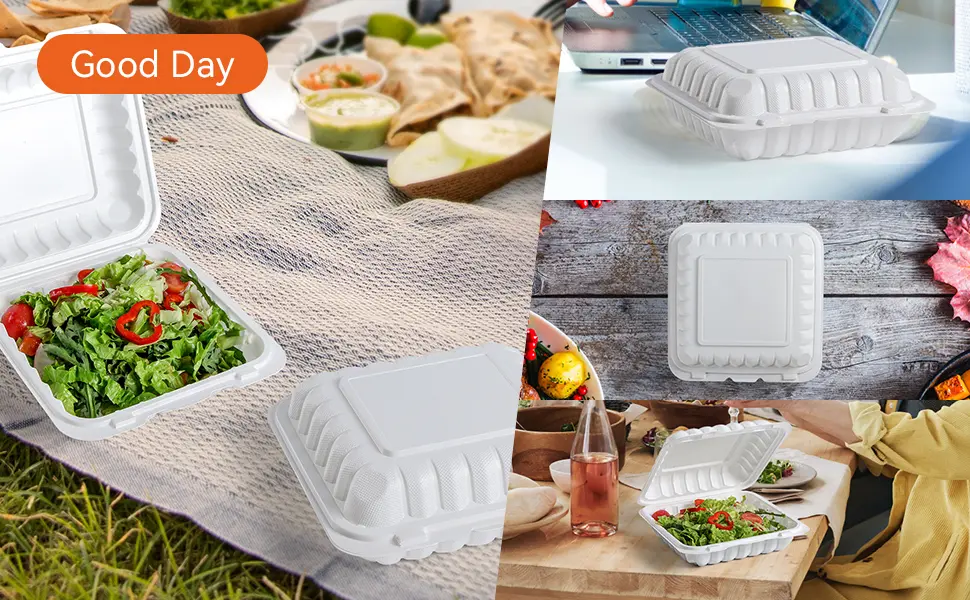
One-piece lunch boxes refer to a lunch box structure where the box body and lid are connected by a single molding or bending section, forming a non-separable structure. These lunch boxes typically use a flip-top design, with the box body and lid connected by a W-shaped or other shaped bending section to form a single unit. Clamshell disposable take-out food containers, on the other hand, refer to a design where the box body and lid can be completely separated, connected by snaps, magnets, or other methods.
Plastic lunch boxes, with their advantages of being lightweight, durable, and low-cost, occupy more than 70% of the takeout and fast food market. Currently, plastic restaurant take-out containers on the market are mainly made of materials such as PP (polypropylene), PS (polystyrene), and PET (polyethylene terephthalate). Among them, PP material is the preferred material for making lunch boxes due to its excellent heat resistance (withstanding high temperatures of 100-130℃) and safety.
II. Definition and Characteristics of Integrated and Separate Plastic Lunch Boxes
2.1 Structural Features and Materials of Integrated Lunch Boxes
The core feature of integrated restaurant take-out containers lies in their one-piece design. According to national standards, integrated disposable take-out food containers refer to "disposable tableware with a lid and container integrated," and should not have cracks or damage after a folding test. The box body and lid of this type of lunch box form a whole through a specific connecting structure. Common connection methods include:
- One-piece molding connection: The box body and lid are made from the same PP sheet through a vacuum forming process, connected by a thin connecting strip. This design ensures the integrity and sealing of the lunch box.
- W-shaped bend connection: The box body and lid are connected by a W-shaped bend, ensuring a strong connection while facilitating easy opening and closing of the lid.
- One-piece color-block design: Some high-end one-piece lunch boxes feature a color-block design, with the box body and lid in different colors, such as a black box body and a transparent lid, which is both aesthetically pleasing and practical.
Regarding material selection, one-piece lunch boxes primarily use the following plastics:
- PP material: This is the most commonly used material for one-piece restaurant take-out containers, offering advantages such as being non-toxic, odorless, and meeting food-grade standards. PP material has a temperature resistance range of -6℃ to 120℃, and some modified PP can withstand extreme environments from -18℃ to 110℃. Its melting point is as high as 167℃, making it the only plastic box that can be microwaved.
- PS material: PS material one-piece lunch boxes have high transparency and are easy to process and mold, but their heat resistance is poor, only able to withstand temperatures of 70-90℃, making them unsuitable for microwave heating.
- PET Material: PET material has extremely high transparency, high hardness, and impact resistance, but its heat resistance is the worst, only able to withstand temperatures below 60℃.
2.2 Structural Features and Materials of Separate Lunch Boxes
The biggest feature of separate lunch boxes is that the box body and lid can be completely separated, providing greater flexibility in use. The structural features of separate lunch boxes include:
- Independent Box Design: The box body and lid are completely independent, combined using snaps, magnets, or other connection methods.
- Multi-Compartment Separation Design: Many separate restaurant take-out containers have multiple independent compartments, each capable of storing different foods, such as staple foods, side dishes, soups, etc., without interference.
- Modular Combination Design: Some high-end separate BPA-free take-out containers adopt a modular design, allowing for the free combination of 2-4 compartments through removable dividers to meet different usage needs.
Separate disposable take-out food containers are similar to integrated restaurant take-out containers in terms of material selection, but offer greater diversity in structural design:
- PP Material Separate Lunch Boxes: These have good heat and chemical resistance and can be directly heated in a microwave oven. Many brands use thickened PP material to improve the durability of lunch boxes.
- PS material separate lunch boxes: High transparency and lower cost, but limited heat resistance, mainly used for holding cold or room temperature foods.
- Multi-layer composite materials: Some high-end separate lunch boxes use a multi-layer composite design, such as an outer layer of high-strength PC, a middle layer of silver-modified PP antibacterial material, and an inner layer of food-grade PE or a composite material of PP and bio-based materials.
2.3 Differences in Design Concepts Between the Two Types of Lunch Boxes
The design concepts of integrated and separate lunch boxes differ fundamentally, directly affecting their usability:
Design concept of integrated lunch boxes:
- Unity of integrity and convenience: Integrated restaurant take-out containers emphasize the concept of "integration," reducing the number of parts to decrease complexity. Users don't need to worry about losing the lid, making it more convenient to take and carry.
- Sealing Preferred: The one-piece molded design of the integrated lunchbox ensures excellent sealing, especially with the W-shaped bend and clamping ribs, effectively preventing food spillage.
- Simple and Practical: The integrated lunchbox design prioritizes simplicity, achieving basic storage and portability through a concise structure, suitable for users who prioritize practicality.
- Separate Lunchbox Design Concept:
- Flexibility and Versatility: Separate lunchboxes emphasize the concepts of "separability" and "combinability," meeting different usage needs through modular design. Users can freely combine the boxes and compartments according to the type and quantity of food.
- Functional Stratification: Separate lunchboxes use multi-compartment designs to achieve categorized storage of food, preventing cross-contamination of flavors between different dishes, meeting the modern demand for refined dining.
- Personalized Customization: Many separate lunchboxes offer various capacity options, ranging from 300ml to 1700ml, allowing users to choose the appropriate size according to their specific needs.

III. Convenience Comparison Analysis
3.1 Portability
In terms of portability, both integrated and separate lunch boxes have their advantages and disadvantages.
Advantages of integrated lunch boxes:
- Significant weight advantage: Due to their integrated design, integrated restaurant take-out containers have a relatively simple structure and are lighter. According to actual test data, a 427g integrated lunch box is 23% lighter than an iPhone 14. This lightweight design makes it easier to carry, especially suitable for daily commutes and students.
- Lack of risk of losing parts: Integrated lunch boxes do not have separate lids, eliminating the risk of losing them. Users only need to carry the whole box and do not need to worry about losing any parts.
- Convenient one-handed operation: Integrated lunch boxes usually use a flip-top design, allowing users to open and close them with one hand, making it very convenient to take food while carrying them.
- Good stacking stability: The integrated structure of integrated disposable take-out food containers makes them more stable when stacked. The grooves or corrugations designed on the bottom of the box prevent slippage when multiple layers are stacked. For example, even with 10 layers of lunch boxes stacked in a takeout box, they can still remain stable.
Disadvantages of carrying a continuous lunchbox:
- Limited space utilization: The fixed structure of a continuous lunchbox limits the flexible use of internal space, making it impossible to adjust to the quantity and type of food.
- Fixed shape: Continuous lunchboxes are usually square or round, with a relatively fixed shape. This makes them less flexible than separate lunchboxes for carrying certain uniquely shaped foods.
Advantages of carrying separate lunchboxes:
- Modular carrying: Separate lunchboxes allow you to choose the number of boxes to carry as needed, such as carrying only one main box or multiple compartments. Some products are designed with tracks to allow multiple boxes to be inserted together, preventing rattling in your bag.
- Adjustable capacity: The multi-compartment design of separate lunchboxes allows for flexible capacity combinations, ranging from 300ml to 1700ml, meeting different appetite needs.
- Clear functional division: Each compartment can be used independently, allowing users to carry main dishes, side dishes, fruits, etc., separately to avoid cross-contamination of flavors.
Disadvantages of carrying separate lunch boxes:
- More parts, prone to disarray: Separate restaurant take-out containers consist of multiple parts (box body, lid, dividers, etc.), which are easily scattered during transport, requiring additional storage bags or boxes.
- Heavier overall weight: Due to their complex structure, separate lunch boxes are generally heavier than integrated lunch boxes, especially multi-compartment designs.
- Easily forgotten parts: Individual lids and dividers are easily forgotten in the office or dining room after use, resulting in loss.
3.2 Cleaning Ease
Ease of cleaning is an important indicator of the practicality of BPA-free take-out containers, and the two types show significant differences in this aspect.
Advantages of cleaning integrated lunch boxes:
- Seamless design for easy cleaning: The one-piece molded structure of integrated lunch boxes has no gaps or dead corners, making it less likely for food residue to remain during cleaning. According to user feedback, integrated lunch boxes are "relatively easy to clean; since there are no dividers requiring special cleaning, one-piece restaurant take-out containers may be more convenient and faster to clean."
- Comprehensive Washability: Connected restaurant take-out containers can be directly immersed in water or washed in a dishwasher without disassembly, saving time and effort.
- Stain-Resistant Material: High-quality connected lunch boxes use a special surface treatment process that prevents them from easily staining with food colors and odors. Unlike some plastic lunch boxes that pick up food smells and are difficult to clean thoroughly, these won't.
- Short Washing Time: Due to their simple structure, connected lunch boxes typically require only 5-10 minutes to wash.
Disadvantages of Cleaning Connected Lunch Boxes:
- Difficulty in Deep Cleaning the Interior: Connected lunch boxes are quite deep, especially round ones. Special tools are needed to thoroughly clean the bottom inside; otherwise, it's difficult to clean completely.
- Limited High-Temperature Sterilization: Frequent high-temperature sterilization can cause the plastic in connected restaurant take-out containers to age. It is recommended to sterilize no more than 3 times a week. For daily cleaning, use warm water below 40℃.
Advantages of Cleaning Detachable Lunch Containers:
- More Thorough Cleaning Through Disassembly: The body, lid, and dividers of detachable lunch containers can be completely disassembled. "Removing the dividers makes cleaning much easier. Anyone who has used plastic divider lunch containers knows that when they contain oily food, you almost want to throw them away after each wash, as they get greasier, especially in the corners."
- Easy Cleaning of Hard-to-reach Areas: Disassembling the container allows for thorough cleaning of each part, especially the crevices between compartments, effectively preventing bacterial growth.
- High-Temperature Sterilization: The components of detachable lunch containers can be sterilized separately at high temperatures. Some products' PP material can withstand sterilization at 120℃.
Disadvantages of Cleaning Detachable Lunch Containers:
- Curious Cleaning Process: Detachable lunch containers require disassembling multiple parts for separate cleaning and then reassembling, making the whole process cumbersome. According to user feedback, "One-piece lunch containers have many small parts, making cleaning troublesome. Detachable lunch containers only have the lid, which can be easily disposed of in the dishwasher daily." Higher Detergent Consumption: Due to the larger surface area requiring cleaning, separate lunch boxes typically require 30-50% more detergent than integrated restaurant take-out containers.
- Longer Cleaning Time: A complete cleaning of a set of separate lunch boxes usually takes 15-20 minutes, twice as long as integrated food containers for take-out

3.3 Heating Convenience
Heating convenience is an important function of modern food containers for take-out, especially for users who need to heat food in the office or school.
Heating Advantages of Integrated Lunch Boxes:
- Direct Microwaveable: PP integrated restaurant take-out containers are the only plastic containers that can be directly placed in a microwave oven, with a heat resistance of up to 120℃. Users do not need to transfer food to other containers; they can heat it directly.
- Good Heating Uniformity: The integrated structure of integrated lunch boxes results in more even heat distribution, avoiding localized overheating. According to tests, after heating in an 800W microwave oven for 3 minutes, the temperature difference of the food in an integrated lunch box does not exceed 5℃.
- Good Sealing: The flip-top design of the integrated lunchbox maintains a certain degree of airtightness during heating, preventing moisture evaporation and preserving the food's texture and nutrients. However, it's important to note that a small opening should be made during heating to prevent excessive pressure and potential bursting.
- Safe Material: High-quality integrated lunchboxes are made of food-grade PP material, which does not release harmful substances during heating, ensuring safety and reliability.
Disadvantages of Integrated Lunchboxes:
- Requires Opening the Lid for Heating: To avoid excessive pressure, the lid of the integrated lunchbox needs to be opened or a small opening left during microwave heating. This may cause moisture loss from the food's surface, affecting its texture.
- Capacity Limitation: The fixed capacity of integrated lunchboxes limits the amount of food that can be heated at once, requiring larger portions to be heated in multiple batches.
- Shape Affects Heating Efficiency: Some integrated lunchboxes are quite deep, which may result in insufficient heating of food at the bottom.
Advantages of Separate Lunchboxes:
- Flexible Heating Component Selection: Separate lunchboxes allow you to select which parts to heat, such as heating only the main container while ignoring the side dishes, saving energy and time.
- Separate Heating to Prevent Flavor Mixing: The multi-compartment design of separate lunchboxes allows different foods to be heated separately, preventing flavor mixing. Some compartments can be removed for individual heating.
- Fast Heat Dissipation: The separate design of lunchboxes allows for faster heat dissipation after heating, preventing burns.
- Partial Heating: Users can heat only the food they need, such as heating only rice and not side dishes, resulting in greater energy savings.
Disadvantages of Separate Lunchboxes:
- Food Transfer Required: Some separate lunchbox lids are made of materials that are not heat-resistant (such as PS material), requiring food to be transferred to other containers during heating, increasing the handling steps.
- Reassembly Required After Heating: Heated parts need to be reassembled, which may result in hot hands.
- Decreased Sealing: After repeated heating, the clips and other connecting parts of separate lunchboxes may deform, affecting the sealing performance.
3.4 Leakage Prevention Performance
Leakage prevention performance is a key indicator of the practicality of a lunchbox, especially for users who need to carry liquid foods such as soups and porridge.
Advantages of Leak-Proof Connected Lunch Boxes:
- One-Piece Molding for Excellent Sealing: The one-piece molding design of connected food containers for take-out fundamentally solves the leakage problem; no gaps prevent leakage. Tests show that a high-quality connected lunch box, when filled with liquid and inverted for 30 minutes, leaks only 0.2ml, exceeding the industry standard threshold of 1ml.
- Special Sealing Structure: Some connected restaurant take-out containers employ special sealing designs, such as a locking plate inside the lid that fits into a sealing groove inside the lunch box. This not only prevents liquid leakage but also avoids food and soup mixing and cross-contamination of flavors.
- Sturdy Clamping Design: The flip-top of connected lunch boxes typically features inverted protrusions and recesses, ensuring a very secure clamping action that won't open even with vigorous shaking.
- High Material Toughness: Connected lunch boxes are mostly made of thickened PP material, which has excellent toughness and is not easily broken. Tests show that the elongation at break of PP restaurant take-out containers can reach 300%, far exceeding the 50% of PS material.
Disadvantages of One-Piece Lunch Containers in Leak Prevention:
- Potential Leakage at the Lid Connection: Although the overall seal is good, slight leakage may occur at the connection point (bend) between the lid and the container if poorly designed.
- Easily Overflows When Full: One-piece lunch containers typically have a large opening, making it easy for food to spill out during transport when full.
Advantages of Separate Lunch Containers in Leak Prevention:
- Multiple Sealing Designs: High-end separate lunch containers employ multiple sealing designs, such as a combination of silicone sealing rings and snap fasteners. Tests show that this design prevented leakage even when a 350ml cup containing 200ml of orange juice was inverted at a 45-degree angle.
- Individual Sealing: Each compartment of a separate lunch container can be sealed independently, so even if one compartment leaks, it will not affect the food in other compartments.
- Leak-Proof Options Available: There are specialized leak-proof separate lunch containers on the market that use special sealing technologies, such as "tight-fitting leak-proof: highly resistant to side leakage without external pressure."
- Individual Leakage Handling: If a component leaks, it can be replaced individually without replacing the entire lunchbox.
Disadvantages of Leakage Prevention with Separate Lunchboxes:
- Sealing Components are Prone to Aging: After repeated use, the sealing rings, clips, and other components of separate lunchboxes are prone to aging and deformation, affecting sealing performance.
- Improper Assembly Leads to Leaks: Separate lunchboxes require proper assembly to ensure a good seal. If the clips are not fully tightened, leaks can easily occur.
- Post-Washing Inspection Required: After washing, the sealing rings need to be carefully inspected for food residue; otherwise, the sealing effect will be compromised.
REACH Guidelines for PP Disposable Food Containers with Lids Exported to the EU
What Is the Difference Between Injection-Molded PP and Blister-Formed PP Take-Out Chinese Boxes?
Related Article

You searched for 4 oz Chinese take out boxes — but what you actually need may not be a paper box at all. The folded paper container with the wire handle looks iconic, but for 4 oz portions of sauce, dressing,
4 oz Chinese Take Out Boxes Alternative — Clear PP Portion Cups
Looking for plastic to-go containers with lids in bulk? Every container we ship includes a matching lid — not as an optional add-on,
Plastic To-Go Containers with Lids Wholesale | Bulk PP Food Boxes
SEND MESSAGE