



A Detailed Guide to Customizing Plastic Take-Out Box Molds
author: Iris
2025-10-07
1. Preliminary Preparation for Mold Customization
Thorough preparation before mold customization can effectively reduce risk and improve the quality of the finished product. Clarifying the lunch box type, design details, and material selection is key to ensuring smooth mass production of disposable take-out boxes.
Clarifying Lunch Box Type and Usage Scenario
Lunchboxes must meet certain functional and design criteria for various situations, including buffets, fast food, and takeout. Fast food packaging stresses rapid opening and stacking, whereas takeout packaging places more emphasis on sealing and transit durability. Disposable take-out boxes come in a variety of mold structures, including edge treatment, lid closure, and stacking design, all of which must be tailored to the particular use case. Making the intended use case clear minimizes waste from poor design while also increasing manufacturing efficiency.
Design Phase
Precise control over criteria, including size, wall thickness, lid closure, and stackability, is necessary throughout the mold design process. In order to satisfy customer aesthetics and guarantee use, the custom take-out box's design and functionality must be harmonized. For instance, the tray's load-bearing and stacking stability must be taken into account, and the lid's design must guarantee a tight seal. In order to prevent mold release issues or dimensional discrepancies during mass production, mold processing feasibility must also be taken into account throughout the design phase, guaranteeing product uniformity and aesthetics.
Material Selection
Plastic lunchboxes are frequently made of PP, PET, PS, and PLA. The durability, cost, and appearance of branded Chinese take-out boxes are all greatly impacted by the materials used. PLA is environmentally friendly but sensitive to temperature changes, PS is inexpensive but brittle, PET is highly transparent and ideal for food display, and PP is appropriate for high-temperature resistance. The choice of material affects mold life and the stability of the resulting production, in addition to the quality of the mold design. Making the right decision early on in the process is therefore essential and should be based on the budget, intended use, and product positioning.

3. Mold Production and Post-Production Maintenance
Mold production not only focuses on molding quality but also requires a systematic maintenance and cost control mechanism to extend its service life and optimize production costs.
Quality Control in Mass Production
During the mass production of take-out boxes, controlling temperature, injection speed, and pressure is crucial. These parameters directly impact the sealing, surface smoothness, and heat resistance of the lunch boxes. A rigorous inspection process, including checks for sealing, heat resistance, and cosmetic defects, is required to ensure that each batch of custom take-out boxes meets the expected standards. Scientific quality control can significantly reduce rework rates, improve production efficiency, and save costs for the company.
Mold Cleaning and Maintenance Cycle
Regular mold cleaning and maintenance can effectively extend its service life and prevent burrs, scratches, and breakage. A standardized maintenance process is recommended, including cleaning the mold surface, inspecting runners, and lubricating moving parts. Regular maintenance ensures stable mold performance, high molding quality, and minimizes production interruptions. It also reduces the additional costs and delays caused by mold damage, ensuring smooth take-out box production.
Cost Optimization and Reuse Strategies
Balancing mold cost allocation and custom quantity is crucial for controlling overall costs. Without compromising custom take-out box quality, cost optimization can be achieved through rational production batch planning, selection of durable materials, and optimized mold design. Reusing and upgrading molds is also an effective strategy for reducing production costs, allowing companies to maintain high product quality while increasing their return on investment.

Where to Buy?
Yangrui provides various specifications of disposable take-out boxes, custom take-out boxes, and branded Chinese take-out boxes, supporting logo customization, exclusive color matching, and different material options. Customers can obtain quotes and sample services through the official website, official sales email, or phone:
Phone: +86-159 8949 1653
Email: sales@yrpak.com
Email: sales@yrpak.com
References
- Huizhou Yangrui Printing and Packaging Co., Ltd. Company Profile and Product Overview.
- Li, Y., & Zhang, H. (2022). Plastic Food Packaging and Mold Customization in China’s Takeout Industry. Journal of Packaging Technology, 15(3), 45-58.
- Wang, Q. (2021). Trends in Disposable Take-Out Containers: Materials, Design, and Market Applications. Packaging Insight, 9(2), 12-27.
- FDA. (2023). Guidelines for Food-Contact Materials and Safety. U.S. Food and Drug Administration.
- European Bioplastics. (2022). PLA and Biodegradable Packaging Materials.
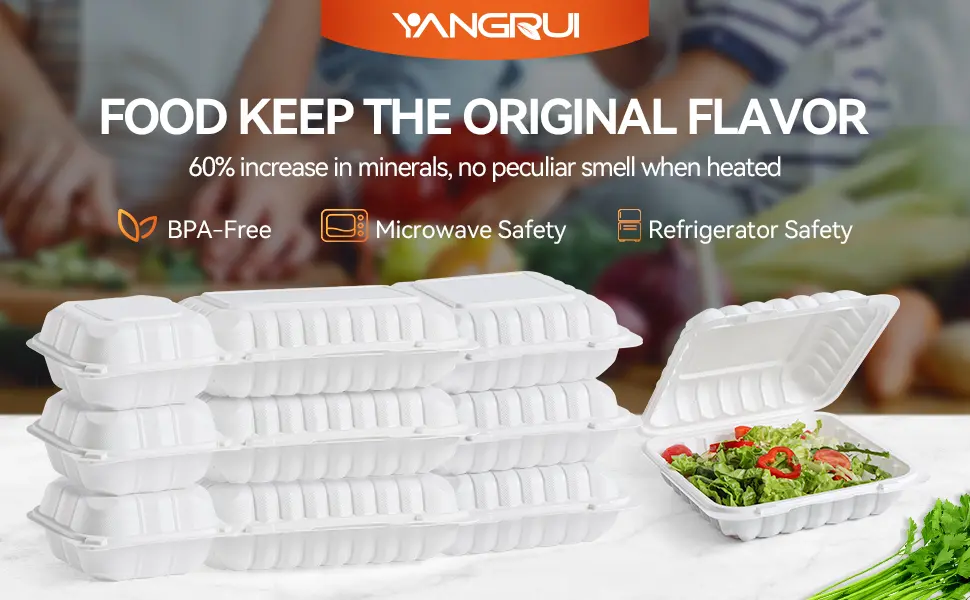
2. Plastic Lunch Box Mold Production Process
Mold production is a core step in plastic lunch box production, encompassing design, prototyping, and optimization. Each step determines the final quality of disposable take-out boxes.
Mold Design and 3D Modeling
In order to minimize manufacturing defects and guarantee ideal dimensions, wall thickness, and structure, mold design necessitates 3D modeling utilizing CAD and CAE software. Draft angles, molding accuracy, and the thermal expansion and contraction properties of disposable take-out boxes must all be taken into account during the design phase. The viability of mass-producing customized take-out boxes can be increased by using simulation analysis to detect possible problems early and optimize venting, runner, and gate design to guarantee mold molding efficiency and product consistency.
Mold Manufacturing and Prototyping
Selecting the right mold steel, precise machining, and surface polishing are essential components in guaranteeing product quality. High-precision polishing and machining improve demolding and minimize burrs. Trial disposable take-out boxes are used in the prototype phase to confirm surface smoothness, stacking stability, and lid tightness. In addition to detecting design flaws, prototyping enables mold structure modifications based on the samples, guaranteeing that the mass production's dimensions, functionality, and aesthetics satisfy the required standards.
Mold Testing and Optimization
Prior to production, mold trialing is an essential step that necessitates thorough testing for product thickness uniformity, demolding smoothness, and stacking performance. In order to guarantee high stability and low defect rates for custom take-out boxes during mass production, runners, gate positions, and draft angles are modified based on trial results. In order to attain the best possible balance between production cost and quality, mold optimization must also concentrate on material consumption and production efficiency, reducing needless waste.

4. Customized Cooperation and Enhanced Brand Value
Through mold customization, companies not only obtain high-quality disposable take-out boxes but also enhance their brand image and achieve a deep integration between packaging and brand.
Key Points in Communication with Suppliers
Before customizing molds, communication with suppliers is crucial. Clearly state the box type, size, functionality, stackability, and brand requirements to ensure consistent production of custom take-out boxes. During sample acceptance, focus on lid tightness, stacking stability, dimensional accuracy, and material properties, providing timely feedback on adjustments. Good communication can reduce production risks, shorten development cycles, and increase the success rate of customized packaging.
Creating Branded Chinese Take-Out Boxes
Through mold customization, companies can achieve unique logo embossing, distinctive shapes, and exclusive color schemes, creating a one-of-a-kind packaging experience. Successful cases demonstrate that well-known chain brands have used customized packaging to enhance brand recognition and consumer loyalty. Branded Chinese take-out boxes are not only food containers but also important carriers of brand image, helping companies stand out in the competitive takeout market and combining marketing value with practicality.
From Disposable Take-Out Boxes to Brand Assets
Custom molds elevate lunch boxes from simple packaging to brand assets. High-quality custom take-out boxes enhance the consumer experience while strengthening brand recognition. Yangrui's extensive experience in mold customization, production quality control, and the use of environmentally friendly materials enables companies to provide stable, high-quality lunch box products. These advantages not only ensure product reliability but also help customers reduce production risks and enhance their brand image, thereby achieving greater competitiveness and long-term value in the food delivery market.

Common Export Problems for Plastic Take-Out Containers with Lids: From Samples to Bulk Shipments
Advantages of Low-MOQ Custom Printed Food Takeout Boxes for Small Restaurants
Related Article

You searched for 4 oz Chinese take out boxes — but what you actually need may not be a paper box at all. The folded paper container with the wire handle looks iconic, but for 4 oz portions of sauce, dressing,
4 oz Chinese Take Out Boxes Alternative — Clear PP Portion Cups
Looking for plastic to-go containers with lids in bulk? Every container we ship includes a matching lid — not as an optional add-on,
Plastic To-Go Containers with Lids Wholesale | Bulk PP Food Boxes
SEND MESSAGE