



Is Microwave Heating Easy to Deform? Revealing the Safe Design of Food Packaging Plastic Boxes
author: Iris
2025-06-16
1. What Challenges Does Microwave Heating Pose to Plastic Lunch Boxes?
With the trend of heating takeout, microwave-safe to-go containers have become an important indicator for catering companies to purchase.
Deformation and Leakage Risks Caused by Uneven Heat Energy
When the microwave oven is heating, the heat in the lunchbox is not evenly distributed. If the lunch box is not designed reasonably, especially the corners or thin-walled parts, if the thickness does not meet the heating standards of the lunch box, it is easy to deform or even crack due to local high temperatures. I believe that many users have experienced this situation. After opening the box after microwave heating, they found that the soup had leaked all over the box. Microwave-safe to-go containers must not only be heat-resistant but also have good heat distribution adaptability.
Performance of Common Heat-Resistant Materials in Microwaves
Not all plastics are suitable for microwave ovens. For example, PS (polystyrene) and PET (polyethylene terephthalate) lunch boxes are easy to soften, deform, and even release harmful substances when heated in a microwave oven. PP (polypropylene) and MFPP (mineral reinforced PP) have become the mainstream materials for microwave-safe to-go containers due to their high thermal stability. By comparing with ordinary PS and PET lunch boxes, it can be found that the PP and MFPP materials used by Yangrui can maintain a stable shape and are not easy to deform even at temperatures as high as 120°C.
Consumer Safety and Brand Reputation Risks
If the lunch box is severely deformed or produces odor after heating, the first reaction of the end consumer is that the quality of the restaurant's lunch box is not good, rather than that the plastic material is not good, which affects the brand's trust. Yangrui has always insisted on using microwave-safe to-go containers that meet FDA, SGS, and other standards to reduce brand risks from the source and win consumer trust for customers.
3. Structural optimization trend of microwave-heated lunch boxes
In order to adapt to the current demand for heating functions by more and more people, lunch boxes are shifting towards a situation where price is not the first choice, but their function and safety are more important.
Thickened bottom design
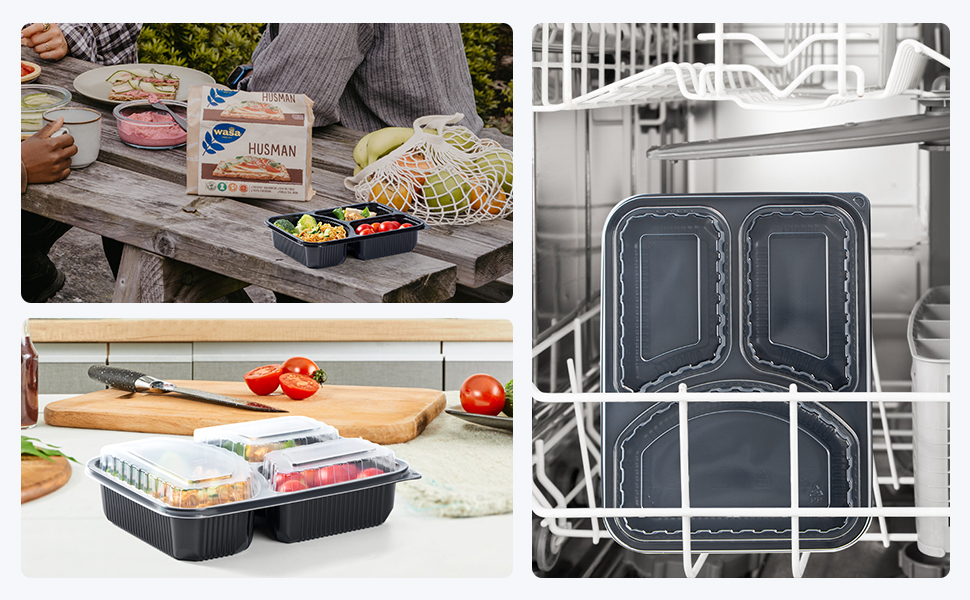
As we all know, the bottom of the lunchbox is the area where the heat is most concentrated. If the structure of the bottom is weak, it is easy to collapse locally or become soft and unable to support, and even cause soup leakage. Yangrui's microwave-safe to-go containers have a particularly thickened bottom and adopt a professional design to effectively avoid deformation during use, and can prevent collapse and leakage. Whether it is rice, soup, or bibimbap, such a structure can handle it calmly.
Heightened cover design
When microwave heating, food will release heat. Heightened cover can prevent the cover from bulging or deforming due to heat during heating. Many of Yangrui's best to go food containers use a transparent high cover design, such as the FG2 and FG3 series, which not only effectively prevents expansion and deformation, but also allows the lunch box to have more space and look more upscale.
The compartment structure reduces heat concentration
Multi-compartment lunch boxes can distribute heat more evenly and avoid deformation caused by overheating in a certain area. Compared with single-compartment lunch boxes, multi-compartment structures can also meet the needs of various food combinations and are the first choice for many chain restaurants. Yangrui's FG series, with 1-5 compartments to choose from, is a multi-compartment food packaging plastic box specially developed for bento and set meals, which is both beautiful and practical.

Where to Buy Microwave-Safe To-Go Containers?
Yangrui focuses on producing high-quality microwave-safe to-go containers, which can be widely used in take-out, chain restaurants, supermarket pre-packaging, and other fields. We provide:
- Multiple specifications and color options (black, transparent, compartmentalized, single compartment)
- PP, MFPP, and other high-temperature resistant materials support the whole process from freezing to microwave
- Free sample testing and third-party test reports (such as SGS, FDA)
Support OEM/ODM customization, helping customers create exclusive packaging brands
Contact us (sales@yrpak.com) to get a quote and a customized solution.
References
- U.S. Food and Drug Administration (FDA). Microwave Heating of Foods
- SGS. “Food Contact Materials Testing.” //www.sgs.com
- European Commission. “Plastics for Microwave Use.”
- Xu, L., & Wang, J. (2021). Thermal Deformation Resistance of Food-Grade Polypropylene Materials under Microwave Conditions. Journal of Packaging Technology.
- Plastics Today. “How to Select Microwave-Safe Packaging Materials.” //www.plasticstoday.com

2. Three Core Factors That Determine the Stability of Microwave Heating
Microwave heating not only depends on the material of the plastic, but also on the thickness and wall thickness design of the lunch box.
Material Selection Is the First Line of Defense
The mainstream microwave heating materials on the market are PP, MFPP, and CPET. Most of Yangrui's food packaging plastic boxes use MFPP, which has good heat resistance and good stacking properties, suitable for various food packaging scenarios. In contrast, although CPET can withstand high temperatures, it is more expensive and is often used for frozen, pre-prepared dishes. MFPP is a more affordable and balanced choice, especially suitable for daily use.
Material Thickness Affects Deformation Resistance
The thickness of the lunch box is not just a matter of thickness; its design is related to whether the lunch box is hard. Usually, thin-wall designs below 0.5mm are prone to softening and deformation in microwaves. Yangrui's microwave-safe to-go containers are generally above 0.6mm thick. The appropriate thickness can not only withstand thermal expansion and contraction, but also improve the feel and rigidity of the product, which is an important guarantee for the performance of food packaging plastic boxes.

4. How Does Yangrui Provide Safer Microwave Heating Lunch Boxes?
Yangrui always takes "materials + design + testing" as the three levels. As a professional food packaging plastic boxes manufacturer, it needs to ensure the microwave safety of each product.
Selected Heat-Resistant Materials
All Yangrui microwave heating products are made of food-grade, high-quality PP or MFPP materials, which meet European and American export standards, with a temperature range of -20℃ to 120℃, and support microwave + freezing two-way applications. They can be taken out of the refrigerator and heated in the microwave to the dining table directly. They are truly microwave safe to go containers.
Support Customized Needs
Yangrui provides the best to-go food containers in various specifications, such as compartments, transparent, and black, supports LOGO customization, color printing, and personalized packaging. It is very suitable for restaurants, supermarkets, and other scenarios that need to create a brand impression, and can meet the needs of different customers.
Passed Microwave Safety Test
All Yangrui microwave series products have passed the tests of third-party testing agencies such as SGS and FDA, and have complete reports. When customers purchase Yangrui products, they are not only buying lunch boxes, but also quality, reputation, and brand guarantees to ensure the end-user experience.
Green Packaging Is Not Just About Paper Boxes: Plastics Can Also Be Low-Carbon
Which Dining Scenarios Are Multi-compartment Meal Boxes Suitable For?
Related Article

You searched for 4 oz Chinese take out boxes — but what you actually need may not be a paper box at all. The folded paper container with the wire handle looks iconic, but for 4 oz portions of sauce, dressing,
4 oz Chinese Take Out Boxes Alternative — Clear PP Portion Cups
Looking for plastic to-go containers with lids in bulk? Every container we ship includes a matching lid — not as an optional add-on,
Plastic To-Go Containers with Lids Wholesale | Bulk PP Food Boxes
SEND MESSAGE