



Customization Process for Disposable Plastic Catering Take-Out Containers: Logo Printing/Size Customization/Material
author: Iris
2026-01-14
I. Overview of Disposable Plastic Catering Take-Out Container Customization
1.1 Market Status and Development Trends of Customization
With the expansion of the food delivery industry and the growing demand for personalized products from consumers, the market for customized disposable plastic catering take-out containers is growing significantly. By 2025, the Chinese disposable catering take-out container market is expected to reach tens of billions of yuan, with customized products accounting for an increasing proportion each year. The core demand comes from restaurant chains, hotels, corporate canteens, and the pre-packaged food and fresh food e-commerce sectors. Customers not only focus on functionality but also on enhancing brand image through customized packaging. Especially under increasingly stringent environmental policies, the demand for biodegradable catering take-out containers is surging.
Technologically, production is shifting towards automation and intelligence. Leading companies are introducing robots and intelligent production lines to improve efficiency and quality; personalized customization technology is mature, enabling small-batch, multi-variety production to meet the needs of customers of different sizes.
1.2 Overview of the Customization Process
The customization process covers everything from demand determination to final delivery, with each link closely interconnected:
- Demand Confirmation and Solution Design: The customer clarifies the usage scenario, specifications, materials, printing content, etc., and the supplier develops a solution including design drawings and material recommendations, which takes 3-5 working days.
- Sample Production and Confirmation: Samples are completed within 72 hours according to the solution, supporting 3D printing preview and physical sample testing. After the customer verifies the appearance, size, etc., production begins.
- Manufacturing: The cycle varies depending on the process and order size. Screen printing takes 3-5 days, heat transfer printing 12-15 days, and in-mold labeling 20-25 days, with large orders taking 7-15 working days.
- Quality Inspection, Packaging, and Delivery: Full inspection of appearance, size, and physical properties is conducted. After passing the inspection, the products are packaged and delivered.
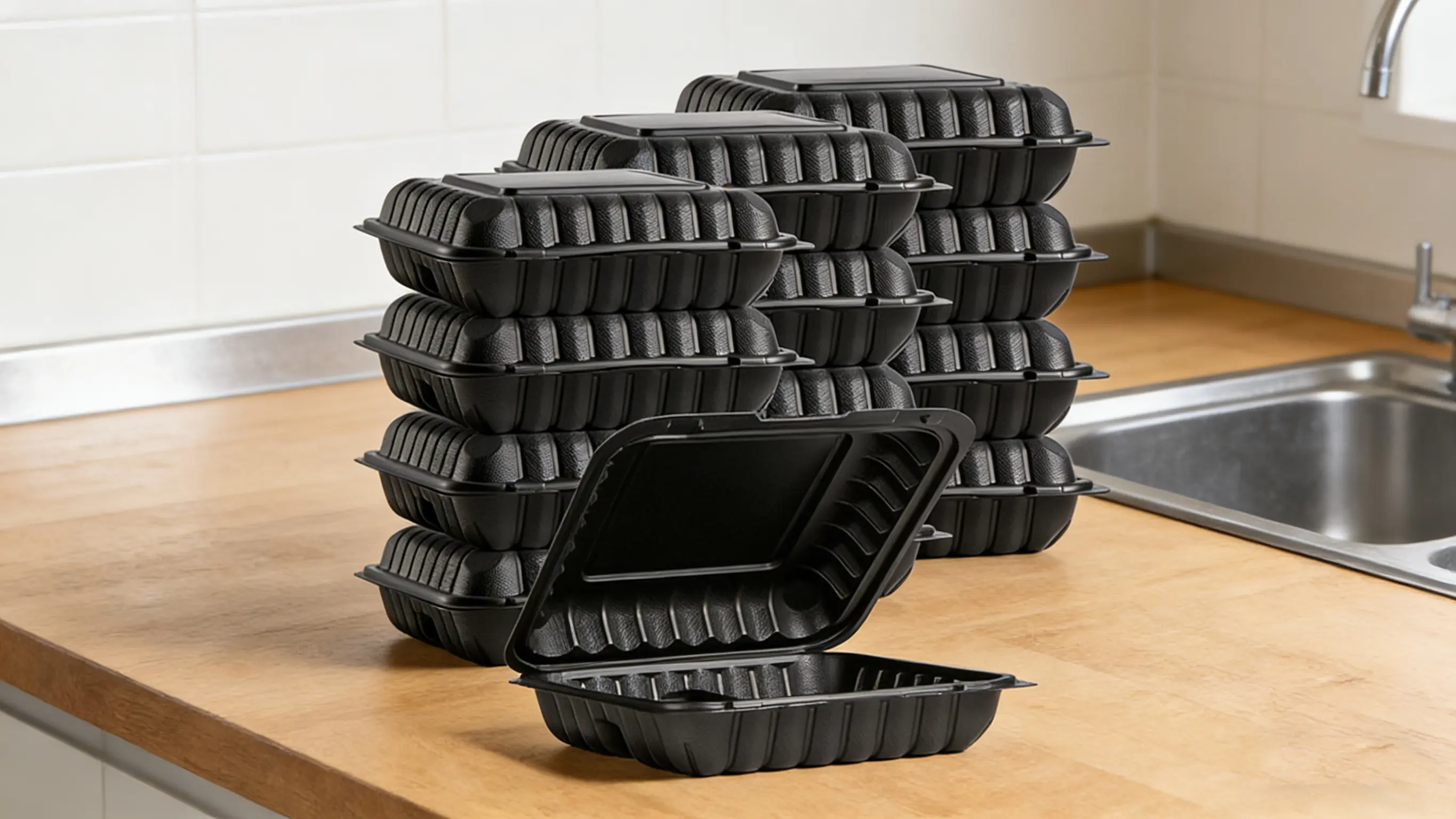
II. Detailed Customization Process
2.1 Demand Determination and Supplier Selection
2.1.1 Key Points for Determining Customization Needs
- Usage Scenario: Takeaway food requires leak-proof and heat-preserving features, while dine-in food emphasizes aesthetics and convenience. Functionality is determined by the scenario.
- Specifications and Sizes: Capacities include 300ml-3500ml, etc., selected according to food type and quantity. For example, 300ml is suitable for small side dishes, and 1500ml is suitable for family-sized portions.
- Material Selection: PP is high-temperature resistant (120℃) and microwaveable; PS is transparent but not high-temperature resistant; PET has high strength but poor heat resistance; PLA is biodegradable but costly.
- Printing Requirements: Provide clear logo files, confirm position and process, and ensure that the content includes the brand logo and regulatory information.
- Quantity and Delivery Time: Supplier minimum order quantities vary from hundreds to tens of thousands; determine quantity based on inventory and negotiate delivery time.
2.1.2 Supplier Selection Criteria
- Qualifications and Certifications: Essential requirements include a business license and a national industrial product production license; food contact materials require GB 4806 certification; ISO 9001 and ISO 14001-certified companies are preferred.
- Production Capacity: Assess equipment (injection molding machines, thermoforming machines) and daily production capacity to ensure order fulfillment, with redundancy during peak seasons.
- Quality Control: Requires raw material inspection, process control, and finished product inspection systems; provides quality certifications.
- Technology and R&D: Evaluate mold development, new material application, and process innovation capabilities; ability to quickly respond to special needs.
- Service Level: Assess the timeliness of quotations, professionalism in answering questions, and after-sales response speed.
- Environmental Compliance: Requires biodegradable material certification and pollutant emission certificates, complying with plastic restriction policies.
2.2 Design Confirmation Stage
2.2.1 Logo Design and Printing Requirements
- File Requirements: Resolution ≥300dpi, vector files (AI, EPS) or high-quality bitmaps (TIFF, JPEG), CMYK color mode for printing.
- Color and Process Matching: Screen printing is suitable for simple patterns with 1-4 colors, UV printing allows full color; design must be adapted to the process.
- Accuracy Requirements: Minimum text size 6pt, lines ≥0.2mm, avoid complex gradients and fine patterns.
- Position Specifications: The logo can be printed on the box body, lid, or bottom; consider printing difficulty and cost, ensuring complete content presentation.
2.2.2 Size and Specifications Determination
Standard Specifications:
Round: 300ml (11.3×9.0×5.0cm), 450ml (11.3×9.6×6.4cm), etc., commonly used for takeout. Square: 400ml (12.1×9.5×4.7cm), 750ml (17×11.8×4.8cm), etc., commonly used for packaging.
Custom specifications: Minimum order quantity ≥ 5000 pieces, requires additional mold fee (several thousand to tens of thousands of RMB), need to consider capacity, stackability, sealing, and cost.
Custom specifications: Minimum order quantity ≥ 5000 pieces, requires additional mold fee (several thousand to tens of thousands of RMB), need to consider capacity, stackability, sealing, and cost.
2.2.3 Material Selection Guide
| Material | Characteristics | Applicable Scenarios | Cost (Relative) |
| PP | Heat resistant 100-130℃, microwaveable, non-toxic, good toughness | Hot food, scenarios requiring heating | Low |
| PS | Transparent, temperature-resistant 60-90℃, brittle | Cold food, ice cream | Low |
| PET | Transparent, high-strength, temperature-resistant -20-70℃ | Cold drinks, fruit containers | Medium |
| PLA | Biodegradable, temperature resistant 60-80℃, plant-derived | Environmental protection requirements, export | High (2-3 times traditional) |
Decision tree for selection: Hot food/microwave → PP; High transparency → PET; Cold food + limited budget → PS; Environmental protection/export → PLA; Balanced performance → PP/PS mixed (e.g., PP box body + PS lid).

2.3 Production and Manufacturing Phase
2.3.1 Mold Development Process
- Design: CAD drawing of 3D model, design of mold structure (parting surface, gate, etc.), 5 working days.
- Manufacturing: Precision machining using steel (mechanical processing, electrical discharge machining, etc.), 45-60 days, adjusted according to complexity.
- Mold trial and adjustment: Multiple mold trials, full inspection of the first batch of products' dimensions and appearance, solving demolding and other problems.
- Mold cost: Simple molds 5000-35000 RMB, complex 20000-175000 RMB, high-end over 210000 RMB, can be amortized or refunded upon meeting standards.
2.3.2 Detailed Explanation of Printing Processes
| Process | Features | Minimum Order Quantity | Unit Price | Lead Time | Applicable Scenarios |
| Screen Printing | 1-4 colors, thick ink layer, low cost | 500 pieces | 0.05-0.2 RMB | 3-5 days | Cost-sensitive, simple logos |
| Heat Transfer Printing | Full color, fine detail, high quality | 1000 pieces | 0.8-1.5 RMB | 12-15 days | High-end complex patterns |
| UV Printing | Instant drying, high precision, no plate cost | 100 pieces | 0.3-0.8 RMB | 1-3 days | Small batch personalization |
| Offset Printing | High precision, suitable for long runs | 5000 pieces | 0.03-0.1 RMB | 7-10 days | Large quantities for chain restaurants |
| In-Mold Labeling | Full color, wear-resistant pattern, high cost | 10000 pieces | 1.5-3 RMB | 20-25 days | High-end brand image |
2.3.3 Molding Process and Quality Control
Molding Process:
- Injection Molding: Applicable to PP, PS. Process: raw material preparation → melting (180-230℃) → injection (50-150MPa) → cooling (10-30 seconds) → demolding. High efficiency, cycle time 30-60 seconds/piece.
- Thermoforming: Applicable to film materials. Heating the sheet (120-180℃) → thermoforming → cooling → cutting. Low cost, poor wall thickness uniformity.
Quality Control:
- Raw Materials: Inspection of dryness, fluidity, and quality certificate.
- First Article Inspection: Full inspection of dimensions, cavity depth, and appearance.
- Process Control: Thickness measurement every 2 hours, patrol inspection to remove defective products.
- Finished Product: Appearance (no scratches, no bubbles), Dimensions (deviation ±2mm), Performance (compressive strength ≥3000N, no damage after 1.2-meter drop, no leakage under negative pressure sealing), Hygiene (microorganisms ≤50cfu/g, no coliforms or pathogenic bacteria, lead ≤0.01mg/kg).
2.4 Delivery and Acceptance Phase
2.4.1 Delivery Cycle and Logistics
- Samples: 3-5 business days, 3D printing 1-2 days.
- Batch Production: Small batch (500-5000 units) 7-10 days, medium batch (5000-50000 units) 10-15 days, large batch (50000+) 15-20 days; printing process affects the cycle (e.g., in-mold labeling 20-25 days); mold opening 45-60 days, mold core replacement reduced to 7 days.
- Logistics: Within the same city 1-2 days, within the province 2-3 days, inter-provincial 3-5 days, remote areas 5-7 days. Some suppliers offer free shipping to the warehouse.
2.4.2 Acceptance Standards
- Appearance: Accurate printing position, color difference ΔE≤3, no blurring, smooth surface without scratches or deformation.
- Dimensions: Length/width/height deviation ±2mm, capacity ±5%, tight-fitting lid.
- Material and Performance: Verification of material certificate, sealing performance (no leakage after 30 minutes of inversion), PP heat resistance (no deformation after 30 minutes in 90℃ water), cold resistance (no cracking after 24 hours at -20℃).
- Quantity and Packaging: Quantity error ±1%, secure packaging, clear labeling.
- Documents: Receive product certificate of conformity, material test report, food safety report, environmental certification, invoice.

III. Detailed Explanation of Key Technical Points
3.1 In-depth Analysis of Logo Printing Technology
3.1.1 Printing Process Comparison and Quality Control
- Process Comparison: Screen printing (low precision, low cost), heat transfer printing (high precision, high cost), UV printing (fast cycle, small batch), offset printing (large batch, low unit price), in-mold labeling (high durability, high positioning).
- Special Effects: Fluorescent (UV light emission), phosphorescent (glows in the dark after absorbing light), pearlescent (pearl luster), matte (texture contrast), 3D (thick ink).
- Quality Control: Colors use CMYK/Pantone color codes, text ≥6pt, lines ≥0.2mm, registration error ≤0.1mm, printing position deviation ±1mm.
3.1.2 Design Specifications
- File: Vector (AI, EPS) or 300dpi bitmap, CMYK mode.
- Text: Use Arial or Times New Roman fonts, title ≥12pt, body text ≥6pt, line spacing 1.2 times.
- Graphics: Main lines ≥0.3mm, details ≥0.2mm, gradient ≤60% range, angle 45°/90°.
- Bleed and Safety Zone: Content extends 3mm beyond the finished product, important content is 5mm from the edge.
3.2 Size Customization Technical Specifications
- Standard Sizes: Round (300ml-3500ml), square (400ml-1000ml), multi-compartment (two compartments 750ml, three compartments 1000ml, etc.), with packaging quantity and applicable scenarios.
- Customization Limitations: Minimum round (top opening ≥8cm, height ≥3cm), square (length ≥10cm, width ≥8cm, height ≥3cm); maximum round (top opening ≤30cm, height ≤15cm), square (length ≤30cm, width ≤25cm, height ≤10cm); tolerance length/width ±2mm, height ±1mm, capacity ±5%; irregular shapes require a minimum order of 10000+, mold making time 90 days.
- Cost: Simple single-cavity molds: 5,000-20,000 RMB; multi-cavity molds: 20,000-55,000 RMB; complex single-cavity molds: 20,000-100,000 RMB; multi-cavity molds: 55,000-175,000 RMB; special processes: 100,000-210,000 RMB. Costs are affected by the number of cavities, materials, and precision requirements.
- Lead Time: Standard: 45-60 days (design 5-7 days + procurement 3-5 days + processing 20-30 days + debugging 10-15 days); Fast-track options (standardized mold base/mold modification/3D printing) reduce lead time to 7-30 days.
- Lifespan: Ordinary steel molds: 500,000-1,000,000 cycles; high-quality molds: 1,000,000-2,000,000 cycles; aluminum molds: 100,000-300,000 cycles. Regular maintenance extends lifespan by 20-30%.
3.3 Material Characteristics and Application Scenarios
3.3.1 Comparison of Performance of Mainstream Materials
| Material | Density (g/cm³) | Tensile Strength (MPa) | Temperature Resistance (°C) | Chemical Stability | Processing Temperature (°C) |
| PP | 0.90-0.91 | 28-38 | -20 to 120 | Resistant to water, acid, and oil | 180-230 |
| PS | 1.04-1.06 | 35-60 | -6 to 75 | Resistant to water and acid, poor alkali resistance | 170-210 |
| PET | 1.37-1.38 | 50-75 | -20 to 70 | Resistant to water and acid, poor alkali resistance | 250-290 |
| PLA | 1.24-1.26 | 48-60 | 0 to 80 | Resistant to water and acid, with general oil resistance | 170-210 |
3.3.2 Development Trends of Environmentally Friendly Materials
- Policy Requirements: By the end of 2025, China requires a 30% reduction in non-degradable take-out containers with dividers in cities above the prefecture level, and a ban on their use in dine-in restaurants in county towns; the EU phased out some plastic products in 2021, and several US states have banned plastics.
- Biodegradable Standards: GB/T 18006.3 requires a relative biodegradation rate of ≥90%, ISO 14855 requires degradation of ≥90% within 180 days, and PLA requires polylactic acid ≥95% and bio-based content ≥50%.
- Cost and Trends: The cost of PLA is 2-3 times that of traditional materials, while starch-based materials are similar in cost to traditional materials; by 2030, environmentally friendly catering take-out containers will account for over 50% of the global market, with technology developing towards high temperature resistance (100℃+), low cost (within 1.5 times that of traditional materials), and rapid degradation (within 30 days).

IV. Cost Control and Quality Assurance
4.1 Cost Structure and Optimization
4.1.1 Cost Structure (Percentage)
- Raw materials: 60-70%, PP 7700-9200 RMB/ton, PS 8000-9500 RMB/ton, PET 9000-11000 RMB/ton, PLA 18000-25000 RMB/ton, color masterbatch 3-5%, additives 2-3%.
- Processing: 20-25%, injection molding 0.05-0.15 RMB/piece, thermoforming 0.03-0.10 RMB/piece, labor 18%, equipment depreciation 5-8%, electricity 15-20%.
- Printing: 5-15%, screen printing plate making 50-200 RMB/color, heat transfer printing plate making 3000-4000 RMB, UV printing no plate making fee.
- Other: 5-10%, mold amortization, packaging 0.02-0.05 RMB/piece, transportation, quality inspection 0.01-0.03 RMB/piece, management 5-8%.
4.1.2 Optimization Strategies
- Raw materials: Bulk contract signing to lock in prices, using recycled materials to reduce costs by 10-20%, and joint procurement to increase bargaining power.
- Production: High-speed equipment to improve efficiency, optimize molds to reduce material usage, standardization to reduce mold costs, and lean manufacturing to reduce waste.
- Printing: Simplify design to reduce colors, centralized batch printing, use UV printing for small batches, and offset printing for large batches.
- Orders: Calculate economic order quantity, long-term cooperation for discounts, place orders during off-season, and consolidate small orders.
4.2 Quality Control System
- Raw materials: Inspect melt flow index (±5%), density (±2%), moisture content (≤0.1%), color value (ΔE≤1.0), and require material certificates.
- Production process: First piece inspection of dimensions, appearance, weight, and sealing; inspect appearance, dimensions, and weight every 2 hours; monitor temperature, pressure, and other parameters.
- Finished Product: Full inspection of appearance and printing, random inspection of compression resistance (≥3000N), drop test (no damage at 1.2 meters), sealing (no leakage under negative pressure), and heat resistance (PP 90℃ for 30 minutes without deformation).
- Traceability: Batch number includes production date and production line, records are kept for 2 years, tracing raw materials, production, quality inspection, and shipment.
4.3 Supplier Management
- Selection Criteria: Must have a business license, a production license, and GB 4806 certification; ISO 9001/14001 preferred; equipment ≥5 units (small batch) / 10 units (large batch), annual production capacity ≥10 million (small) / 50 million (large); with quality inspection equipment and records.
- Evaluation Method: On-site inspection of environment, equipment, personnel, and system; testing of 3-5 batches of samples (7-15 days); small-batch trial production (500-2000 units, 7-10 days).
- Contract Terms: Clearly define quality assurance clauses (implementation of national standards, 6-month warranty, return/exchange of defective products), delivery time (specific date for the first batch, 7-15 days for subsequent batches, liquidated damages of 0.3% per day for delays), price (valid for 1 year, adjustable if raw material fluctuations exceed 10%, payment method mostly 30% prepayment), and intellectual property rights (design belongs to the customer, mold ownership agreement).
- Performance Evaluation: Graded according to quality (batch pass rate ≥99%, complaint rate ≤0.1%, weight 40%), delivery time (on-time rate ≥95%, weight 30%), service (24-hour response, 100% problem resolution rate, weight 20%), and cost (price competitiveness, weight 10%): Grade A (above 90 points) for strategic partners, Grade B (80-89 points) for normal cooperation, Grade C (70-79 points) for improvement within a limited time, Grade D (below 70 points) for termination of cooperation. Review and promote improvements quarterly.

V. Risk Control and Compliance Key Points
5.1 Food Safety and Regulatory Compliance
Must comply with GB 4806.1 (General Safety) and GB 4806.7 (Plastics Specific), with key testing items including: total migration ≤ 10 mg/dm² (water-based simulant), potassium permanganate consumption ≤ 10 mg/kg, heavy metals (calculated as Pb) ≤ 1 mg/kg, lead migration ≤ 0.01 mg/kg, and plasticizer (DEHP) ≤ 1.5 mg/kg.
Labeling must include product name and material (e.g., "Disposable PP Plastic catering take-out container"), GB 4806.7 standard number, "Food Contact Use" label, production license number, production date (shelf life 2-3 years), manufacturer name, and address. The material should be labeled according to GB 4806.6-2023 resin name, and the temperature range (e.g., "-20℃ to 120℃") and usage restrictions (e.g., PS "Not suitable for microwave heating") must also be indicated.
5.2 Environmental Policies and Sustainable Development
Domestic requirements include a 30% reduction in the consumption of non-degradable hinged take-out containers in cities above the prefecture level by the end of 2025, and a ban on their use in dine-in restaurants in county towns; the EU is phasing out some plastic products, and several US states have banned plastics. Companies need to prepare in advance by developing biodegradable technologies (such as PLA and starch-based materials), establishing environmentally friendly production capacity, and applying for certifications such as the Ten-Ring Certification.
Sustainable development can be promoted in three aspects: technologically, developing bio-based and recyclable materials and optimizing processes to reduce emissions; operationally, establishing a recycling system and using renewable energy; and in the supply chain, selecting compliant suppliers, requiring environmental certifications, and quantifying emissions through carbon footprint accounting to enhance product competitiveness.

VI. Case Studies and Best Practices
6.1 Typical Cases
6.1.1 Chain Restaurant (50 million/year demand)
Selected 750ml PP square catering take-out containers, 4-color offset printing (including logo and QR code), signed an annual agreement with a supplier with a daily production capacity of 2 million units, a monthly order of 4-5 million units, a unit price of 0.35 yuan, saving 20% of annual costs. Quality and supply are guaranteed through standardization and long-term cooperation.
6.1.2 Emerging Brand (10,000/month demand, monthly design changes)
Used 500ml PP round catering take-out containers, UV printing (no plate-making fee), selected a flexible supplier with a minimum order quantity of 100 units, 3-day delivery, unit price of 0.6 yuan. Although 40% higher than bulk orders, customer loyalty was enhanced through monthly themed designs, resulting in over 1 million social media impressions.
6.2 Solutions to Common Problems
- Long lead times: Reduce lead times by 20-30 days using aluminum molds, maintain a stock of standard products, and select local suppliers.
- Printing color differences: Provide Pantone color numbers, confirm color samples first, and establish a color management system.
- Incorrect material selection: Use PP for hot food, PS for cold food, and PLA for environmentally friendly options; send samples to a third-party for material testing if necessary.
- Quality fluctuations: Establish batch traceability, strengthen first-piece and in-process sampling inspections, and regularly evaluate suppliers.
- Cost overruns: Calculate economic order quantity, conduct joint procurement, and simplify printing designs.
- Compliance risks: Track policy updates, obtain certifications in advance, standardize labeling, and avoid false environmental claims.
Plastic Food Tray Classification: Thermoforming vs. Injection Molding
Global Trends in Disposable Plastic Portion Cups in 2026
Related Article

You searched for 4 oz Chinese take out boxes — but what you actually need may not be a paper box at all. The folded paper container with the wire handle looks iconic, but for 4 oz portions of sauce, dressing,
4 oz Chinese Take Out Boxes Alternative — Clear PP Portion Cups
Looking for plastic to-go containers with lids in bulk? Every container we ship includes a matching lid — not as an optional add-on,
Plastic To-Go Containers with Lids Wholesale | Bulk PP Food Boxes
SEND MESSAGE