



Plastic Food Tray Classification: Thermoforming vs. Injection Molding
author: Iris
2026-01-14
I. Comparison of Technical Basis and Production Processes
1.1 Technical Principles and Characteristics of Thermoformed Disposable Food Trays
Thermoformed disposable food trays use thermoplastic sheets as raw materials and achieve material deformation through vacuum suction technology. The production process is as follows: the plastic sheet is heated to its glass transition temperature (e.g., approximately 120°C for PVC) to soften it, then moved above the mold, and a vacuum pump is used to draw air, causing the sheet to conform to the mold. After cooling and shaping, the edges are trimmed. The process relies on the thermoplasticity of the plastic, and vacuum suction is key to shaping.
Common materials include PET, PP, and PS. PET is environmentally friendly, non-toxic, resistant to high and low temperatures, and recyclable, making it suitable for food disposable food trays; PP is resistant to chemical corrosion and can be microwaved, used for food containers and fresh-keeping boxes; PS has high hardness but poor toughness, and is mostly used for electronic packaging inserts.
Common materials include PET, PP, and PS. PET is environmentally friendly, non-toxic, resistant to high and low temperatures, and recyclable, making it suitable for food disposable food trays; PP is resistant to chemical corrosion and can be microwaved, used for food containers and fresh-keeping boxes; PS has high hardness but poor toughness, and is mostly used for electronic packaging inserts.
1.2 Technical Principles and Characteristics of Injection-Molded Disposable Food Trays
Injection-molded disposable food trays involve feeding HDPE or PP plastic granules into an injection molding machine, where they are heated and melted at 200-300°C into a viscous state, and then injected into the mold cavity at high pressure and speed. The core process includes four steps: plasticization, injection, pressure holding and cooling, and demolding. The plasticization stage involves melting and uniformly mixing the granules; the injection stage involves high-speed injection of the molten plastic into the mold; the pressure holding and cooling stage prevents backflow and solidifies the plastic; finally, the product is demolded.
HDPE has a dense molecular structure and is resistant to low temperatures, while PP is heat-resistant (can withstand 110-120°C), and both meet food safety standards.
HDPE has a dense molecular structure and is resistant to low temperatures, while PP is heat-resistant (can withstand 110-120°C), and both meet food safety standards.
1.3 Performance Differences Resulting from Technical Differences
Thermoformed disposable food trays, due to the heating and shaping of the sheet material, have limited shapes and are difficult to produce complex structures, resulting in lower strength and susceptibility to deformation. Injection-molded food trays for parties, due to the high-pressure filling of the mold with plastic, have a dense structure, excellent strength and rigidity, and strong load-bearing capacity, making them suitable for heavy-duty handling and storage. In 2025-2026, there will be innovations in thermoforming technology. Thick-sheet thermoforming technology offers mold costs more than ten times lower than injection molding, and embedded RFID chip technology enables full lifecycle traceability of pallets. This is expected to become an industry standard in 2026.
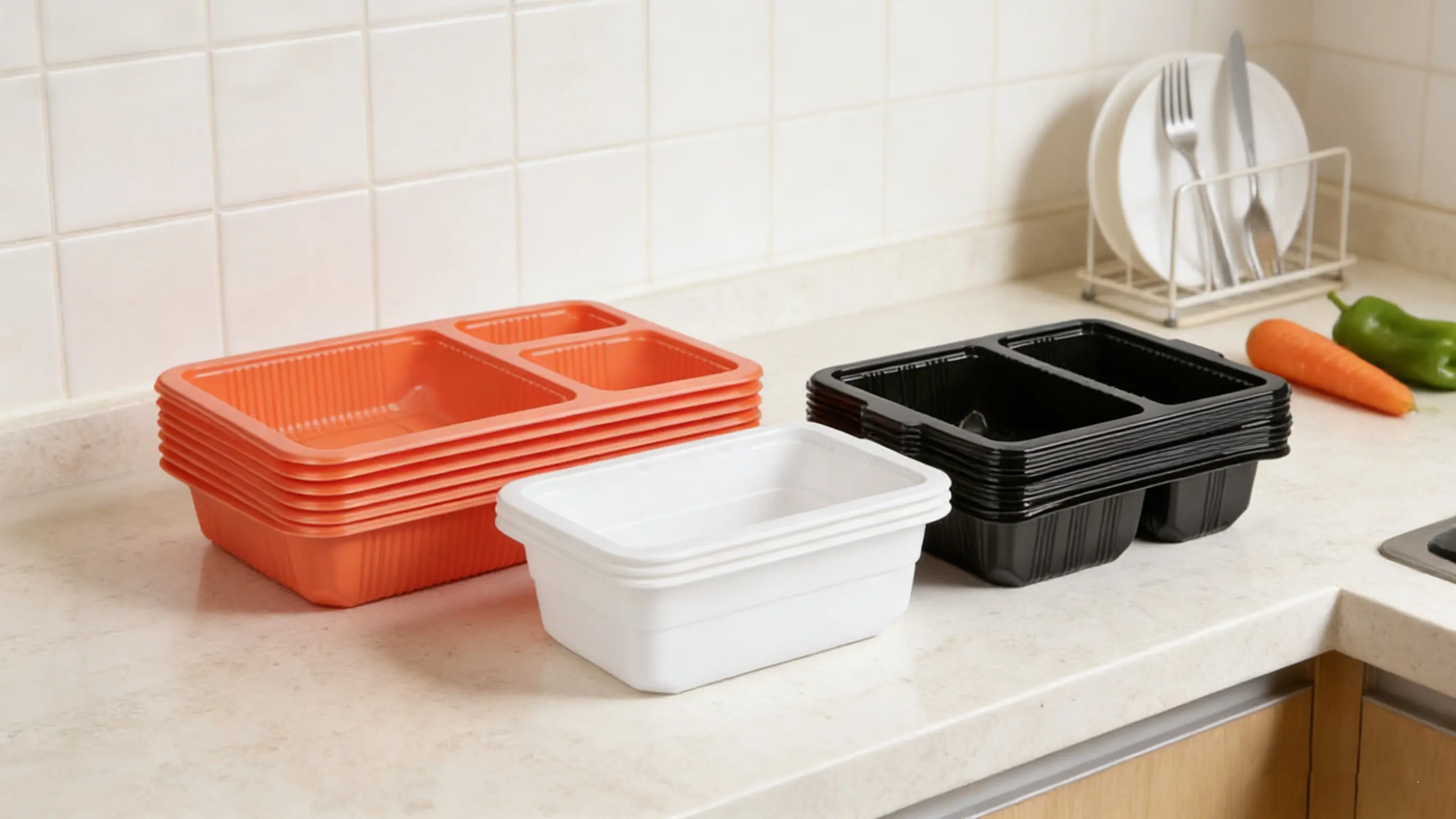
II. Cost Comparison Analysis
2.1 Raw Material Cost Differences
Market data from January 2026 shows that HDPE prices ranged from 6800-7200 RMB/ton, with an average price of 7022.50 RMB/ton on January 12th, a 2.52% increase compared to the previous month; PP prices ranged from 5600-7000 RMB/ton, and the price is expected to trend downwards in 2026.
Thermoforming sheet prices are higher. On January 13th, the PET sheet was quoted at 8863 RMB/ton, the PS sheet at 6500-7500 RMB/ton, and the PP sheet was slightly higher due to its high-temperature resistance. Injection molding raw material prices are generally lower than thermoforming sheets, and the advantage is even more significant with large-volume purchases. Furthermore, raw material prices are heavily influenced by international crude oil prices. In 2025, PE and PP prices fell by over 20% and 16%, respectively, and there may still be downward pressure in 2026.
Thermoforming sheet prices are higher. On January 13th, the PET sheet was quoted at 8863 RMB/ton, the PS sheet at 6500-7500 RMB/ton, and the PP sheet was slightly higher due to its high-temperature resistance. Injection molding raw material prices are generally lower than thermoforming sheets, and the advantage is even more significant with large-volume purchases. Furthermore, raw material prices are heavily influenced by international crude oil prices. In 2025, PE and PP prices fell by over 20% and 16%, respectively, and there may still be downward pressure in 2026.
2.2 Significant Differences in Mold Costs
Thermoforming molds are inexpensive: gypsum molds cost 300-800 RMB, electroplated copper molds 1000-2500 RMB, and aluminum molds 2500-15000 RMB (depending on size and precision). Injection molding molds are extremely expensive, costing tens of thousands of RMB or even more, about 10 times the cost of thermoforming molds.
For example, an injection molding mold for a product using inferior materials costs 50,000 RMB, while a good quality mold costs 100,000 RMB, but a thermoforming mold only costs 5,000 RMB. Thermoforming mold costs are 1/5 to 1/10 of injection molding costs, making it suitable for small-batch customization and allowing for prototyping and mass production within 3-7 days, ideal for new product trials and multiple small orders.
For example, an injection molding mold for a product using inferior materials costs 50,000 RMB, while a good quality mold costs 100,000 RMB, but a thermoforming mold only costs 5,000 RMB. Thermoforming mold costs are 1/5 to 1/10 of injection molding costs, making it suitable for small-batch customization and allowing for prototyping and mass production within 3-7 days, ideal for new product trials and multiple small orders.
2.3 Comparison of Processing Costs and Energy Consumption
Thermoforming equipment investment is 200,000-800,000 RMB, with a single-piece energy consumption of 0.3-0.6 kWh; injection molding equipment investment is 800,000-3,000,000 RMB, with a single-piece energy consumption of 0.8-1.2 kWh. The investment in injection molding equipment is 4-5 times that of thermoforming, and the energy consumption per unit product of thermoforming is 20%-30% higher than that of pulp molding.
In the thermoforming process, the electricity consumption for thermal processing accounts for 8% of the material cost, and labor costs account for 10% (mainly machine production); injection molding energy consumption is concentrated in heating and equipment operation, with higher labor costs (requiring loading, unloading, operation, and inspection). Traditional injection molding hydraulic presses consume 15-30 kW·h/ton, accounting for 20% of the cost. Servo motor drives can save 40%-60% of energy, and although the equipment price is 100,000-300,000 RMB higher, the long-term cost is lower.
In the thermoforming process, the electricity consumption for thermal processing accounts for 8% of the material cost, and labor costs account for 10% (mainly machine production); injection molding energy consumption is concentrated in heating and equipment operation, with higher labor costs (requiring loading, unloading, operation, and inspection). Traditional injection molding hydraulic presses consume 15-30 kW·h/ton, accounting for 20% of the cost. Servo motor drives can save 40%-60% of energy, and although the equipment price is 100,000-300,000 RMB higher, the long-term cost is lower.
2.4 Comprehensive Usage Cost Analysis
Injection molded pallets have a lifespan of 5-10 years, which is 3-5 times that of wooden pallets; thermoformed pallets have a lifespan of 5-7 times that of wooden pallets, but shorter than injection molded pallets.
For a 1200×1000mm standard pallet, the unit price of a wooden pallet is 80 RMB, with an annual maintenance cost of 40 RMB; the unit price of a steel pallet is 350 RMB, with an annual maintenance cost of 60 RMB; the unit price of an HDPE injection molded pallet is 220 RMB, with an annual maintenance cost of only 15 RMB. Plastic pallets only require regular cleaning, while wooden pallets require frequent anti-corrosion treatment, reinforcement, and repair.
In terms of transportation costs, thermoformed pallets have an advantage due to their lighter weight. A 2-ton truck can carry 200 pallets, and the plastic solution can reduce the self-weight by 500 kg, saving over 12,000 RMB in fuel annually for an average annual mileage of 50,000 kilometers. In the long term, although injection-molded pallets have a higher initial investment, their longer lifespan and lower maintenance costs result in significant overall cost advantages, especially suitable for high-frequency turnover and high-intensity use scenarios.
For a 1200×1000mm standard pallet, the unit price of a wooden pallet is 80 RMB, with an annual maintenance cost of 40 RMB; the unit price of a steel pallet is 350 RMB, with an annual maintenance cost of 60 RMB; the unit price of an HDPE injection molded pallet is 220 RMB, with an annual maintenance cost of only 15 RMB. Plastic pallets only require regular cleaning, while wooden pallets require frequent anti-corrosion treatment, reinforcement, and repair.
In terms of transportation costs, thermoformed pallets have an advantage due to their lighter weight. A 2-ton truck can carry 200 pallets, and the plastic solution can reduce the self-weight by 500 kg, saving over 12,000 RMB in fuel annually for an average annual mileage of 50,000 kilometers. In the long term, although injection-molded pallets have a higher initial investment, their longer lifespan and lower maintenance costs result in significant overall cost advantages, especially suitable for high-frequency turnover and high-intensity use scenarios.

III. Strength Performance Comparison
3.1 Fundamental Differences in Mechanical Strength
Due to the high-pressure injection process, injection-molded pallets have a dense structure, excellent strength and rigidity, and strong load-bearing capacity. PET thermoformed disposable food trays have a bending tensile stress of 90 MPa, a fracture tensile strain of 15%, a tensile elastic modulus of 3700 MPa, and a compressive stress of 26/51 MPa at 1%/2% normal strain; HDPE has a regular molecular arrangement, making it strong, impact-resistant, and with good tensile properties and low deformation at room temperature.
Thermoformed disposable food trays have thin (0.5-2mm) and uneven wall thickness, resulting in weak load-bearing capacity, easy deformation and damage, and are not suitable for repeated use. Data from the National Plastics Product Quality Inspection Center in 2024 shows that, at the same thickness, the drop damage rate of thermoformed PP boxes is 2.1 times that of injection-molded boxes.
Injection molding technology is mature, with a scrap rate of <5%. Fully electric precision injection molding machines have a penetration rate of 61% in hard plastic box manufacturing, with a single-cavity production cycle of 8-12 seconds and a stable yield rate of over 99.2%.
Thermoformed disposable food trays have thin (0.5-2mm) and uneven wall thickness, resulting in weak load-bearing capacity, easy deformation and damage, and are not suitable for repeated use. Data from the National Plastics Product Quality Inspection Center in 2024 shows that, at the same thickness, the drop damage rate of thermoformed PP boxes is 2.1 times that of injection-molded boxes.
Injection molding technology is mature, with a scrap rate of <5%. Fully electric precision injection molding machines have a penetration rate of 61% in hard plastic box manufacturing, with a single-cavity production cycle of 8-12 seconds and a stable yield rate of over 99.2%.
3.2 Differences in Temperature Resistance Applications
Thermoformed disposable food trays have a wide temperature range. PET can be used from -40℃ to 120℃, PP from -35℃ to 110-120℃, and HDPE does not deform at ±50℃. PP has a melting point of 164-170℃, and products can be sterilized above 100℃. The heat distortion temperature is 110℃, and the embrittlement temperature is -35℃, making it suitable for food packaging requiring high-temperature sterilization or microwave heating.
Injection-molded disposable food trays have a narrower temperature range, usually used from -35℃ to 40℃, but within this range, the performance is stable and not easily deformed or degraded due to temperature changes.
Thermoformed disposable food trays are suitable for food packaging that needs to withstand large temperature changes, such as pre-packaged food that is refrigerated and then heated, or high-temperature sterilized packaging; injection-molded disposable food trays are suitable for food storage and transportation in stable temperature environments.
Injection-molded disposable food trays have a narrower temperature range, usually used from -35℃ to 40℃, but within this range, the performance is stable and not easily deformed or degraded due to temperature changes.
Thermoformed disposable food trays are suitable for food packaging that needs to withstand large temperature changes, such as pre-packaged food that is refrigerated and then heated, or high-temperature sterilized packaging; injection-molded disposable food trays are suitable for food storage and transportation in stable temperature environments.
3.3 Significant Differences in Load-Bearing Capacity
Injection-molded disposable food trays have a far superior load-bearing capacity than thermoformed food trays for parties, with a dynamic load of 0.5-1 ton and a static load of 1-3 tons; blow-molded disposable food trays (another process) have a dynamic load of 1.5-2 tons and a static load of 4-6 tons. Lightweight injection-molded pallets (e-commerce warehousing, small item handling) have a static load capacity of 500-1000 kg and a dynamic load capacity of 200-500 kg; medium-sized pallets (food and beverage, daily necessities warehousing) have a static load capacity of 1500-2000 kg and a dynamic load capacity of 800-1200 kg; heavy-duty pallets (industrial raw materials, equipment transfer) have a static load capacity exceeding 3000 kg and a dynamic load capacity of 1500-2000 kg.
Thermoformed pallets have a weaker load-bearing capacity due to their wall thickness. Specially designed composite thermoformed pallet bases can withstand static loads of 6000 kg and dynamic loads of over 2000 kg, but this is not universally applicable.
Injection-molded pallets are suitable for stacking storage, rack storage, and long-distance transportation, such as in large supermarkets and logistics centers; thermoformed pallets are suitable for carrying light loads, where stacking is not required, or for short-term storage of food products.
Thermoformed pallets have a weaker load-bearing capacity due to their wall thickness. Specially designed composite thermoformed pallet bases can withstand static loads of 6000 kg and dynamic loads of over 2000 kg, but this is not universally applicable.
Injection-molded pallets are suitable for stacking storage, rack storage, and long-distance transportation, such as in large supermarkets and logistics centers; thermoformed pallets are suitable for carrying light loads, where stacking is not required, or for short-term storage of food products.
3.4 Impact Resistance Comparison
Injection-molded pallets have a rigid structure and weak impact resistance, and are prone to cracking, damage, or even breakage under strong impact. Thermoformed pallets, due to their relatively soft sheet molding, may have better cushioning capabilities under impact, but the thin-walled structure is prone to fatigue damage from repeated impacts.
In logistics facilities with frequent cargo handling and complex environments, injection-molded pallets are easily damaged after multiple impacts and require frequent replacement; thermoformed pallets may have better single-impact resistance, but also have a high damage rate in long-term use.
Adding impact modifiers can improve the impact resistance of plastic pallets by 30%, extending their lifespan to more than 5 years.
In logistics facilities with frequent cargo handling and complex environments, injection-molded pallets are easily damaged after multiple impacts and require frequent replacement; thermoformed pallets may have better single-impact resistance, but also have a high damage rate in long-term use.
Adding impact modifiers can improve the impact resistance of plastic pallets by 30%, extending their lifespan to more than 5 years.

IV. Environmental Friendliness Comparison Analysis
4.1 Differences in Material Recyclability
Thermoformed pallets made of PP, PET, and other materials are recyclable. Production scraps can be crushed and mixed with new materials, and damaged waste can also be recycled, conforming to the circular economy. The total recycling volume of PE is expected to reach 10.5 million tons in 2025, accounting for 23.3%, while the proportion of LDPE film materials will decrease to 41% (from 50% in 2020). The "Action Plan for Plastic Pollution Control" requires that the recycled content of PET bottles be no less than 30% by 2025, and the recycling rate of PET, PP, and PE exceeds 75%. Injection-molded pallets made of HDPE and PP materials are also recyclable. By 2025, physical recycling is expected to account for 68%, and chemical recycling capacity will increase by 24%. The global recycled plastics market is projected to exceed US$80 billion, with China contributing over 40% of the increase. PET, PE, and PP recycling account for 76% of the total.
Injection-molded PP is easier to recycle, while thermoformed PVC is difficult to process; therefore, PET and PP are preferred for thermoformed pallets.
Injection-molded PP is easier to recycle, while thermoformed PVC is difficult to process; therefore, PET and PP are preferred for thermoformed pallets.
4.2 Environmental Impact of the Production Process
The carbon emissions of thermoformed pallets mainly come from the treatment of non-methane total hydrocarbons (47.67%) and PET sheet extrusion molding (30.22%), with electricity accounting for 22.80%.
Producing one wooden pallet consumes 15 kg of wood and emits 12 kg CO₂e; a 3 kg HDPE plastic pallet emits 9 kg CO₂e. Plastic pallets can be recycled more than 150 times, resulting in a single-use carbon emission of only 0.06 kg CO₂e, which is only 1/8 of that of a wooden pallet. Producing one standard plastic pallet consumes 2.3 kg of petroleum-based raw materials, has a lifespan five times longer than a wooden pallet, and has 60% lower annual carbon emissions. Recycling and reuse can further reduce emissions by 35%.
Thermoforming unit energy consumption is 1.0-1.5 kWh/thousand units, while injection molding is 1.5-2.0 kWh/thousand units. Although injection molding has higher unit energy consumption, its higher production efficiency and longer lifespan may result in a smaller overall environmental impact.
Producing one wooden pallet consumes 15 kg of wood and emits 12 kg CO₂e; a 3 kg HDPE plastic pallet emits 9 kg CO₂e. Plastic pallets can be recycled more than 150 times, resulting in a single-use carbon emission of only 0.06 kg CO₂e, which is only 1/8 of that of a wooden pallet. Producing one standard plastic pallet consumes 2.3 kg of petroleum-based raw materials, has a lifespan five times longer than a wooden pallet, and has 60% lower annual carbon emissions. Recycling and reuse can further reduce emissions by 35%.
Thermoforming unit energy consumption is 1.0-1.5 kWh/thousand units, while injection molding is 1.5-2.0 kWh/thousand units. Although injection molding has higher unit energy consumption, its higher production efficiency and longer lifespan may result in a smaller overall environmental impact.
4.3 Impact Trends of Environmental Regulations
China requires that by the end of 2025, the consumption intensity of non-degradable disposable plastic tableware in catering and takeaway services in cities above the prefecture level be reduced by 30%, and non-degradable plastic packaging be prohibited in all postal and express delivery outlets nationwide. Provinces such as Hainan, Zhejiang, and Jiangsu have already restricted the use of disposable plastic pallets in warehousing and distribution. In 2024, the growth rate of the traditional plastic pallet market is expected to decrease from 6.8% in 2021 to 2.1%, and may even experience negative growth of 0.7% in 2025.
The EU's comprehensive plastic ban in 2026 is driving an average annual increase of 40% in China's PLA tableware exports, with the export scale expected to reach US$800 million in 2025. The EU plastic tax (0.8 euros/kg for non-recycled plastic packaging) and the Single-Use Plastics Directive require that 55% of packaging materials be recycled by 2030, with PET bottles containing at least 25% recycled content by 2025 and at least 30% by 2030. Single-use beverage bottles must contain at least 30% recycled content by 2025 and 50-65% by 2040.
The EU's comprehensive plastic ban in 2026 is driving an average annual increase of 40% in China's PLA tableware exports, with the export scale expected to reach US$800 million in 2025. The EU plastic tax (0.8 euros/kg for non-recycled plastic packaging) and the Single-Use Plastics Directive require that 55% of packaging materials be recycled by 2030, with PET bottles containing at least 25% recycled content by 2025 and at least 30% by 2030. Single-use beverage bottles must contain at least 30% recycled content by 2025 and 50-65% by 2040.
4.4 Development Opportunities for Bio-based Materials
Bio-based thermoformed disposable food trays are becoming increasingly common in fresh food cold chain applications, offering good sealing and preservation properties, and reducing food waste. Corn starch-based disposable food trays have a compressive strength of 800 N/m², and their cost is 23% lower thanthat of traditional PLA. A production capacity of 500,000 tons is expected by 2025. By 2025, the production cost of PLA disposable food trays may decrease by another 22%, the energy consumption of bamboo fiber processing may decrease by 30%, and the recycling rate of paper-based materials may exceed 6 cycles.
Coveris has launched a "sustainable cardboard + ultra-thin EVOH barrier film" solution, reducing plastic use by 90% and extending shelf life to 21 days.
Thermoformed disposable food trays offer flexible material choices and easy access to bio-based materials; injection-molded food trays for parties have a longer lifespan and higher recycling value, offering advantages in terms of environmental friendliness throughout their life cycle.
Coveris has launched a "sustainable cardboard + ultra-thin EVOH barrier film" solution, reducing plastic use by 90% and extending shelf life to 21 days.
Thermoformed disposable food trays offer flexible material choices and easy access to bio-based materials; injection-molded food trays for parties have a longer lifespan and higher recycling value, offering advantages in terms of environmental friendliness throughout their life cycle.

V. Hygienic Comparison Analysis
5.1 Food Contact Safety Standards
Both types of disposable food trays must comply with GB 4806.7-2023 "National Food Safety Standard for Plastic Materials and Products for Food Contact" (effective September 6, 2024), requiring a total migration limit of ≤10 mg/dm², lead ≤0.01 mg/kg, cadmium ≤0.002 mg/kg, and formaldehyde ≤15 mg/kg. They must also comply with US FDA and EU 10/2011 standards, such as benzene ≤0.01 mg/kg, toluene ≤1.2 mg/kg, and be free of odor and color changes (ΔE ≤1.0).
Microbiological indicators require a total bacterial count ≤100 CFU/cm², mold and yeast ≤10 CFU/cm², and no pathogenic bacteria (such as Salmonella) detected.
Microbiological indicators require a total bacterial count ≤100 CFU/cm², mold and yeast ≤10 CFU/cm², and no pathogenic bacteria (such as Salmonella) detected.
5.2 Surface Smoothness and Bacterial Control
Injection-molded disposable food trays have a surface smoothness of over 0.8 μm. One company's product passed 100,000 dynamic load tests, with a dynamic load capacity still exceeding 1.5 tons, and surface microbial residue levels below 10 CFU/cm². Precision ±0.1mm, integrally injection-molded products with no seams, can be steam sterilized at 121°C for 30 minutes (compliant with FDA 21 CFR 177.1520 standard), with a total bacterial count ≤5 CFU/cm², far below the industry average of 20 CFU/cm².
The blister disposable food trays have a flat and smooth surface, are free of parasites, easy to clean and disinfect, and meet food hygiene requirements. The surface should be clean and free of debris, and the molding should be complete.
A bottled beverage factory used disposable food trays with textured surfaces that harbored dirt, resulting in a monthly cleaning cost of 5,000 yuan and a microbial growth rate of 15%. After switching to smooth disposable food trays, only water washing was required (40 minutes/100 disposable food trays), reducing the growth rate to 5%, increasing the product pass rate by 2%, and saving 60,000 yuan annually.
The blister disposable food trays have a flat and smooth surface, are free of parasites, easy to clean and disinfect, and meet food hygiene requirements. The surface should be clean and free of debris, and the molding should be complete.
A bottled beverage factory used disposable food trays with textured surfaces that harbored dirt, resulting in a monthly cleaning cost of 5,000 yuan and a microbial growth rate of 15%. After switching to smooth disposable food trays, only water washing was required (40 minutes/100 disposable food trays), reducing the growth rate to 5%, increasing the product pass rate by 2%, and saving 60,000 yuan annually.
5.3 Antibacterial Performance and Additive Application
Adding silver ions, zinc ions, copper ions, or antibacterial masterbatches during the processing of the two types of Chinese food party trays can provide antibacterial and antiviral functions. Lanfeng antibacterial and antifungal agent has a 99.99% antibacterial rate against 20+ types of pathogenic bacteria and molds, is certified by ISO 22196 and JIS Z 2801, and is resistant to high temperatures >600°C without decomposition or failure during processing.
A carbonated beverage factory in East China used mesh disposable food trays, requiring 30 hours of monthly cleaning to remove sugar residue; after switching to flat antibacterial disposable food trays, cleaning time was reduced to 10 hours/month, and the workshop hygiene score increased from 85 to 98, passing the HACCP re-audit.
The plastic antibacterial agent LF-1084 is a white powder, suitable for plastics, rubber, etc., preventing mold erosion and odor generation, and complying with regulatory requirements.
A carbonated beverage factory in East China used mesh disposable food trays, requiring 30 hours of monthly cleaning to remove sugar residue; after switching to flat antibacterial disposable food trays, cleaning time was reduced to 10 hours/month, and the workshop hygiene score increased from 85 to 98, passing the HACCP re-audit.
The plastic antibacterial agent LF-1084 is a white powder, suitable for plastics, rubber, etc., preventing mold erosion and odor generation, and complying with regulatory requirements.
5.4 Differences in Cleaning and Maintenance Convenience
The 1200×1000mm HDPE injection-molded tray costs 220 yuan per unit, with an annual maintenance cost of 15 yuan, requiring only regular cleaning and disinfection; wooden pallets have higher maintenance costs. A large dairy company replaced mesh pallets with flat plastic pallets, resulting in a reduction in total bacterial count from 120 CFU/cm² to 15 CFU/cm², and an increase in hygiene compliance rate from 85% to 98%. This also led to an annual reduction in product spoilage losses of approximately 500,000 RMB, and a reduction in cleaning time from 2 hours per cleaning to 30 minutes per cleaning.
When thermoformed disposable food trays are difficult to clean, they can be soaked in a dilute sodium hydroxide solution before scrubbing. A thermoformed tray cleaning machine can clean 1000 pieces per hour, or 8000 pieces in 8 hours, offering high efficiency, energy saving, and water conservation.
Injection-molded pallets have significant advantages in surface finish, ease of cleaning, and maintenance costs; thermoformed pallets can also meet standards with the addition of antibacterial agents and the use of professional cleaning equipment.
When thermoformed disposable food trays are difficult to clean, they can be soaked in a dilute sodium hydroxide solution before scrubbing. A thermoformed tray cleaning machine can clean 1000 pieces per hour, or 8000 pieces in 8 hours, offering high efficiency, energy saving, and water conservation.
Injection-molded pallets have significant advantages in surface finish, ease of cleaning, and maintenance costs; thermoformed pallets can also meet standards with the addition of antibacterial agents and the use of professional cleaning equipment.

VI. Production Efficiency Comparative Analysis
6.1 Significant Differences in Production Cycles
Thermoformed pallets have a short production cycle, with design, mold making, and sample production taking 15 days, regular orders delivered in 3 days, and urgent orders expedited within 24 hours, which is 5-7 days faster than the conventional cycle for injection-molded boxes. This is suitable for new product launches, seasonal products, and promotional packaging.
Injection-molded pallets have a longer production cycle. While the molding time is short (tens of seconds to a few minutes), mold making takes 1-2 months, making them suitable for large-volume, long-term stable production.
Injection-molded pallets have a longer production cycle. While the molding time is short (tens of seconds to a few minutes), mold making takes 1-2 months, making them suitable for large-volume, long-term stable production.
6.2 Huge Disparity in Equipment Capacity
Injection molding equipment has a capacity of 20,000-50,000 pieces/hour, while thermoforming equipment has a capacity of 10,000-30,000 pieces/hour. The Lison 380 bottle preform injection molding machine with a 72-cavity solution has an 8.9-second cycle time, a capacity of over 29,000 pieces per hour, and a daily capacity of 700,000 pieces.
A fully automatic positive and negative pressure thermoforming machine processes 4-5 tons of material per day at a speed of 13-30 cycles/minute; a semi-automatic machine processes 2 tons of material per day at a speed of 3-6 cycles/minute. A double-station positioning thermoforming machine produces twelve molds at a time, yielding 600-700 sheets per hour; one thermoforming machine can produce sixty molds per minute, and with a three-screw four-layer sheet extruder, the output is 400-500 kg/hour.
A fully automatic positive and negative pressure thermoforming machine processes 4-5 tons of material per day at a speed of 13-30 cycles/minute; a semi-automatic machine processes 2 tons of material per day at a speed of 3-6 cycles/minute. A double-station positioning thermoforming machine produces twelve molds at a time, yielding 600-700 sheets per hour; one thermoforming machine can produce sixty molds per minute, and with a three-screw four-layer sheet extruder, the output is 400-500 kg/hour.
6.3 Comparison of Yield Rate Stability
The scrap rate of injection molding is less than 5%, with a yield rate of 92%-97%, and over 99.2% for all-electric precision injection molding machines.
The average yield rate for thermoforming is 92.4%-95%, with high-quality companies achieving 98.7%-99.8%. One company's conductive PP thermoformed disposable food trays have a yield rate of 98.7%, and another thermoforming company consistently achieves a yield rate exceeding 99.8%, with an average daily production capacity of 500,000 pieces and a customer repurchase rate of 95%.
In polyester tray production, rPET sheets with excessive impurities or moisture are prone to bubbles or yellowing, resulting in a yield rate of 85%-90%, lower than that of injection molding.
The average yield rate for thermoforming is 92.4%-95%, with high-quality companies achieving 98.7%-99.8%. One company's conductive PP thermoformed disposable food trays have a yield rate of 98.7%, and another thermoforming company consistently achieves a yield rate exceeding 99.8%, with an average daily production capacity of 500,000 pieces and a customer repurchase rate of 95%.
In polyester tray production, rPET sheets with excessive impurities or moisture are prone to bubbles or yellowing, resulting in a yield rate of 85%-90%, lower than that of injection molding.
6.4 Differences in Customization Flexibility
Thermoformed Chinese food party trays, relying on vacuum thermoforming technology, can be precisely customized according to product shape and size, with an error control within ±0.5mm. Their flexible production system supports small batch (10-500 pieces) sample delivery in 3-7 days, and mass production (over 500 pieces) in 7-15 days. An expedited service is also available for urgent orders, with 24-hour accelerated production. In the customization process, dimensions are restored through 3D scanning, assembly is simulated using CAD software, 2-3 sets of samples are produced for testing, and mass production begins only after confirmation, avoiding dimensional deviations.
Injection-molded disposable food trays require high-cost molds and have a long development cycle, making them more suitable for large-volume customization. However, the Chen Hsong magnetic quick mold change system reduces the mold change time for extra-large molds from over 2 hours to 10 minutes, improving the efficiency of small-batch, multi-variety production and enhancing customization flexibility.

VII. Application Scenario Suitability Analysis
7.1 Fresh Food Packaging
Thermoformed disposable food trays (PET/PP material) have high transparency and good display properties. They can be designed with ventilation and drainage holes, adapting to the needs of fresh food preservation, and are suitable for single-use applications. A chain supermarket uses anti-static PS thermoformed disposable food trays, which improve moisture resistance by 50%, extending the shelf life of fresh food by 3 days. The quick mold change supports weekly changes of promotional products. Injection-molded pallets (HDPE material) are resistant to low temperatures (-40℃) and have high strength, making them suitable for forklift handling and stacking in large fresh food distribution centers, meeting the needs of repeated turnover.
7.2 Cooked Food and Baked Goods Packaging
Thermoformed disposable food trays (PP material) are resistant to high temperatures (120℃) and have good sealing properties, allowing for the display of food colors. They are suitable for reheating cooked food and preserving baked goods, and are commonly used as inner Chinese food party trays for mooncakes and pastries. Injection-molded disposable food trays are less commonly used due to their low transparency and high cost.
7.3 Frozen Food Packaging
Thermoformed disposable food trays (PET/PP material) are resistant to low temperatures down to -35℃ to -40℃, with some containing added freeze-resistant materials. They are suitable for packaging frozen seafood and frozen pastries, and their high sealing properties prevent moisture damage and spoilage. In 2025, frozen food-grade thermoformed packaging boxes will account for 28% of the food-grade thermoformed packaging market.
Injection-molded pallets (HDPE material) maintain stable performance and impact resistance at -40℃, making them suitable for long-term storage and cold chain transportation of frozen foods. Their integrated molding eliminates the risk of cracking.
Injection-molded pallets (HDPE material) maintain stable performance and impact resistance at -40℃, making them suitable for long-term storage and cold chain transportation of frozen foods. Their integrated molding eliminates the risk of cracking.
7.4 Single-Use and Reusable Scenarios
In single-use scenarios, thermoformed disposable food trays are low-cost and suitable for single use at the retail end. However, due to the "plastic ban," the growth rate of the traditional plastic tray market slowed to 2.1% in 2024 and may experience negative growth in 2025.
In reusable scenarios, injection-molded pallets are highly durable. After a South China brewery switched to injection-molded reusable crates, the damage rate decreased from 10% to 2%, saving 120,000 yuan in packaging costs annually; a fresh food cold chain company using injection-molded pallets achieved stable stacking up to 5 layers, reducing the cargo damage rate from 7% to 3%, saving 120,000 yuan annually.
In reusable scenarios, injection-molded pallets are highly durable. After a South China brewery switched to injection-molded reusable crates, the damage rate decreased from 10% to 2%, saving 120,000 yuan in packaging costs annually; a fresh food cold chain company using injection-molded pallets achieved stable stacking up to 5 layers, reducing the cargo damage rate from 7% to 3%, saving 120,000 yuan annually.

VIII. Comprehensive Decision-Making Framework and Recommendations
8.1 Multi-Dimensional Weighting Assessment
Ranked by weight: Durability (25%, including number of cycles and recyclability), Hygiene (20%, including surface gap rate and microbial growth rate), Load-bearing capacity (20%, including dynamic load, static load, and shelf load), Scene adaptability (20%, including temperature adaptability and sealing), Customization capability (10%), Price (10%, calculated as total life cycle cost).
8.2 Scenario-Based Selection Recommendations
Fresh food retail packaging: Choose blister disposable food trays (PET/PP), focusing on transparency and cost.
Cold chain logistics transportation: Choose injection-molded disposable food trays (HDPE), emphasizing energy saving and reusability.
Baked goods packaging: Choose blister disposable food trays (PP), highlighting high temperature resistance and display properties.
Industrial turnover: Choose injection-molded disposable food trays (HDPE), prioritizing high strength and durability.
Cold chain logistics transportation: Choose injection-molded disposable food trays (HDPE), emphasizing energy saving and reusability.
Baked goods packaging: Choose blister disposable food trays (PP), highlighting high temperature resistance and display properties.
Industrial turnover: Choose injection-molded disposable food trays (HDPE), prioritizing high strength and durability.
8.3 Cost-Benefit Analysis and Risk Management
After a dairy company switched to flat plastic pallets, the total bacterial count decreased significantly, resulting in an annual reduction of 500,000 RMB in scrap losses; intelligent pallet systems can shorten order processing time and reduce labor costs. Regarding risks, environmental risks require prioritizing recyclable or bio-based materials; cost risks can be mitigated by signing long-term supply contracts; quality risks require strengthening supplier qualification audits and incoming inspection.
8.4 Future Trends and Recommendations
Technologically, RFID chip traceability technology may become an industry standard by 2026, and the cost of bio-based materials (such as PLA) may decrease by another 22% by 2025. In the short term, companies can pilot new materials; in the medium term, gradually phase out non-biodegradable products; and in the long term, build a circular economy system to achieve sustainable development.
Clear Portion Cups with Lids Size Guide: Suitable Sauce Types for Different Capacities from 0.5oz to 4oz
Customization Process for Disposable Plastic Catering Take-Out Containers: Logo Printing/Size Customization/Material
Related Article

You searched for 4 oz Chinese take out boxes — but what you actually need may not be a paper box at all. The folded paper container with the wire handle looks iconic, but for 4 oz portions of sauce, dressing,
4 oz Chinese Take Out Boxes Alternative — Clear PP Portion Cups
Looking for plastic to-go containers with lids in bulk? Every container we ship includes a matching lid — not as an optional add-on,
Plastic To-Go Containers with Lids Wholesale | Bulk PP Food Boxes
SEND MESSAGE