



Is It Normal for Take-Out Containers Plastic to Have an Odor After Heating?
author: Iris
2026-01-07
I. Comparison of Heating Performance of Common Plastic Materials
Different plastic materials have significantly different heat resistance and safety, directly determining the odor production and health risks during heating. The following is a detailed analysis of mainstream materials:
1.1 Polypropylene (PP, No. 5 plastic)
PP is currently the only plastic material suitable for microwave heating. It has stable chemical properties, a heat distortion temperature of 120-140℃, and a melting point of approximately 167℃. It is not prone to structural changes under normal cooking and heating. Experiments show that PP may slightly deform and emit white smoke when heated, but without a pungent odor. This is because the C-C bonds (bond energy approximately 347 kJ/mol) and C-H bonds (bond energy approximately 414 kJ/mol) in the PP molecular chain have high bond energies, and under conventional microwave heating (≤100℃), only slight molecular vibration occurs, without bond breakage or decomposition. However, it's important to note: Only food-grade PP is safe; industrial-grade PP may release toxic substances and produce odors at room temperature or high temperatures. Even food-grade PP, when heated above 120°C (especially above 189°C), may liquefy and release irritating gases; prolonged contact with hot oil will accelerate the migration of harmful substances; and aging and scratches on the food container will also affect its safety.
1.2 Polystyrene (PS, plastic #6)
PS is commonly used in disposable take-out containers plastic and instant noodle cups. It has poor heat resistance, with a heat distortion temperature of only 70-90°C, and is easily deformed when in contact with hot food. Experiments show that PS quickly turns black and emits a pungent odor when heated. It softens and deforms at temperatures above 70°C, releasing harmful substances such as styrene monomers; foamed PS (expanded polystyrene) has even worse heat resistance and decomposes rapidly at high temperatures.
A 2022 report by the China Plastics Association showed that after reheating PS take-out containers plastic for 10 minutes, the migration of styrene monomers reached 300 μg/kg, far exceeding the EU limit of 60 μg/kg (5 times the limit). Styrene is classified as a Group 2B carcinogen by the International Agency for Research on Cancer (IARC), and long-term ingestion may damage the liver and nervous system; PS may also release endocrine-disrupting substances such as dioxins at high temperatures.
1.3 Other materials
- PET (plastic #1): Commonly used in mineral water bottles, with a heat distortion temperature of 70-80°C. Overheating will cause deformation and release trace amounts of terephthalic acid. It has a characteristic odor when burned, and any odor during heating requires immediate discontinuation of use.
- PVC (plastic #3): Although rare, it is still used in some inexpensive takeout containers. It has a heat distortion temperature of 60-70°C, and heating releases vinyl chloride monomers and plasticizers (such as phthalates). At high temperatures, it may decompose into dioxins, the "century's poison," and has a strong chlorine odor when burned.
- HDPE (plastic #2): Has a heat distortion temperature of approximately 110°C and is theoretically microwaveable, but it is difficult to clean thoroughly and easily breeds bacteria. It is not recommended for repeated use with food, and products with a "microwaveable" label should be selected. LDPE (Plastic #4): Commonly used in cling film and plastic bags, it has poor heat resistance (softens and becomes sticky at 80°C). PE cling film will stick to food when heated, and the release of harmful substances is 6 times higher than at room temperature. It should never be used to wrap food for heating.
- PC (a type of Plastic #7): Commonly used in water bottles, it has high transparency and good strength, but may contain bisphenol A (BPA), which is easily released at high temperatures, interfering with human hormone levels. It has a peculiar odor when burned. Avoid high temperatures and prolonged heating.
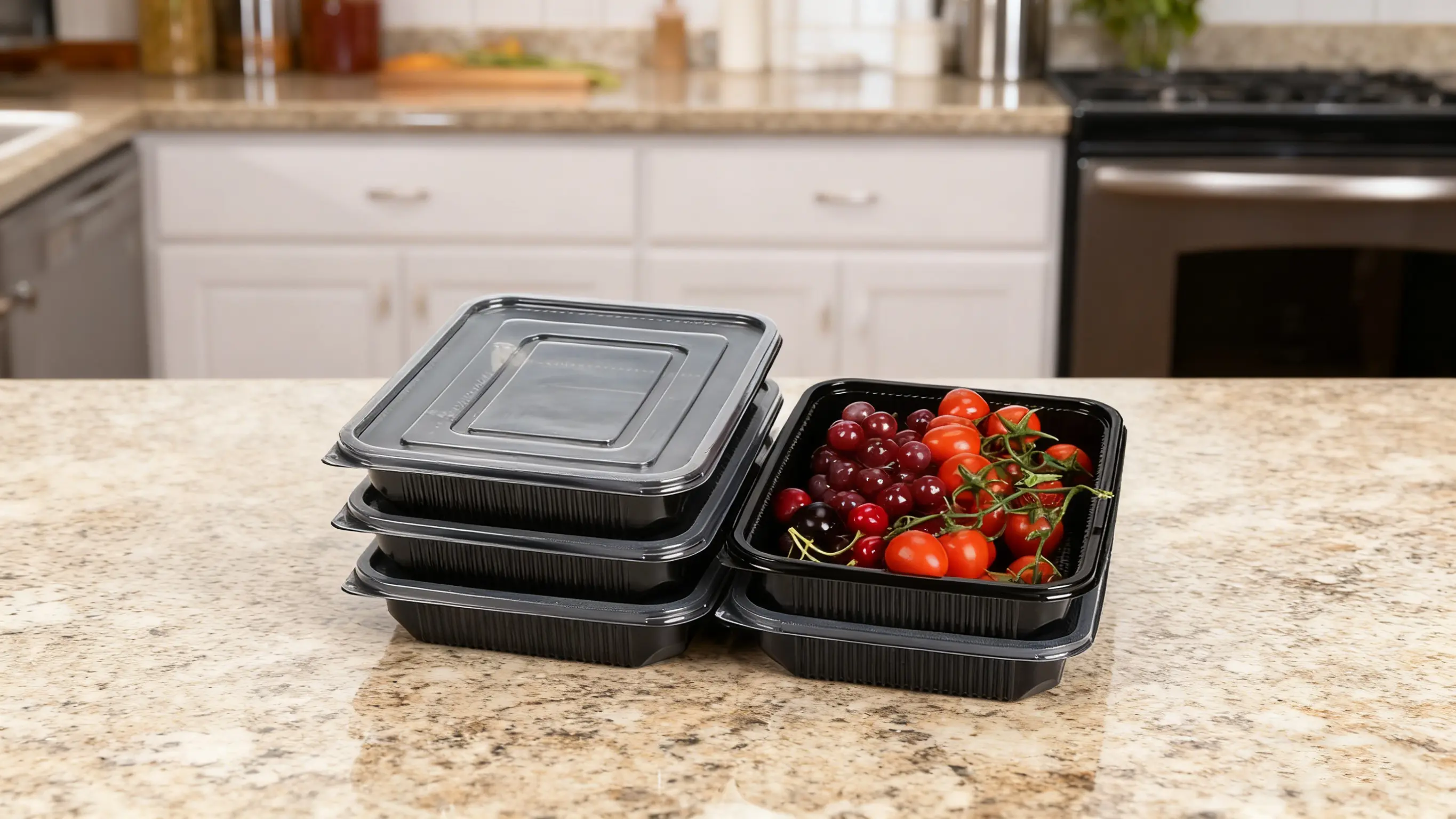
II. The Impact of Heating Conditions on Odor Generation
Temperature, duration, method, and food type all significantly affect the generation of odors and the release of harmful substances from take-out containers plastic, as follows:
2.1 Temperature: 60°C is the Critical Risk Point
Temperature is the core influencing factor; 60°C is a critical point for the release of harmful substances from plastics. Above this temperature, molecular thermal motion intensifies, and the migration rate of chemical substances increases sharply. Data from a simulated experiment at a university materials laboratory shows:
| Temperature | Main Phenomena | Release of Harmful Substances |
| 60℃ | - | Phthalate migration amount 0.5 mg/kg, exceeding the EU standard by 2 times |
| 70℃ | PS food container softens and deforms | Styrene monomer begins to be released |
| 80℃ | - | Bisphenol A release amount 1.2 μg/L, long-term intake interferes with the endocrine system |
| 95℃ | - | PP food container releases 12,000 microplastics/cm² in 15 minutes; PS food container releases 35,000 microplastics/cm² |
| 100℃ | - | Microplastic particle release reaches 1.2 billion per liter, which can enter the bloodstream through the digestive tract |
In daily meals, freshly cooked dishes are 90-100°C, and fried foods are 160-200°C. Directly placing them in ordinary take-out containers with dividers will accelerate the release of "toxins"; in summer, the temperature inside a car exposed to direct sunlight can reach 70°C, and even empty containers will slowly release harmful substances.
2.2 Duration
Heating duration has a significant impact; 3 minutes is the point at which a large amount of harmful substances are released. A study published in *Environmental Science & Technology* in July 2023 showed that microwaving for 3 minutes can release 4.22 million microplastic particles and 2.11 billion nanoplastic particles per square centimeter of plastic surface. A single heating session could result in the ingestion of billions of plastic particles.
Different materials have different tolerance times: PP lunchboxes (thinner) are recommended for ≤5 minutes, thicker ones for ≤10 minutes; PS material will produce a noticeable odor even with short-term heating. Prolonged heating not only increases the release of particles but may also change the type of substances (e.g., molecular chain breakage producing complex decomposition products); repeated heating has a cumulative effect. If a lunchbox still has a pungent odor after more than six months of use, it may be due to damage to the plastic molecular structure and the release of a large amount of plasticizers. It is recommended to replace lunchboxes every 6-8 months, and to stop using them immediately if they are deformed, discolored, or have an odor.
2.3 Method
Microwave heating is most likely to cause odors and the release of harmful substances because the heat generated by the vibration of water molecules puts pressure and friction on the plastic, causing it to crack and peel, and particles to mix with the food; heating in a water bath or at low temperatures is relatively safer, but caution is still needed. Studies show that the release of microplastics and nanoplastics from microwave heating is hundreds of times higher than from refrigeration or room temperature storage, and the release is even greater when heating liquids (because the liquid is in more complete contact with the plastic).
Precautions for microwave heating: Remove the lid (or leave a small opening to release steam) to avoid excessive pressure that can deform the lunchbox and accelerate the release of particles; use microwave-safe containers (ordinary PP boxes may not be designed properly); do not heat empty containers (they can overheat).
2.4 Food Type
- Fatty foods: High-temperature fats act like a "solvent," significantly accelerating the dissolution of residual monomers and additives in the plastic. The release of harmful substances when containing high-fat foods is more than 3 times higher than when containing rice; the amount of styrene released when hot, freshly cooked pork is placed in a foam lunchbox is 23 times higher than at room temperature.
- Acidic foods: Acidic liquids such as vinegar and lemon juice may corrode the plastic surface, promoting the leaching of substances such as bisphenol A. When containing foods with a pH below 5, it is recommended to use glass containers. Other types: High-salt foods, alcoholic beverages, and strong-smelling foods such as garlic and onions may react with plastic components or absorb odor molecules; avoid storing them in plastic containers for extended periods.

III. Health Risk Assessment of Odorous Substances
The odors produced by heating take-out containers plastic are a mixture of various chemical substances. Different substances have different risk levels and pose a greater threat to vulnerable populations. Authoritative institutions have also clearly identified their health hazards.
3.1 Components of Odorous Substances
- Monomer Residues: Small molecules that are not completely polymerized during plastic production, such as styrene released from PS, vinyl chloride from PVC, and terephthalic acid from PET, are one of the main sources of odor.
- Plasticizers: Primarily phthalates (DEHP, DBP, etc.), which increase the flexibility of plastics, easily migrate at high temperatures, and have estrogen-like effects, interfering with the endocrine system.
- Additives: Including sulfur/amine stabilizers, zinc stearate lubricants, and amine antioxidants, which volatilize at high temperatures, producing a distinctive odor, and some are toxic.
- Thermal Decomposition Products: Plastics decompose when exceeding their heat resistance limit, such as PE decomposing at 150℃ to produce acids, esters, and formaldehyde; PVC decomposes at high temperatures to produce dioxins (highly toxic).
- Microplastics and Nanoplastics: While not having a noticeable odor themselves, they can adsorb persistent organic pollutants and heavy metals, entering the bloodstream through the digestive tract and accumulating in organs such as the heart and liver.
3.2 Health Risk Level Classification
- High-Risk Substances (Carcinogenic or Highly Toxic): Styrene (IARC Group 2B carcinogen, liver and nerve damage), vinyl chloride (released from PVC, carcinogenic), dioxins (from high-temperature decomposition of PVC, highly toxic), phthalates (IARC Group 2B carcinogen, endocrine disruption).
- Medium-Risk Substances (Endocrine Disruption): Bisphenol A (BPA, affects reproductive development, increases cancer risk), perfluorinated compounds (damages vascular endothelium, increases cardiovascular disease risk), antimony (possibly present in PET, EU standard 30 ppm, 9/11 samples exceeded the standard).
- Low-Risk but Requiring Attention: Microplastics and nanoplastics (organ and cell damage, associated with neurodegenerative diseases), formaldehyde/acetaldehyde (irritating), other plasticizers and antioxidants (long-term low-dose effects require further study). The risks are also related to concentration and exposure time. For example, the safe dose of bisphenol A (BPA) has been reduced from 4 μg/kg body weight/day in 2015 (according to EFSA, the European Food Safety Authority) to 0.2 ng/kg body weight/day in 2023, a decrease of 20,000 times, reflecting a deeper understanding of the risks.
3.3 High Risks for Special Populations
- Pregnant and breastfeeding women: Harmful substances can cross the placental barrier and affect the fetus (potentially causing miscarriage and birth defects). Microplastics were detected in the blood of 92% of women of childbearing age, with particles smaller than 5 μm accumulating in the placental barrier at a concentration 4.7 times higher. BPA and other substances can also be transferred to infants through breast milk, affecting neonatal development.
- Children and infants: Due to their lower body weight and slower metabolism, the concentration of toxins in their bodies is 3-5 times higher than in adults under the same exposure. Their endocrine and nervous systems are sensitive to endocrine disruptors; phthalates may cause precocious puberty and reproductive developmental abnormalities. Children inhale 35,000-45,000 microplastic particles annually.
- Elderly and immunocompromised individuals: The elderly have decreased liver and kidney function, a weaker ability to metabolize harmful substances, and are prone to accumulation and poisoning. Immunocompromised individuals are more sensitive to chemicals, and even low-dose exposure may trigger adverse reactions.
- Patients with chronic diseases: Plasticizers damage vascular endothelium, accelerating atherosclerosis. Frequent users of takeout food (long-term use of take-out containers plastic) have a 27% higher recurrence rate of myocardial infarction than the general population, and those who regularly use disposable plastic tableware for hot food have a 13% increased risk of heart failure.
3.4 Assessment Conclusions from Authoritative Institutions
- World Health Organization (WHO): A 2023 report pointed out that various chemicals in plastics are endocrine disruptors, causing hormonal imbalances, reproductive disorders, and infertility, and increasing the risk of kidney disease and cancer. It emphasized that the plastic crisis is a health crisis and that vulnerable groups need priority protection.
- European Food Safety Authority (EFSA): In April 2023, EFSA lowered the tolerable daily intake (TDI) of bisphenol A to 0.2 ng/kg body weight/day (originally 4 μg/kg), stating that BPA may damage the immune system and increase the risk of allergic pneumonia and autoimmune diseases. China National Center for Food Safety Risk Assessment: Studies show that food packaging is the largest source of microplastics in our diet (accounting for 63%), and long-term low-dose intake leads to intestinal flora imbalance and decreased immune function; microplastics are commonly detected in commercially available bottled water, averaging hundreds of particles per liter.
- International Agency for Research on Cancer (IARC): Classified phthalates (DEHP) and styrene as Group 2B carcinogens, with long-term exposure increasing the risk of cancer.
- Authoritative institutions unanimously agree that a single exposure to harmful substances in take-out containers with dividers may not cause immediate serious harm, but long-term and frequent exposure will have a cumulative effect, posing a greater threat to vulnerable populations.

IV. Guidelines for Correctly Selecting and Using Heatable Take-Out Containers Plastic
Understanding material identification, purchasing considerations, and usage methods is key to reducing the health risks associated with microwavable take-out food containers. The specific procedures are as follows:
4.1 Material Identification Methods
Regular take-out containers plastic have a triangular recycling symbol on the bottom, with numbers 1-7 indicating different materials. The symbol should be used in conjunction with the following table to determine appropriate usage:
| Number | Material Name (English Abbreviation) | Heat Resistance Temperature | Usage Suggestions | Risk Level |
| 1 | Polyethylene Terephthalate (PET) | ≤70℃ | Only for cold drinks, do not heat, do not reuse | Low-Medium |
| 2 | High-Density Polyethylene (HDPE) | ≤110℃ | Can be heated for a short time, reuse not recommended | Low |
| 3 | Polyvinyl Chloride (PVC) | ≤60-70℃ | Prohibited for food packaging | High |
| 4 | Low-Density Polyethylene (LDPE) | ≤80℃ | Only for room temperature use, do not heat | Low-Medium |
| 5 | Polypropylene (PP) | ≤120-140℃ | The only material suitable for microwave heating, reusable | Low |
| 6 | Polystyrene (PS) | ≤70-90℃ | Do not heat, do not use for hot food | High |
| 7 | Other Plastics (OTHER) | Variable | Depends on the specific material, most are not suitable for heating | Variable |
In addition to the numerical markings, heatable take-out containers plastic should also have: the words "Microwave Safe," a microwave-safe icon, and a "Food Contact" label (conforming to GB 4806.7-2023 standard). Note: Some microwave-safe containers have a PP (number 5) body and a PE (number 4) lid; the lid must be removed before heating.
4.2 Purchasing Channels and Product Selection Considerations
- Choose reputable channels: Purchase from large supermarkets, shopping malls, or reputable online platforms. Avoid products without labels or with unclear labels from small vendors. Products from reputable channels have quality inspection reports and after-sales service.
- Check for complete labeling: Confirm packaging information, including material identification, manufacturer, production license number (QS/SC mark), production date, expiration date, instructions for use, and heat resistance temperature. National standards require take-out containers plastic to indicate the maximum usage temperature.
- Inspect appearance quality: Qualified take-out containers plastic should have a smooth, flat surface (no scratches, wrinkles, or cracks), uniform texture (no bubbles or deformation), uniform color (no significant color difference in colored containers), and no pungent odor (even newly opened containers should be odorless).
- Choose appropriate materials: Prioritize PP (polypropylene) material (number 5), and avoid PVC (number 3) and PS (number 6).
- Texture can be used as an aid in identification: PP containers are relatively hard and not very transparent, PS containers are hard and brittle and easily broken, and PET containers are highly transparent but soft.
- Look for special markings: Markings such as "BPA free," "food grade," and "biodegradable" can be considered, but should be evaluated in conjunction with the material identification, and not relied upon alone.
4.3 Safe Use and Operation Suggestions
Control temperature and time: For PP microwavable take-out food containers, heating temperature should be ≤120℃, and time ≤3-5 minutes, using a low power setting in a microwave oven; for steaming, the temperature should be ≤100℃, and time ≤5 minutes.
Standardize heating: Remove the lid (or leave a small opening) before heating to avoid excessive pressure causing deformation/explosion; place the food container in the center of the microwave turntable; do not heat empty containers; if deformation, odor, or smoke occurs during heating, stop using immediately.
Avoid high-temperature contact: Do not put freshly cooked hot food (>90℃) directly into the container; cool it to below 60℃ first; fried foods, hot pot, and hot soups (>100℃) should never be put into ordinary take-out containers plastic.
Choose food types: Do not use plastic containers for high-fat or acidic foods for extended periods; glass/ceramic containers are recommended for such foods; reduce the storage time of food in plastic containers, especially in high-temperature environments.
Replace regularly: Replace take-out containers plastic every 6-8 months, and immediately discontinue use if any of the following occur: deformation, discoloration, cracks; surface scratches/wear; heating odor; exceeding the expiration date; or illegible markings.
Standardize heating: Remove the lid (or leave a small opening) before heating to avoid excessive pressure causing deformation/explosion; place the food container in the center of the microwave turntable; do not heat empty containers; if deformation, odor, or smoke occurs during heating, stop using immediately.
Avoid high-temperature contact: Do not put freshly cooked hot food (>90℃) directly into the container; cool it to below 60℃ first; fried foods, hot pot, and hot soups (>100℃) should never be put into ordinary take-out containers plastic.
Choose food types: Do not use plastic containers for high-fat or acidic foods for extended periods; glass/ceramic containers are recommended for such foods; reduce the storage time of food in plastic containers, especially in high-temperature environments.
Replace regularly: Replace take-out containers plastic every 6-8 months, and immediately discontinue use if any of the following occur: deformation, discoloration, cracks; surface scratches/wear; heating odor; exceeding the expiration date; or illegible markings.
Global Trends in Paper Cup Environmental Policies
The Difference Between Cheap Paper Cups and High-Quality Paper Cups
Related Article

You searched for 4 oz Chinese take out boxes — but what you actually need may not be a paper box at all. The folded paper container with the wire handle looks iconic, but for 4 oz portions of sauce, dressing,
4 oz Chinese Take Out Boxes Alternative — Clear PP Portion Cups
Looking for plastic to-go containers with lids in bulk? Every container we ship includes a matching lid — not as an optional add-on,
Plastic To-Go Containers with Lids Wholesale | Bulk PP Food Boxes
SEND MESSAGE