



Microwaveable vs Regular Food Service Take-Out Containers
author: Iris
2026-01-21
I. Product Definition and Technical Basis
1.1 Technical Standards and Certification Requirements for Microwaveable Disposable Food Service Take-Out Containers
Microwaveable disposable food service take-out containers refer to disposable food contact plastic products that can be safely heated in a microwave oven. The national standard "Determination of the Temperature of Food Contact Surfaces of Plastic Food Contact Materials and Products under Microwave Heating Conditions" (GB/T 45171-2024), under the jurisdiction of the National Technical Committee for Standardization of Food Contact Materials and Products (TC397), will be implemented on July 1, 2025. In terms of international certification, the US FDA standard (21CFR 177.1520) requires plastic tableware to have a temperature resistance of ≥100℃, a potassium permanganate consumption of ≤10mg/L, and to pass a safety assessment; the EU standard (EC 10/2011) stipulates a bisphenol A (BPA) migration limit of ≤0.05mg/kg, adds a limit for decamethyltetrasiloxane (CAS 141-62-8), and requires materials to be approved by the European Food Safety Authority (EFSA). China's current standard GB 4806.7-2023 "National Food Safety Standard for Plastic Materials and Products in Contact with Food" (effective September 6, 2024) clearly states that food containers shall not release harmful substances under expected conditions of use and must be marked with the maximum use temperature.
1.2 Basic Characteristics and Standard Specifications of Ordinary Disposable Food Service Take-Out Containers
According to the "General Technical Requirements for Disposable Plastic Tableware" (GB/T 18006.1-2025, effective March 1, 2026), ordinary disposable take-out containers with lids refer to utensils used for eating or similar purposes (including food boxes, plates, dishes, etc., excluding fresh food trays, yogurt cups, and other non-food packaging), made from non-degradable plastic resins or thermoplastic materials through thermoforming, and are not applicable to disposable straws. Compared with microwaveable food containers, their temperature resistance and material composition requirements are more lenient, mainly meeting the needs of packaging food at room temperature or low temperatures.
1.3 Essential Differences in Material Composition
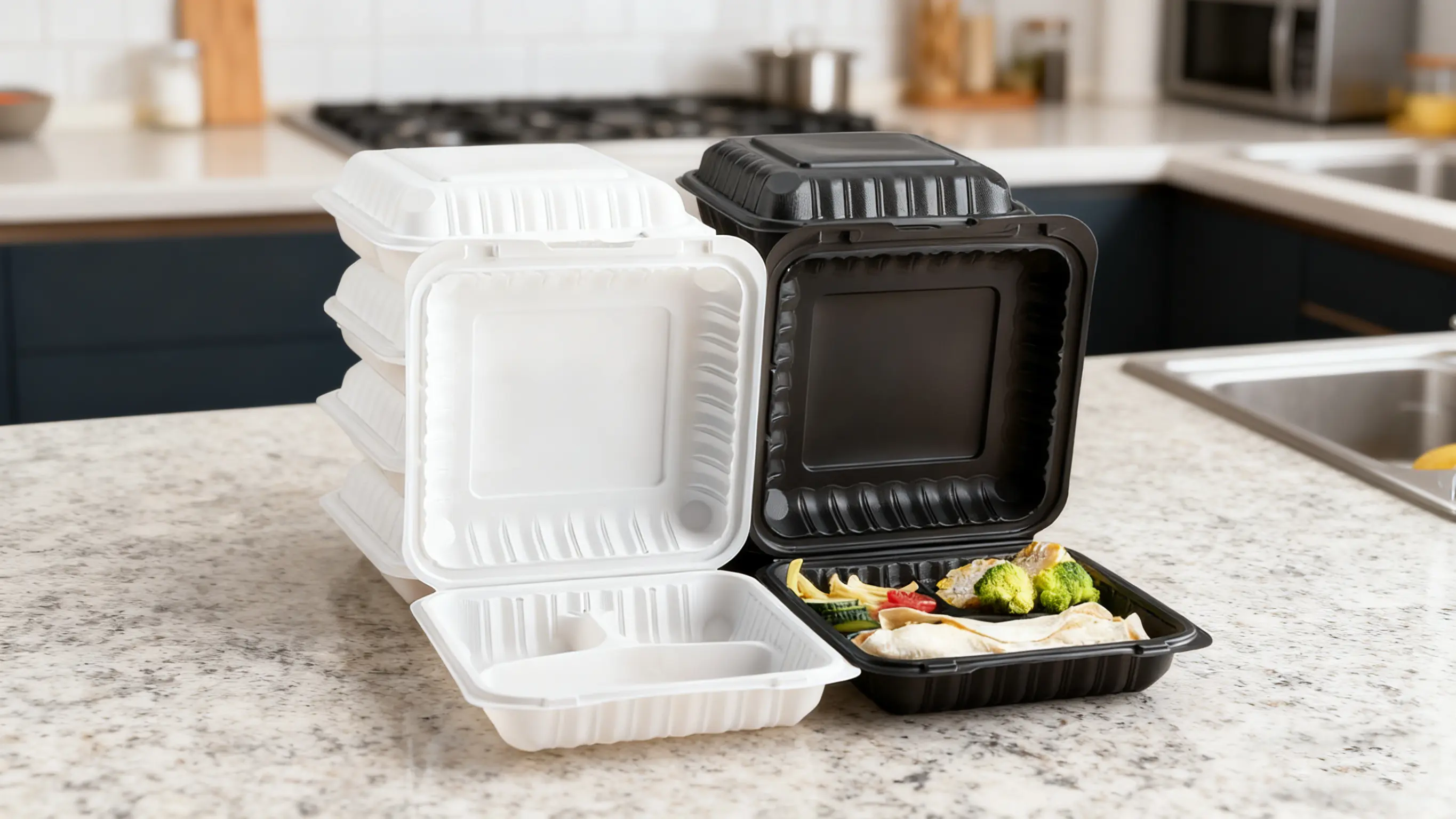
There are fundamental differences in the materials of the two types of food containers: microwaveable food containers use polypropylene (PP, code 5) as the core material, which is the only recognized microwave-safe food-grade plastic, with a melting point of 167°C, far exceeding the conventional heating temperature of microwave ovens, and can withstand high temperatures of 130°C for a short time; ordinary food containers mostly use polystyrene (PS), polyethylene terephthalate (PET), and polyethylene (PE): PS has high transparency (transmittance above 90%), but poor heat resistance (use temperature ≤70°C), and easily releases styrene at high temperatures; PET has high strength and is recyclable, but its heat resistance temperature is only 70°C and cannot be used for hot food or microwave heating; PE has a heat resistance temperature of 70-80°C, and easily melts and releases plastic particles during microwave heating.
II. Technical Differences at the Material Science Level
2.1 Material Characteristics and Molecular Structure of Microwaveable Food Containers
The advantages of microwaveable wholesale take-out containers stem from the special molecular structure of PP: the highly regular molecular chains and methyl side chains give it excellent thermal stability and chemical inertness. The heat distortion temperature reaches 120-140℃, and the temperature resistance range is usually -20℃ to 120℃. Some modified products (such as mineral-filled PP) can withstand high temperatures of 140℃ with a deformation rate of <0.5%. For example, Taiwan Chemical Fiber's TAIRIPRO food-grade PP K2051 has a heat distortion temperature of ≥110℃ and can withstand prolonged microwave heating or boiling water. At the same time, PP has excellent microwave penetration, does not absorb microwave energy, allowing microwaves to act directly on the food, preventing the container from overheating. It also has good chemical stability and does not release harmful substances under normal use.
2.2 Performance Limitations of Ordinary Food Container Materials
Ordinary food container materials have significant shortcomings in heat resistance: PS has a heat distortion temperature of 70-80℃, easily softens and deforms at high temperatures, releasing terephthalic acid, and has poor impact resistance and brittle texture, easily breaking at low temperatures; PET has a heat resistance temperature of ≤60℃, and may release plasticizers and heavy metals at high temperatures; PE (including high-density HDPE and low-density LDPE) has a heat resistance temperature of 70-80℃, easily melts and releases plastic microparticles during microwave heating, posing health risks with long-term use.
2.3 Differences in Material Costs and Production Processes
In terms of cost, microwaveable food containers are significantly more expensive than ordinary food containers: the market price of food-grade virgin PP is approximately 7700 yuan/ton. The cost of a pack of 200 30-gram containers (net weight 6 kg) is approximately 46.2 yuan, and after adding 20% miscellaneous expenses, the total cost is approximately 65 yuan, with a wholesale price of 3-4 cents per container; among ordinary food containers, foam containers are the cheapest at 7 cents per container (500 containers for 50 yuan), white environmentally friendly plastic containers are about 0.35 yuan each, and transparent ones are about 0.5 yuan each. In terms of manufacturing process, PP (polypropylene) processing offers good fluidity, allowing for the production of products in various shapes and thicknesses, and has a low density (0.90-0.91 g/cm³). However, it has a high shrinkage rate, requiring precise control of mold design and molding process. The manufacturing process for ordinary food containers is simpler, with lower quality control requirements.

III. Analysis of Application Scenarios in the Food Service Industry
3.1 Demand Characteristics of Food Delivery Scenarios
The food delivery industry is the largest market for disposable food containers. In 2024, the demand for disposable food containers in China was approximately 45 billion units, and is expected to exceed 60 billion units by 2030, with food delivery accounting for over 60%. Furthermore, 34% of food delivery orders involve microwave heating, driving the annual procurement of microwaveable food containers to 65 million units. Food delivery containers need to withstand temperature changes from "high-temperature cooking - room-temperature delivery - microwave heating." Ordinary containers are prone to deformation and leakage, while microwaveable containers (temperature resistant from -20℃ to 120℃) can ensure integrity and food safety throughout the process. Platform data shows that in 2023, sales of 500-800g microwaveable containers increased by 217% year-on-year, and the repurchase rate of reusable sealed products reached 73%, reflecting strong consumer demand for microwave functionality.
3.2 Standardization Requirements of Fast Food Services
The fast food industry's demand for food containers exhibits "standardization and scale" characteristics, with a high demand for cost control. Ordinary food containers (such as foam containers costing 7 cents per unit) dominate due to their price advantage. However, with increasing consumer concern for food safety, international fast food brands have begun to promote microwaveable food containers, while also considering environmental attributes to comply with regulations, gradually balancing "cost" and "quality."
3.3 Special Requirements for Group Meal Services
Group meals (corporate employee meals, school cafeterias, hospital meals) require containers that meet the needs of "large capacity, high temperature resistance, and easy distribution": microwaveable meal boxes are available in 500ml single-serving and 1000ml multi-serving sizes, with extra-large capacity to accommodate large portions of main dishes, avoiding the need for multiple boxes; high-temperature resistance (withstanding 80-90℃ hot food) ensures safety; and the microwave function enhances dining convenience, making them particularly suitable for hospitals, schools, and other settings, becoming the preferred choice for group meal services.
3.4 Diversified Needs for Retail Food Packaging
Retail food (pastries, sandwiches, porridge, etc.) has diverse needs for meal containers: pastries and light meals use PET transparent meal boxes (emphasizing presentation, no microwave needed); porridge and hot soups use microwaveable meal boxes (withstanding hot food temperatures and convenient for heating); sandwiches and cold meals use regular PS/PET meal boxes (for room temperature storage). Under the new retail model, the expansion of takeaway services further promotes the application of microwaveable meal boxes in the retail sector.

IV. Performance Comparison and Analysis
4.1 Significant Differences in Usable Temperature Range
Microwave-safe food service take-out containers (made of PP material) have a temperature resistance range of -20℃ to 120℃ (some up to 140℃), a melting point of 167℃, and a heat distortion temperature of 120-140℃, covering the entire "refrigeration-microwave heating" scenario; ordinary food containers have a narrow temperature resistance range: PS ≤ 70℃, PET ≤ 70℃, PE 70-80℃, only suitable for room temperature/low temperature, and cannot withstand hot food or microwave heating.
4.2 Fundamental Differences in Microwave Compatibility
The PP material of microwave-safe food containers does not deform in a 2.45GHz microwave environment (800W power, 5 minutes), has a stable molecular structure, and does not release harmful substances; ordinary food containers pose safety hazards: PS releases carcinogenic styrene above 70℃, PET releases plasticizers/heavy metals at high temperatures, and PE melts and releases microplastics during microwave heating. Only food containers marked "No. 5 PP" or "Microwave Safe" can be safely used for microwave heating.
4.3 Comprehensive Comparison of Physical Properties
| Performance Indicator | Microwaveable Food Container (PP Material) | Ordinary Food Container (PS/PET Material) |
| Transparency | Semi-transparent, relatively soft texture | PS: High transparency (over 90%); PET: High transparency |
| Strength and Toughness | High strength, good toughness, not easily broken | PS: Poor impact resistance, brittle texture; PET: High strength, strong impact resistance |
| Sealing Performance | Good, can be repeatedly sealed | Generally, mostly single-use sealing |
| Processing Performance | Good fluidity, easy to mold | PS: Easy to color, good insulation; PET: Balanced mechanical properties |
| Weight Density | 0.90-0.91 g/cm³ | PS: Approximately 1.05 g/cm³; PET: Approximately 1.38 g/cm³ |
4.4 Comprehensive Assessment of Cost-Effectiveness
In terms of direct costs, ordinary food containers have an advantage (the price of foam food containers is 1/4-1/5 of that of microwaveable food containers); however, in terms of overall cost, microwaveable food containers offer greater long-term value: PP material has a high reusability rate, reducing replacement frequency; improving customer satisfaction and reducing complaint and return rates; avoiding environmental compliance risks and reducing penalty costs, especially suitable for brand catering and chain enterprises with high quality requirements.

V. Safety and Environmental Protection Dimension Analysis
5.1 Strict Requirements for Food Safety Certification
Microwaveable food containers need to meet stricter safety standards: GB 4806.7-2023 requires heavy metals (lead < 1 mg/kg, cadmium ≤ 0.05 mg/kg), bisphenol A migration amount (≤ 0.05 mg/kg, prohibited for infant products), and total migration amount (≤ 10 mg/dm²). The US FDA requires potassium permanganate consumption ≤ 10 mg/L. Manufacturers need to provide material safety data sheets (MSDS) and pass microwave adaptability tests to ensure no harmful substances are released under high temperature/microwave conditions.
5.2 Analysis of Environmental Performance Differences
Both types of food containers present environmental challenges: microwaveable food containers (PP) are non-biodegradable, requiring 200-500 years to decompose in the natural environment, but they are recyclable and chemically stable (not releasing harmful substances); among ordinary food containers, PS/PET are non-biodegradable, and foamed containers are difficult to recycle, posing greater environmental harm. The industry is currently promoting biodegradable alternative materials: PLA (polylactic acid) food containers (decompose in 3-6 months in industrial composting), bamboo fiber food containers (decompose within 15 weeks, with 5.47-11.75 times lower environmental impact than PP), and sugarcane pulp tableware (decompose in 3-6 months in the natural environment, leaving no residue).
5.3 Carbon Footprint and Life Cycle Assessment
From a life cycle assessment (LCA) perspective, fully starch-based biodegradable tableware has the lowest environmental impact, releasing a cumulative 39.91 kg of CO₂ and consuming 332.04 MJ of electricity, representing a 69.5% reduction in carbon emissions and a saving of 416.23 MJ of electricity compared to fully fiber-based biodegradable food containers; traditional PP food containers have a higher carbon footprint (due to petroleum-based raw materials), but their advantages in "reducing food waste and lowering replacement frequency" can indirectly reduce the overall environmental impact.
5.4 Impact of Policies and Regulations
Global plastic restriction policies are driving industry transformation: China's "Opinions on Further Strengthening the Governance of Plastic Pollution" requires a 30% reduction in the consumption intensity of non-biodegradable food containers in the takeaway sector in cities above the prefecture level by 2025, driving the market share of biodegradable food containers from 18% to 35% (market size exceeding 22 billion RMB in 2025); the EU Single-Use Plastics Directive (SUP, 2019/904) restricts the use of single-use plastics, and California and New York State in the US are increasing the demand for biodegradable food containers. Policies are forcing companies to develop environmentally friendly alternative solutions while ensuring performance.

VI. Summary
The nature of the technology determines the application boundaries: microwaveable food service take-out containers (PP material) are heat-resistant to 120-140℃ and have microwave penetration properties, making them the only microwaveable food-grade plastic; ordinary food containers (PS/PET/PE) are heat-resistant to ≤80℃ and cannot be microwaved. The material differences directly define their application scenarios.
- Functional advantages solidify market position: Microwave-safe food containers cover a full temperature range from -20℃ to 120℃, offering excellent safety performance and enhancing the experience and safety in scenarios such as takeout and group meals. In 2024, they held a 65.6% market share, becoming the industry mainstream.
- Comprehensive benefits require long-term consideration: Microwave-safe food containers are 3-4 times more expensive than ordinary containers, but their high reusability, high customer satisfaction, and low compliance risks result in better long-term overall costs, making them suitable for branded restaurants and chain enterprises.
- Environmental pressure drives transformation: Plastic restriction policies and increased environmental awareness are driving industry innovation. Although microwave-safe food containers are not biodegradable, they offer advantages in durability and recyclability; future bio-based and biodegradable materials will become an important direction.
- Technological innovation leads the future: The integration of functions such as intelligent temperature control, steam valves, and antibacterial coatings is driving the development of microwave-safe food containers towards "high-end and intelligent" products. By 2030, biodegradable containers will account for 58% of the market, making technological innovation a core competitive factor.
Food service companies need to choose food containers based on cost, safety, consumer demand, and environmental requirements. Currently, microwave-safe food containers have become the standard for high-quality service. Companies need to pay attention to material innovation and policy dynamics to prepare for industrial upgrading.
Why PP Remains the Backbone of High-Performance Takeout Solutions in a Sustainable World
The Service Life of Biodegradable Sugarcane Bagasse Eco Take-Out Food Containers
Related Article

You searched for 4 oz Chinese take out boxes — but what you actually need may not be a paper box at all. The folded paper container with the wire handle looks iconic, but for 4 oz portions of sauce, dressing,
4 oz Chinese Take Out Boxes Alternative — Clear PP Portion Cups
Looking for plastic to-go containers with lids in bulk? Every container we ship includes a matching lid — not as an optional add-on,
Plastic To-Go Containers with Lids Wholesale | Bulk PP Food Boxes
SEND MESSAGE