



PP Plastic Compostable Take-Out Containers: One-Piece Molding vs. Separate Lid Design
author: Iris
2026-01-15
I. Analysis of Technical Characteristics and Structural Differences of PP Plastic Compostable Take-Out Containers
1.1 Technical Principles and Characteristics of One-Piece Molding Design
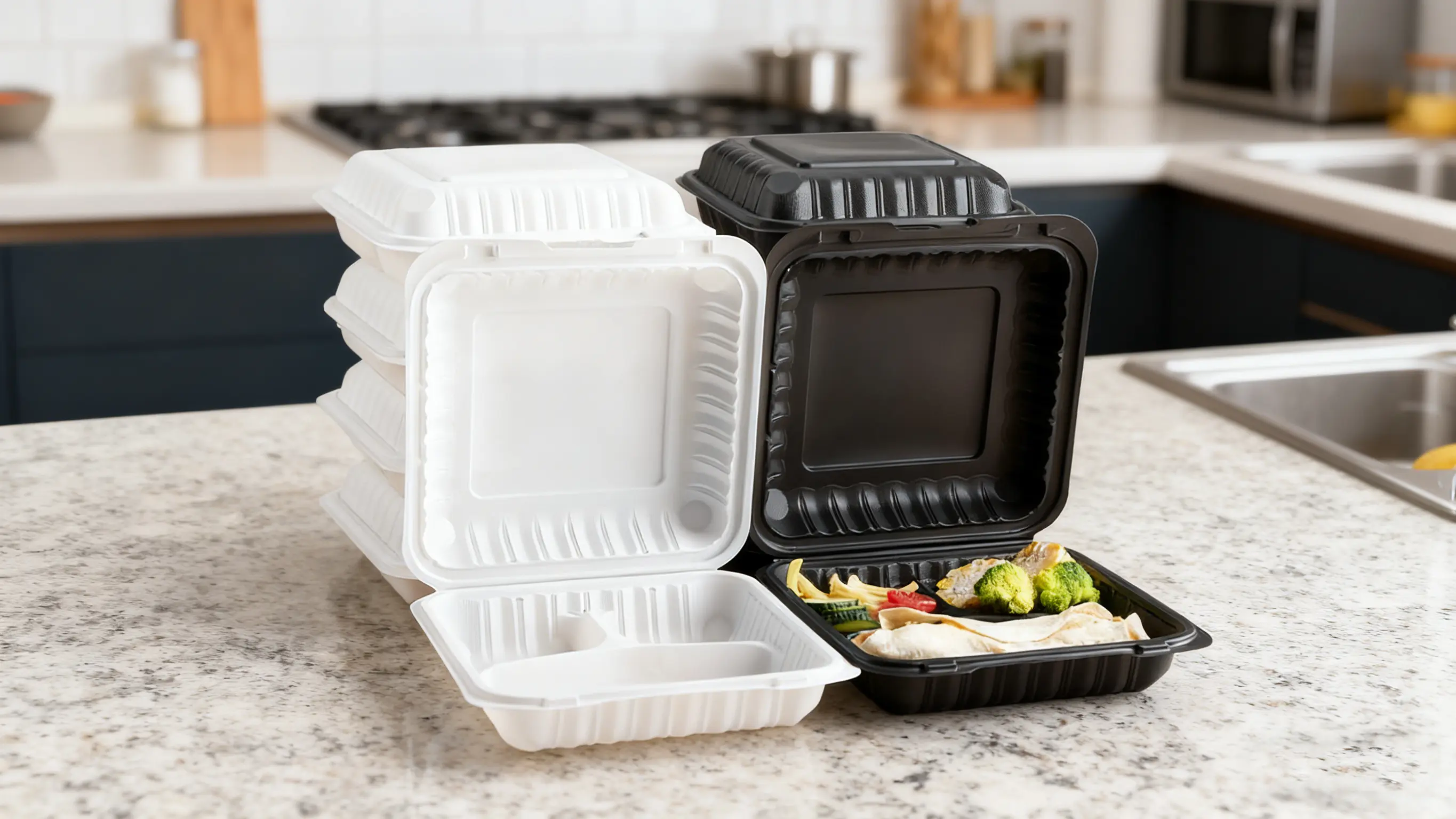
- One-piece molding relies on injection molding: Food-grade PP granules are heated to 220°C-240°C, melted, and injected into a customized mold for cooling and solidification. The box and lid are formed in one piece through connecting strips (non-separable).
- Material Selection: Primarily uses transparent thermoforming grade homopolymers such as Formosa Plastics PP 5200U and 5250T, with a density of only 0.91 g/cm³, colorless, odorless, and non-toxic; high-end products add POE toughening agents, increasing drop resistance by 50% while maintaining transparency, with a temperature range of -18℃ to 110℃ (special modifications can reach 120℃-140℃).
- Structural Advantages: Reduces splicing gaps, improving liquid leak-proof performance by 50% (suitable for soups and porridges); no complex components, reducing production complexity; no risk of lid loss, convenient to use.
1.2 Technical Principles and Features of the Split-Lid Design
The split-lid design features a separate box body and lid, sealed together using a combination of buckles, threads, and silicone sealing rings. The core innovation lies in the optimized sealing mechanism:
- Sealing Technology: Modern products mostly adopt a "multi-layer buckle + silicone sealing ring" design, capable of withstanding pressure tests of ≥50kPa, with a liquid penetration rate of <0.5%; high-end models feature upgraded "double sealing" (widened sealing groove + raised sealing ribs + double buckles + annular locking edge), ensuring leak-proof performance even when inverted.
- Structural Flexibility: Supports free combination of 4-8 compartments, with a single compartment capacity of 150ml-500ml (suitable for light meals, salads, and Chinese fast food); some products also include additional storage functions (such as a sliding storage compartment in the lid for utensils), meeting diverse needs.
1.3 Material Selection and Process Differences
| Dimension | Integrated Molding Design | Separate Lid Design |
| Material Focus | High-flow PP (suitable for injection molding, ensuring transparency) | High-toughness PP (with silicone sealing ring, improving sealing performance) |
| Production Process | Single injection molding process (mold closing → filling → pressure holding → cooling → demolding) | Injection molding/thermoforming combination (some use three-layer co-extrusion thermoforming: PP layer + filler layer + scrap layer) |
| Process Parameters | Injection temperature 250-270℃, holding pressure 50-60MPa, holding time 20-60 seconds | Thermoforming requires heating the sheet to soften it; injection molding parameters are similar to integrated molding |
1.4 Current Technological Development and Innovation Trends
The industry is evolving towards green, intelligent, and high-performance solutions:
- Green: Biodegradable PP (PP/PLA + corn starch) production lines are becoming widespread; Tsinghua University's molecular self-assembly technology improves photodegradation efficiency by 40% and reduces raw material costs by 15%;
- Intelligent: The lid features a food date recording function and a hidden vent hole; the inner liner uses 316L stainless steel integrated molding;
- High-performance: Sealing technology is upgraded from "surface sealing" to "line sealing" (elastic sealing points reduce the impact of process fluctuations), and the PP temperature resistance limit is increased to 130℃ (suitable for microwave ovens and dishwashers).
II. Performance Comparison and Analysis
2.1 Sealing Performance Comparison
Sealing performance directly affects food preservation and transportation safety. The two design technologies show significant differences:
- Integrated molding: Relies on the interference fit between the box body and lid (e.g., annular groove + rolled edge), reducing splicing gaps and improving liquid leak resistance by 50%. However, the sealing performance is limited, only meeting basic leak-proof requirements (such as rice and solid dishes), and is insufficient for high-pressure or long-distance transportation;
- Separate lid: Uses a composite structure of "multi-layer buckles + silicone sealing ring," with a pressure resistance of ≥50kPa and a liquid penetration rate of <0.5%. The high-end "double-seal" version can handle harsh transportation scenarios such as those involving electric vehicles, and is suitable for foods with high liquid content such as soups and porridges. Actual testing shows no leakage even when inverted.
2.2 Durability Comparison
Key durability indicators include impact resistance, temperature resistance, chemical resistance, and reusability:
- Impact resistance: Ordinary PP lunch boxes are easily broken when dropped. After adding POE toughening agent, the drop resistance of both designs is improved by 50%, with no significant scratches after 100 drops at temperatures ranging from -20℃ to 120℃;
- Temperature resistance: Basic PP is resistant to temperatures from -6℃ to 120℃ (suitable for microwave ovens and steamers), and special modification can reach 140℃, far exceeding materials such as PS (polystyrene);
- Chemical resistance: PP is resistant to acids, alkalis, and solvents. The mass change rate and tensile strength retention rate meet the standards after contact with various chemicals;
- Reusability: Integrated molding has no easily damaged parts (such as buckles and sealing rings), resulting in better long-term stability; the separate lid, due to its multiple moving parts, is prone to loose buckles and aging sealing rings (affecting sealing performance) during long-term use.
2.3 Cost Analysis
Based on a comprehensive assessment of raw materials, equipment, and labor costs:
- Raw material costs: The raw material cost for a single PP compostable take-out container weighing approximately 50g is about 0.15 yuan. The market price for basic models is 0.3-0.6 yuan (accounting for over 60% of the market), and the difference in raw material costs between the two designs is minimal;
- Equipment costs: One-piece molding relies on injection molding machines (manual equipment: 20,000-30,000 yuan, fully automatic production line: 600,000-650,000 yuan); separate lids can be produced using thermoforming machines (semi-automatic: 160,000-315,000 yuan), but this requires additional mold development for the lids (the cost per set is 10%-15% higher than for one-piece molding);
- Labor costs: A fully automatic injection molding line requires only 3 people for a day shift (including packaging); if the separate lid uses a combination of thermoforming and injection molding processes, labor costs increase by approximately 20%;
- Overall costs: Due to simpler molds and a single process, the cost per unit for one-piece molding is 0.03-0.05 yuan lower than for separate lids when produced in large quantities (daily capacity of 100,000+), while the cost difference narrows in small-batch production.
2.4 Production Efficiency Comparison
Production efficiency depends on equipment capacity, cycle time, and yield rate:
- Molding cycle: The injection molding cycle for one-piece molding is 30-60 seconds/mold (multiple cavities per mold), with a daily capacity of up to 150,000 units; if separate lids use the thermoforming process, the cycle is extended to 1-2 minutes/mold (requiring secondary processing of the lids), with a daily capacity of approximately 80,000-100,000 units;
- Mold efficiency: One-piece molding requires only 1 set of molds, with a manufacturing cycle of 15-20 days; separate lids require 2 sets of molds (container body + lid), with a manufacturing cycle of 30-40 days;
- Yield rate: One-piece molding has a simple structure, resulting in a yield rate of over 98%; separate lids involve component assembly, resulting in a yield rate of 95%-97% (failure in sealing tests is the main cause of loss).

III. Application Scenario Suitability Assessment
3.1 Home Use Scenarios
Home scenario needs focus on convenience, cleanliness, and functional versatility:
- Integrated design suitability: Emphasizes "convenient storage," suitable for storing leftovers (refrigerator preservation without odor transfer), and carrying meals (for students/office workers carrying fruits and main courses); temperature resistance is suitable for microwave heating and steaming (no deformation or odor when used with hot pot or hot water); no risk of lid loss, suitable for temporary use during gatherings;
- Separate lid design suitability: Focuses on "classification and cleanliness," with multi-compartment design to separate vegetables, meat, and main courses (preventing odor transfer); the container body and lid are detachable, and the sealing ring can be removed for separate cleaning (such as the notched design of Lock & Lock compostable take-out containers); diverse colors/shapes meet family aesthetic needs, suitable for users who value hygiene and personalization.
3.2 Food Delivery Scenarios
The core requirements for food delivery scenarios are leak-proof sealing, pressure resistance, and suitability for bulk delivery:
- Integrated molding adaptability: The advantage lies in "cost and stability." The thickened 1.2mm PP material can withstand 8kg of pressure (3-4 compostable take-out containers stacked without deformation), and the three reinforcing ribs at the bottom of the box resist bumps; the leak-proof design meets the basic requirements for soup delivery, suitable for economical takeout (such as fast food and porridge shops); the simple structure is easy to pack, suitable for bulk delivery of group meals during peak hours;
- Separate lid adaptability: The core lies in "high sealing and functionality." The "double sealing" design ensures zero leakage of liquids such as soups and milk tea; the multi-compartment design is suitable for high-end catering (such as light meals and private kitchen dishes), allowing for the separation of main courses and side dishes; some products have an insulation layer to extend food insulation time, suitable for high-end takeout with an average order value of over 30 yuan.
3.3 Food Industry Application Scenarios
The food industry requires standardization, scale, and food safety compliance:
- Integrated molding adaptability: High degree of standardization (uniform specifications, stable quality), suitable for large-scale production of sealed containers for braised dishes, meat trays, and disposable take-out food containers with lids; the material complies with GB 4806.6-2016 standard, and can be used in high-safety scenarios such as infant compostable take-out containers and fitness meal packaging; simple recycling process (no separate parts), with a recycling rate 5%-8% higher than separate lids;
- Separate lid adaptability: The advantage lies in "functional customization." Through antibacterial coatings and special sealing designs, it can be adapted to products that require extended shelf life, such as pre-packaged meals and cooked food; multi-compartment combinations meet the needs of small-portion packaging (such as snacks and sauces), but the mold cost is high and standardization is difficult, making it more suitable for niche high-end food packaging (such as imported snacks and customized baby food).

IV. Market Structure and Development Trends
4.1 Market Size and Competitive Landscape
- Overall Scale: In 2023, the national plastic compostable take-out container market size was approximately 58 billion yuan, with PP material accounting for 58%; in 2024, the disposable compostable take-out container market size was 42.5 billion yuan, with PP fresh-keeping containers for takeout accounting for 65% (expected to reach 75% by 2030);
- Competitive Landscape: The market is highly concentrated among leading companies. Zhuhai Zhongfu (12% market share, annual revenue of 7 billion yuan) and Shanghai Ailu (9% market share, annual revenue of 5.2 billion yuan) together account for over 20%, and the top ten companies have a market concentration of 45%-48%;
- Regional Distribution: East China (35%), the Pearl River Delta (28%), and the Yangtze River Delta (22%) are the core markets, while the growth rate in northern regions is slower (affected by the distribution of the catering industry).
4.2 Consumption Trends and Demand Changes
- Upgraded Environmental Protection Requirements: In 2024, the market share of biodegradable PP compostable take-out containers was 25%, expected to reach 35% in 2025 and 50% in 2030. Consumers are willing to pay a 10%-15% premium for environmentally friendly products;
- Improved Quality Requirements: In addition to leak-proof and temperature resistance, consumers are more concerned about "no odor, smooth surface, and microwaveable." The growth rate of mid-to-high-end products (unit price 0.8-1.5 yuan) reaches 20% (higher than the basic models at 5%);
- Diversified Functions: Demand for multi-compartment, heat preservation, antibacterial, and date recording functions is increasing. The split-lid design, due to its strong adaptability, has a 12% higher growth rate in the mid-to-high-end market than integrated lids.
4.3 Technological Innovation Directions
- Material Innovation: The cost of biodegradable PP (PLA + corn starch) continues to decline, and the price difference with ordinary PP is expected to narrow to 20% by 2025;
- Process Upgrades: One-step extrusion molding technology is becoming popular (suitable for multi-layer PP sheets, used in pre-packaged food packaging), and the efficiency of multi-station thermoforming machines has increased by 30%;
- Intelligent Design: The lid integrates an NFC chip (for tracing food information), an automatic pressure relief valve (for explosion protection during microwave heating), and the inner liner uses a PP + stainless steel composite material (to improve heat preservation).
4.4 Policy Environment and Industry Impact
- Tightening Safety Standards: GB 4806.7-2022 (implemented in June 2023) prohibits the use of recycled PP and unapproved fluorescent whitening agents; resins/additives must comply with the positive list;
- Plastic Restriction Policies: In areas with "strict enforcement + high subsidies" such as Shenzhen and Xiamen, the proportion of biodegradable vented take-out containers reaches 58% (higher than the national average of 31%);
- Improved Recycling System: Many areas are piloting "special recycling of PP compostable take-out containers," with recycled PP used to manufacture industrial pallets and garbage cans, increasing the recycling rate to 35% (2024).

V. Summary and Recommendations
Core Summary
- Technology and Performance: Integrated molding focuses on "low cost, high efficiency, and basic sealing," suitable for large-scale standardized scenarios; separate lids emphasize "high sealing, multi-functionality, and flexible adaptation," suitable for high-end differentiated needs;
- Cost and Efficiency: In large-scale production, the cost per unit of integrated molding is 0.03-0.05 yuan lower than separate lids, and daily production capacity is 50% higher; separate lids have higher mold and labor costs, but there is a large premium space in the mid-to-high-end market (unit price can be increased by 50%-100%);
- Scenario Adaptation: Integrated molding is suitable for basic household storage, economical takeout, and large-scale food industry production; separate lids are suitable for household classified storage, high-end takeout, and niche food customized packaging.
Recommendations
- Manufacturers: Large-scale manufacturers should focus on integrated molding technology (optimizing injection molding processes to reduce costs), while high-end manufacturers should focus on innovation in separate lids (developing antibacterial, heat preservation, and other functions); simultaneously, they should develop biodegradable PP to meet policy and environmental requirements;
- Catering Businesses: Fast food/porridge shops should choose integrated molding (to control costs), while high-end restaurants/light food businesses should choose separate lids (to improve quality); prioritize suppliers that comply with GB 4806.7-2022 standards;
- Policymakers: Provide tax incentives and subsidies for biodegradable technologies, establish a special recycling system for PP compostable take-out containers, and balance environmental requirements with companies' cost bearing capacity.
Future Outlook
The PP plastic compostable take-out container industry will develop towards "green solutions (biodegradable + high recyclability), intelligence (integrated functions + traceability), and high-end products (composite materials + customized design)." Two design approaches will form a complementary pattern: integrated molding dominating the basic market, and separate lids gaining traction in the high-end market. Companies need to focus on technological innovation and scenario-specific applications to achieve sustainable development.
The Influence of Color on Heat Absorption in PP Plastic Chinese Take-Out Containers
PET vs. PP Plastic Water Cups: Core Parameter Comparison
Related Article

You searched for 4 oz Chinese take out boxes — but what you actually need may not be a paper box at all. The folded paper container with the wire handle looks iconic, but for 4 oz portions of sauce, dressing,
4 oz Chinese Take Out Boxes Alternative — Clear PP Portion Cups
Looking for plastic to-go containers with lids in bulk? Every container we ship includes a matching lid — not as an optional add-on,
Plastic To-Go Containers with Lids Wholesale | Bulk PP Food Boxes
SEND MESSAGE