



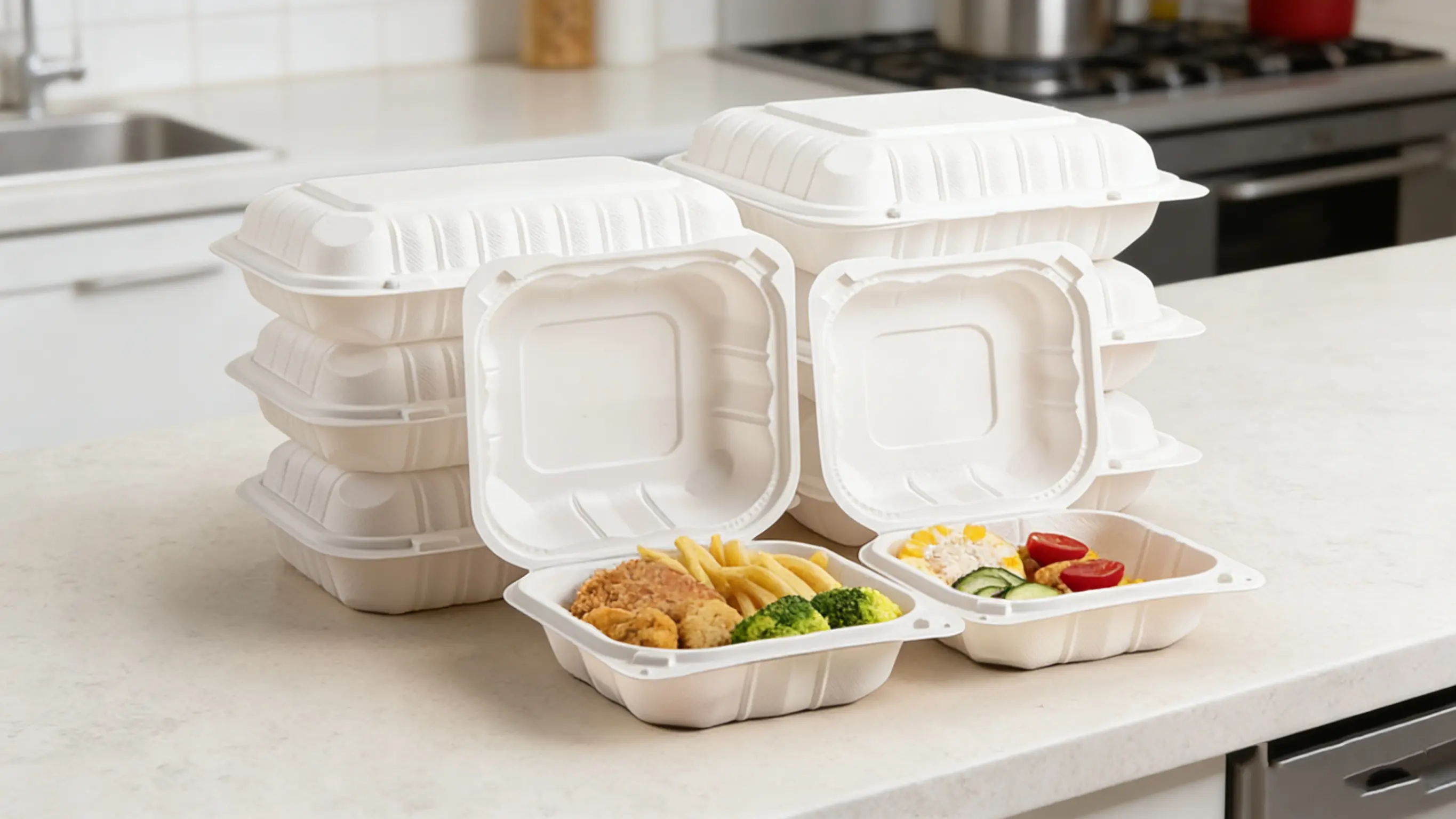
Sugarcane Pulp Food Containers Vs. Chinese Take out Containers Plastic
author: Iris
2026-01-20
I. Comparison and Analysis of Material Characteristics
1.1 Raw Material Characteristics and Production Process of Sugarcane Pulp Food Containers
The core raw material of sugarcane pulp food containers is bagasse, the waste product left after sugarcane is processed for sugar. my country produces over 40 million tons of bagasse annually, which was previously mostly disposed of through incineration, polluting the environment and wasting resources. Bagasse accounts for 21%-23% of the total weight of sugarcane. Each ton of sugarcane can produce 280 kilograms of dry fiber. Its chemical composition is mainly cellulose (40%-55%), hemicellulose (20%-30%), and lignin (18%-32%), with a small amount of ash and residual sugar. Among these, cellulose is the main structural component, hemicellulose acts as a binder, and lignin forms a supporting framework, allowing for molding without chemical adhesives. The production process mainly includes five steps:
- Raw material processing: Sugarcane bagasse fibers are extracted, impurities are removed, and then the fibers are cut and ground to obtain a uniform fiber raw material;
- Pulping and sterilization: The fibers are mixed with water in a 7:1 ratio and crushed in a pulper at 200-600 revolutions per minute, while ozone is injected for sterilization, resulting in a pulp slurry;
- Additive addition: Food-grade waterproofing agents composed of agar, propylene glycol alginate, beeswax, etc., are added to the pulp slurry and stirred for 5-7 minutes;
- Molding: The mixed slurry is transported to a cold mold, dewatered by vacuum filtration, and initially pressed into a preform. It is then transferred to a hot mold and heated at 100℃ for 30-60 seconds (advanced production lines use 230℃ high temperature and 15 tons of pressure) to reduce the water content to below 5%;
- Finished product processing: The finished product is obtained after edge trimming. The production process generates minimal wastewater and meets environmental protection requirements.
1.2 Main Types and Characteristics of Chinese Take out Containers Plastic
Chinese take out containers plastic on the market are mainly divided into three types: polypropylene (PP), polystyrene (PS), and polyethylene terephthalate (PET), with significant differences in characteristics:
| Material | Molecular Structure Characteristics | Core Characteristics | Applicable Scenarios | Production Process |
| Polypropylene (PP) | Contains tertiary carbon atoms, strong oxidation resistance | Heat resistant to 100-130℃ (the only one that can be microwaved), resistant to acids and alkalis, no harmful substances released; tensile strength 30-40MPa, can be used at -20℃ to -30℃, can be repeatedly cleaned | Hot food packaging, microwave heating | Injection molding, melted at 180-220℃ and then injected into the mold under high pressure, cooled and shaped |
| Polystyrene (PS) | Contains benzene rings, strong rigidity | High transparency, high hardness; only resistant to 70-90℃ (releases harmful substances at high temperatures), easily brittle at 0-10℃, low cost | Cold food packaging (salads, fruits) | Injection molding, processing temperature approximately 160℃ |
| Polyethylene Terephthalate (PET) | Contains ester groups, good barrier properties | Extremely high transparency, strong hardness; only resistant to ≤60℃ (not microwaveable), used at -10℃ to 0℃ | Fruit boxes, cold drink cups | Injection molding or blow molding, requires precise temperature control |
1.3 Comprehensive Comparison of the Characteristics of the Two Materials
Raw material source: Sugarcane pulp food containers use agricultural waste as raw material, 1 ton of product consumes 3 tons of sugarcane residue, equivalent to reducing the felling of 250 cubic meters of timber; Chinese take out containers plastic rely on non-renewable petroleum, with high oil consumption in production and emission of greenhouse gases.
Structure and molding: Sugarcane pulp is formed by the natural network structure of 0.65-2.17 mm long fibers, without the need for chemical adhesives; plastics form strength through the entanglement and crystallization of polymer chains, requiring the addition of chemical additives to improve performance.
Safety: Sugarcane pulp food containers are certified by FDA, SGS, etc., with heavy metal content 30% lower than national standards, and contain no plasticizers or fluorescent agents; Chinese take out containers plastic (especially PS and PET) easily release harmful substances such as bisphenol A at high temperatures.
Structure and molding: Sugarcane pulp is formed by the natural network structure of 0.65-2.17 mm long fibers, without the need for chemical adhesives; plastics form strength through the entanglement and crystallization of polymer chains, requiring the addition of chemical additives to improve performance.
Safety: Sugarcane pulp food containers are certified by FDA, SGS, etc., with heavy metal content 30% lower than national standards, and contain no plasticizers or fluorescent agents; Chinese take out containers plastic (especially PS and PET) easily release harmful substances such as bisphenol A at high temperatures.

II. Performance Comparison Analysis
2.1 Heat and Cold Resistance Comparison
Sugarcane pulp food containers: Temperature range from -20℃ to 220℃, can withstand 120℃ high-temperature hot oil without deformation or release of harmful substances; maintains toughness even at -18℃ freezing temperatures, and the pure natural, non-coated version can be directly microwaved (-15℃ to 220℃). Its excellent temperature resistance stems from the high-temperature and high-pressure molding process – the fiber structure is dense and has low water content, combined with a water-repellent agent in the pulp, achieving 48-hour leak resistance.
Chinese take out containers plastic: Performance varies greatly depending on the material. PP food containers are temperature resistant from 100-130℃ (microwaveable) and -20℃ to -30℃, with stable continuous use temperature; PS food containers are only resistant to 70-90℃ (soften at higher temperatures) and are prone to cracking at 0-10℃; PET food containers are temperature resistant only up to ≤60℃ (deform and release substances at higher temperatures), only suitable for low temperatures.
Chinese take out containers plastic: Performance varies greatly depending on the material. PP food containers are temperature resistant from 100-130℃ (microwaveable) and -20℃ to -30℃, with stable continuous use temperature; PS food containers are only resistant to 70-90℃ (soften at higher temperatures) and are prone to cracking at 0-10℃; PET food containers are temperature resistant only up to ≤60℃ (deform and release substances at higher temperatures), only suitable for low temperatures.
2.2 Mechanical Strength and Deformation Resistance Comparison
- Sugarcane pulp food containers: A standard 500ml food container has a static load capacity of 5 kg, and 10 fully loaded containers can be stacked without crushing; compressive strength is over 1.5 kg (superior to straw tableware at 1.2 kg and corn starch tableware at 1 kg), and can hold 3000ml of liquid without leakage; burst strength is 30% higher than traditional paper pulp tableware, and it does not soften easily when holding hot pot.
- Chinese take out containers plastic: PP food containers have the best performance, with tensile strength of 30-40MPa and impact strength of 20-30kJ/m², load capacity is 30%-50% higher than PS, and they are impact resistant and reusable; PS food containers are rigid but brittle, easily cracking with slight impact; PET food containers have high hardness but poor toughness, and are easily broken by impact.
2.3 Comparison of Waterproof, Oil-proof, and Sealing Properties
- Sugarcane pulp food containers: Achieve 48-hour leak resistance through the addition of waterproofing agents to the pulp; no leakage in 85℃ hot oil and 100℃ boiling oil tests; the inner wall is surface-treated, providing oil and water resistance without the need for lamination, ensuring 100% biodegradability, and preventing softening when containing liquids.
- Chinese take out containers plastic: PP containers have excellent waterproof and oil-proof properties, with a smooth surface that is easy to clean; PS containers have good water resistance but poor oil resistance (swelling occurs when exposed to oil at high temperatures); PET containers have good water resistance and barrier properties, but their protective performance decreases at high temperatures.
III. Comparison and Analysis of Environmental Performance
3.1 Comparison of Degradation Methods and Degradation Cycles
Sugarcane pulp food containers: Biodegraded through microbial enzymatic action, without the need for industrial composting facilities. Complete degradation takes 60-120 days in industrial composting, 45 days in home composting, and 3-6 months in the natural environment. The final products are CO₂, water, and humus, which can improve soil organic matter.
Chinese take out containers plastic: Degradation cycles last for hundreds of years, and mainly involve "fragmentation" rather than complete mineralization. PP degradation takes 300-500 years, PS takes 500-1000 years, and PET takes 450-500 years. The microplastics produced during the degradation process will remain in the environment for a long time.
Chinese take out containers plastic: Degradation cycles last for hundreds of years, and mainly involve "fragmentation" rather than complete mineralization. PP degradation takes 300-500 years, PS takes 500-1000 years, and PET takes 450-500 years. The microplastics produced during the degradation process will remain in the environment for a long time.
3.2 Environmental Impact Assessment (Full Life Cycle)
| Stage | Sugarcane Pulp Food Containers | Chinese take out containers plastic |
| Raw Material Acquisition | Resource utilization of agricultural waste, reducing incineration pollution | Consumption of petroleum (non-renewable), greenhouse gas emissions from extraction |
| Production Process | 60% less wastewater discharge than traditional pulping, carbon emissions are 1/3 of plastic | 1000 PP food containers emit 186.18 kg of CO₂, consume 4949.96 MJ of energy, and produce wastewater and exhaust gases |
| Usage Stage | No harmful substances released, safe for food contact | Release of bisphenol A and other substances at high temperatures, harmful to human health |
| Waste Disposal | Compostable and biodegradable, no long-term pollution, 89% lower carbon footprint than plastic | Only 9% recycled, the rest is landfilled/incinerated; microplastics enter water sources and the food chain (94% of tap water, 83% of marine fish contain microplastics) |
3.3 Analysis of Recycling Possibilities
- Sugarcane pulp food containers: The core recycling method is biodegradation (composting into organic fertilizer), and some can be repulped after pulping and screening; however, food residue needs to be cleaned, and additives may affect recycling quality, making it less economical than traditional waste paper.
- Chinese take out containers plastic: The overall recycling rate is low (only 9%), with PP food containers having the best recycling rate (29.6% in 2023), using "mechanical recycling (crushing, melting, and granulation) + chemical recycling (pyrolysis to produce raw materials)"; PS and PET are difficult to recycle due to poor performance and high cleaning costs; biodegradable plastics (such as PLA) easily contaminate traditional recycling streams, increasing sorting costs.

IV. Cost and Price Comparison Analysis
4.1 Raw Material and Production Cost Analysis
- Sugarcane pulp food containers: Raw material costs are only 1/3 of those for plastic (sugarcane bagasse is a byproduct of sugar production and is inexpensive); on the production side, economies of scale reduce costs – Shaoneng Green Oasis has 50 production lines with an annual capacity of 1.5 billion units, automation reduces labor costs by 40%, and daily production capacity is 500,000 units.
- Cost breakdown: raw materials account for 30-40%, processing for 40-50%, and other costs for 10-20%, with an average annual cost reduction of 8.7% (the unit price of bamboo fiber food containers decreased from 0.48 yuan to 0.35 yuan from 2021 to 2023).
- Chinese take out containers plastic: Raw material costs are highly susceptible to oil price fluctuations (in January 2026, the market price of PP was 6600 yuan/ton, an increase of 150 yuan compared to the previous month; the market price of PET was 8250-8350 yuan/ton); the production process is mature (high injection molding efficiency), but environmental taxes must be paid (2000 yuan per ton), and while PP raw material prices fluctuate by ±23.7%, the increase in terminal selling price is only 2.3%, resulting in a decline in gross profit margin for small and medium-sized manufacturers by 4.2-6.8 percentage points.
4.2 Market Price Comparison and Influencing Factors
| Product Type | Retail Price (RMB/unit) | Bulk Price (1000+ units, RMB/unit) | Price Influencing Factors |
| Sugarcane Pulp Food Containers | 0.3-0.8 | 0.2-0.6 | Raw materials (stable), scale (increased production lowers price), process (complex process slightly increases cost) |
| PP Chinese take out containers plastic | 0.15-0.3 | 0.1-0.25 | Oil prices (high volatility), scale (mature production leads to lower prices), environmental tax (increases cost) |
| PS Chinese take out containers plastic | 0.1-0.25 | 0.08-0.2 | Low raw material cost, simple process, but poor performance limits premium pricing |
| PET Chinese take out containers plastic | 0.2-0.4 | 0.15-0.35 | High raw material cost, difficult processing, price higher than PP/PS |
| PLA Food Containers | 0.4-0.8 | 0.3-0.7 | Expensive bio-based raw materials, high industrial composting costs |
Core reasons for price differences: Sugarcane pulp food containers have low raw material costs but a complex process, making them 25-40% more expensive than traditional plastics; plastic microwaveable take-out containers rely on low-cost petroleum raw materials but are greatly affected by environmental policies and oil price fluctuations; PLA food containers have the highest price due to raw material and composting costs.
4.3 Comprehensive Cost-Effectiveness Evaluation
- Sugarcane pulp food containers: Although the initial price is high, they offer significant environmental value (contributing to corporate ESG scores, with high-ESG companies enjoying a 15% price-to-earnings ratio premium), superior long-term costs (policy subsidies + no environmental tax), and a good user experience (microwaveable, temperature resistant). Takeaway packaging labeled "biodegradable sugarcane pulp" sees a 15% increase in repeat purchases.
- Chinese take out containers plastic: Low initial price, PP containers are reusable (low long-term cost for household use), but have high hidden environmental costs (microplastic pollution, health risks), and face the risk of plastic ban policies. Scenario-based recommendations: For hot food takeout, choose sugarcane pulp/PP food containers; for cold food, choose PS/PET food containers; for home storage, choose reusable PP food containers; for those prioritizing environmental protection, choose sugarcane pulp food containers.

V. Summary and Recommendations
5.1 Core Conclusions
- Material Characteristics: Sugarcane pulp food containers are made from agricultural waste, formed from natural fibers, and are safe and harmless; Chinese take out containers plastic rely on petroleum and require chemical additives, releasing harmful substances at high temperatures.
- Performance: Sugarcane pulp food containers have a wide temperature range (-20℃ to 220℃), high strength, excellent water and oil resistance, and are microwaveable; among Chinese take out containers plastic, only PP offers balanced performance, while PS/PET have significant temperature limitations.
- Environmental Performance: Sugarcane pulp food containers biodegrade quickly (45-120 days) and have low carbon emissions (89% lower than plastic); Chinese take out containers plastic take hundreds of years to degrade and produce microplastic pollution.
- Cost and Price: Sugarcane pulp food containers are currently 25-40% more expensive than plastic (retail price 0.3-0.8 yuan/piece), but the average annual cost is decreasing by 8.7%; Chinese take out containers plastic have a low initial price, but there are hidden environmental and policy costs.
5.2 Selection Recommendations
Prioritize sugarcane pulp food containers: for environmentally conscious businesses/consumers, hot food takeout and microwave use scenarios, situations requiring high food safety standards, and businesses that use them long-term and care about brand image.
Chinese take out containers plastic are an option: for those with limited budgets, for use only at room temperature/low temperatures, for single-use scenarios, and for those with low environmental requirements.
Chinese take out containers plastic are an option: for those with limited budgets, for use only at room temperature/low temperatures, for single-use scenarios, and for those with low environmental requirements.
5.3 Future Trends
With scaled-up production (such as the widespread adoption of ten-thousand-ton production lines) and technological optimization, the cost of sugarcane pulp food containers will further decrease. It is expected that the price difference with small plastic take out containers will narrow to within 15% by 2026; coupled with the advancement of environmental policies and increased consumer awareness, sugarcane pulp food containers are expected to become the market mainstream within 5-10 years, driving the food container industry towards a sustainable direction.
Common Problems and Solutions in Mini Takeout Box Printing
The Impact of Plastic Disposable Food Packaging Box Materials on Food Insulation
Related Article

You searched for 4 oz Chinese take out boxes — but what you actually need may not be a paper box at all. The folded paper container with the wire handle looks iconic, but for 4 oz portions of sauce, dressing,
4 oz Chinese Take Out Boxes Alternative — Clear PP Portion Cups
Looking for plastic to-go containers with lids in bulk? Every container we ship includes a matching lid — not as an optional add-on,
Plastic To-Go Containers with Lids Wholesale | Bulk PP Food Boxes
SEND MESSAGE