



What Are the Benefits of Anti-Fogging in Takeout Food Containers?
author: Iris
2025-12-09
1. Analysis of Improved Consumer Experience
1.1 Improved Visual Clarity
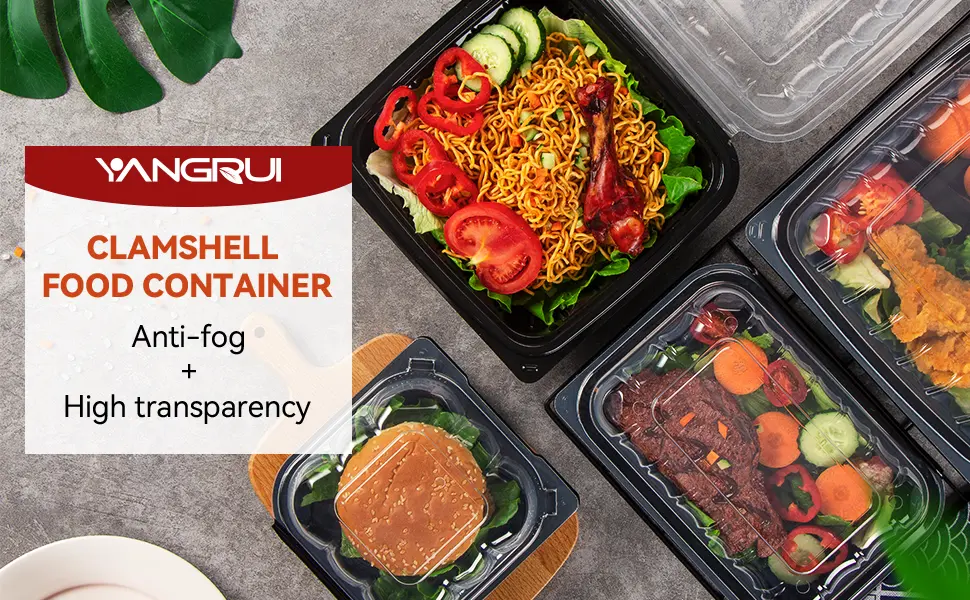
Anti-fogging technology significantly improves the visual clarity of disposable plastic food containers. Traditional transparent containers, when holding hot food, suffer from condensation due to temperature differences between the inside and outside of the container, severely affecting product presentation. The intended design, allowing customers to see the delicious food directly, is greatly compromised by the fogging. Anti-fogging technology, through surface activity, makes the film surface hydrophilic, resulting in fine water droplets that are highly transparent. The contents of the container can be clearly seen through the anti-fogging container.
Actual test data shows that the effect of anti-fogging technology is very significant. According to user tests, when using anti-fogging sealing film to package freshly cooked hot dishes, after sealing and letting it sit for 10 minutes, the inside of the film remains clean, and the contents of the food box are clearly visible, completely unaffected by condensation. In applications such as sushi, where presentation is crucial, the anti-fogging high-lid design allows the salmon sashimi to maintain its sparkling texture through the plastic, effectively solving the problem of seaweed becoming soft after two hours of refrigeration due to condensation in traditional flat-lid boxes.
The optical performance optimization effect of anti-fogging technology lies in eliminating the scattering effect of water droplets on light, avoiding the decrease in light transmittance caused by fogging, and ensuring visual clarity. This improvement not only enhances the aesthetics of the food but, more importantly, allows consumers to accurately understand the true state of the food before purchasing, including key information such as freshness, quantity, and ingredients, thus making more confident purchasing decisions.
Actual test data shows that the effect of anti-fogging technology is very significant. According to user tests, when using anti-fogging sealing film to package freshly cooked hot dishes, after sealing and letting it sit for 10 minutes, the inside of the film remains clean, and the contents of the food box are clearly visible, completely unaffected by condensation. In applications such as sushi, where presentation is crucial, the anti-fogging high-lid design allows the salmon sashimi to maintain its sparkling texture through the plastic, effectively solving the problem of seaweed becoming soft after two hours of refrigeration due to condensation in traditional flat-lid boxes.
The optical performance optimization effect of anti-fogging technology lies in eliminating the scattering effect of water droplets on light, avoiding the decrease in light transmittance caused by fogging, and ensuring visual clarity. This improvement not only enhances the aesthetics of the food but, more importantly, allows consumers to accurately understand the true state of the food before purchasing, including key information such as freshness, quantity, and ingredients, thus making more confident purchasing decisions.
1.2 Temperature Perception and Opening Convenience
Anti-fogging technology plays an important role in improving the accuracy of temperature perception and convenience. In traditional containers, due to fogging, consumers have difficulty accurately judging the temperature of the food, especially after receiving takeout, making it difficult to intuitively understand the food's temperature, which affects the expected dining experience. Anti-fogging technology, by maintaining the clear transparency of the container surface, allows consumers to directly observe the steam from the food, thus accurately judging the temperature.
In terms of opening convenience, the combination of anti-fogging technology and sealing design significantly improves the user experience. Modern anti-fog food containers incorporate various user-friendly designs, such as one-handed opening and easy-tear features, allowing consumers to enjoy their meals more conveniently. Some high-end anti-fog food containers use a push-pull lid design, which can be opened with a single hand, making it more convenient than traditional snap-on designs and avoiding the problem of dirt and grime accumulating in the edges of traditional containers.
Anti-fog technology also solves the problem of difficulty in opening traditional food containers due to the negative pressure caused by airtight sealing. Ordinary food containers, due to the cooling and contraction of internal air after sealing, create negative pressure, requiring considerable force to open and potentially causing food spillage. Modern food containers using anti-fog technology, through special ventilation designs or pressure-balancing structures, effectively avoid the negative pressure problem, making the opening process easier and smoother.
In terms of opening convenience, the combination of anti-fogging technology and sealing design significantly improves the user experience. Modern anti-fog food containers incorporate various user-friendly designs, such as one-handed opening and easy-tear features, allowing consumers to enjoy their meals more conveniently. Some high-end anti-fog food containers use a push-pull lid design, which can be opened with a single hand, making it more convenient than traditional snap-on designs and avoiding the problem of dirt and grime accumulating in the edges of traditional containers.
Anti-fog technology also solves the problem of difficulty in opening traditional food containers due to the negative pressure caused by airtight sealing. Ordinary food containers, due to the cooling and contraction of internal air after sealing, create negative pressure, requiring considerable force to open and potentially causing food spillage. Modern food containers using anti-fog technology, through special ventilation designs or pressure-balancing structures, effectively avoid the negative pressure problem, making the opening process easier and smoother.
1.3 Consumer Satisfaction Improvement Data
The positive impact of anti-fog technology on consumer satisfaction has been verified by actual market data. According to industry case studies, a high-end European and American brand saw a 23% increase in customer satisfaction and a 41% increase in repurchase rate after adopting a customized anti-fog coating. This is a typical example of the successful application of anti-fog technology. This data shows that anti-fog technology not only improves the immediate user experience but, more importantly, has a positive impact on consumers' long-term purchasing behavior.
The effect of anti-fog technology is even more evident in actual application scenarios. A light meal brand reduced its complaint rate by 73% and increased its repurchase rate by 41% by improving its packaging with anti-fog technology. Another blind test of users receiving food delivery showed that the satisfaction rate for meals delivered with anti-fog and other advanced technologies reached 89%, far exceeding the 52% for ordinary deliveries. This data fully demonstrates the significant value of anti-fog technology in improving the consumer experience.
Consumer acceptance and satisfaction with anti-fog food containers are also reflected in their evaluation of the product's appearance. Food containers using anti-fog technology allow food to maintain its best presentation, especially for dishes like sushi and sashimi, which require a high standard of appearance. Anti-fog technology allows the color and texture of the ingredients to be fully displayed, enhancing the consumer's visual enjoyment. Consumer feedback indicates that anti-fog food containers make "the food look incredibly appealing," effectively enhancing the sense of occasion and satisfaction of the meal.
The effect of anti-fog technology is even more evident in actual application scenarios. A light meal brand reduced its complaint rate by 73% and increased its repurchase rate by 41% by improving its packaging with anti-fog technology. Another blind test of users receiving food delivery showed that the satisfaction rate for meals delivered with anti-fog and other advanced technologies reached 89%, far exceeding the 52% for ordinary deliveries. This data fully demonstrates the significant value of anti-fog technology in improving the consumer experience.
Consumer acceptance and satisfaction with anti-fog food containers are also reflected in their evaluation of the product's appearance. Food containers using anti-fog technology allow food to maintain its best presentation, especially for dishes like sushi and sashimi, which require a high standard of appearance. Anti-fog technology allows the color and texture of the ingredients to be fully displayed, enhancing the consumer's visual enjoyment. Consumer feedback indicates that anti-fog food containers make "the food look incredibly appealing," effectively enhancing the sense of occasion and satisfaction of the meal.
1.4 Differences in Needs Among Different Consumer Groups
There are significant differences in the needs for anti-fog food containers among different age groups and consumer habits. Young consumers (18-35 years old) place greater emphasis on product personalization, intelligence, and fashion. Their demand for anti-fog food containers extends beyond functionality, focusing also on design and social attributes. This group is willing to pay a premium of around 15% for anti-fog food containers with innovative features and aesthetically pleasing designs, especially those with customized patterns and smart temperature displays.
Middle-aged consumers (35-55 years old) prioritize practicality and cost-effectiveness. Their core need for anti-fog food containers is to solve practical problems, such as preventing leakage, maintaining food temperature, and ease of carrying. This group's acceptance of anti-fog technology mainly depends on the product's actual effectiveness and reasonable price, and they tend to choose products with stable performance and moderate prices.
Elderly consumers (55 years and older) prioritize ease of use and safety. Due to age, they may prefer simple and easy-to-open packaging designs, such as food containers with easy-tear openings. This group also has a greater concern for food safety and environmental protection, and is more willing to choose anti-fog food containers that meet food safety standards and are recyclable or biodegradable.
In terms of geographical distribution, consumers in first-tier cities have a higher acceptance and demand for anti-fog food containers. This is closely related to the takeaway consumption habits, lifestyle, and purchasing power in these regions. According to market research, the usage rate of anti-fog food containers in first-tier cities such as Beijing, Shanghai, Guangzhou, and Shenzhen exceeds 60%, while in second- and third-tier cities this proportion is about 35%, and in county-level markets it is less than 20%.
Middle-aged consumers (35-55 years old) prioritize practicality and cost-effectiveness. Their core need for anti-fog food containers is to solve practical problems, such as preventing leakage, maintaining food temperature, and ease of carrying. This group's acceptance of anti-fog technology mainly depends on the product's actual effectiveness and reasonable price, and they tend to choose products with stable performance and moderate prices.
Elderly consumers (55 years and older) prioritize ease of use and safety. Due to age, they may prefer simple and easy-to-open packaging designs, such as food containers with easy-tear openings. This group also has a greater concern for food safety and environmental protection, and is more willing to choose anti-fog food containers that meet food safety standards and are recyclable or biodegradable.
In terms of geographical distribution, consumers in first-tier cities have a higher acceptance and demand for anti-fog food containers. This is closely related to the takeaway consumption habits, lifestyle, and purchasing power in these regions. According to market research, the usage rate of anti-fog food containers in first-tier cities such as Beijing, Shanghai, Guangzhou, and Shenzhen exceeds 60%, while in second- and third-tier cities this proportion is about 35%, and in county-level markets it is less than 20%.
2. Analysis of Business Operational Benefits
2.1 Benefits of Reducing Fog-Related Problems
The fogging problem of traditional best disposable food containers has brought multiple negative impacts on business operations, while the application of anti-fog technology can significantly improve these problems. First, there is a significant reduction in customer complaints. According to actual case data, the leakage rate with ordinary food containers is as high as 15%, and the customer complaint rate is 8%; after using anti-fog sealed food containers, the leakage rate drops to below 2%, and the customer complaint rate drops to below 1%. A light food brand improved its packaging by adopting anti-fog technology, resulting in a 73% reduction in complaints and a 41% increase in repurchase rate.
Anti-fog technology can also reduce food damage during the delivery process. Traditional food containers are prone to problems such as lids popping open due to condensation during delivery, leading to leakage of liquids. According to feedback from delivery drivers, food containers not wrapped in plastic wrap are more likely to spill during bumpy deliveries, resulting in damaged food and customer complaints. Anti-fog technology effectively reduces the probability of these problems by improving sealing performance and reducing internal pressure.
In terms of food presentation and sales, anti-fog technology can enhance product appeal and sales conversion rates. Market research conducted by a food delivery platform in conjunction with a third-party organization shows that for food packaged in transparent plastic containers, the customer order rate increased by an average of 15%-20%, and the repurchase rate also increased by 8%-12%. Especially for food items that require high-quality presentation, such as sushi and sashimi, the application of anti-fog technology allows ingredients to maintain their best presentation, significantly enhancing the visual appeal of the product.
Anti-fog technology can also reduce food damage during the delivery process. Traditional food containers are prone to problems such as lids popping open due to condensation during delivery, leading to leakage of liquids. According to feedback from delivery drivers, food containers not wrapped in plastic wrap are more likely to spill during bumpy deliveries, resulting in damaged food and customer complaints. Anti-fog technology effectively reduces the probability of these problems by improving sealing performance and reducing internal pressure.
In terms of food presentation and sales, anti-fog technology can enhance product appeal and sales conversion rates. Market research conducted by a food delivery platform in conjunction with a third-party organization shows that for food packaged in transparent plastic containers, the customer order rate increased by an average of 15%-20%, and the repurchase rate also increased by 8%-12%. Especially for food items that require high-quality presentation, such as sushi and sashimi, the application of anti-fog technology allows ingredients to maintain their best presentation, significantly enhancing the visual appeal of the product.
2.2 Improved Delivery Efficiency and Customer Service
Anti-fog technology improves delivery efficiency in several ways. First, it improves packaging efficiency; the improved sealing performance of anti-fog containers shortens packaging time, increasing packing speed and operational efficiency. Second, it improves stability during delivery; the improved sealing performance reduces the risk of leakage during delivery, reducing delivery costs and time wasted due to damaged food.
In terms of customer service, the application of anti-fog technology significantly reduces after-sales disputes and customer service costs. Customer complaints caused by condensation problems in traditional food containers require significant customer service resources for handling, including explanations, apologies, refunds, and replacements. By improving the visibility and integrity of the food, anti-fog technology reduces the occurrence of such complaints at the source, thereby reducing customer service costs and processing time.
Anti-fog technology can also enhance the merchant's brand image and reputation. When customers receive food that remains intact and visually appealing, they will have a better impression and evaluation of the merchant. According to merchant feedback, after using anti-fog containers, "orders increased by 30%, and negative reviews decreased by 80%." This improvement is not only reflected in immediate sales data but, more importantly, has a positive impact on the long-term development of the brand.
In terms of customer service, the application of anti-fog technology significantly reduces after-sales disputes and customer service costs. Customer complaints caused by condensation problems in traditional food containers require significant customer service resources for handling, including explanations, apologies, refunds, and replacements. By improving the visibility and integrity of the food, anti-fog technology reduces the occurrence of such complaints at the source, thereby reducing customer service costs and processing time.
Anti-fog technology can also enhance the merchant's brand image and reputation. When customers receive food that remains intact and visually appealing, they will have a better impression and evaluation of the merchant. According to merchant feedback, after using anti-fog containers, "orders increased by 30%, and negative reviews decreased by 80%." This improvement is not only reflected in immediate sales data but, more importantly, has a positive impact on the long-term development of the brand.
2.3 Cost-Benefit and Return on Investment Analysis
The cost-benefit analysis of anti-fog food containers requires a careful consideration of initial investment, operational cost savings, and revenue growth. From a cost perspective, anti-fog food containers typically cost $0.3-0.5 more per unit than regular food containers. In the Chinese market, the production cost of traditional plastic food containers is approximately 0.2 RMB per set, while anti-fog containers cost approximately 0.6-0.8 RMB per set, representing a cost increase of about 15%-20%.
However, the return on investment for anti-fog food containers is relatively short. According to a real-world case study of a Chinese restaurant in the United States, the business recouped its 30,000 RMB investment in a sealing machine within three months, increasing daily orders by 50, particularly among customer groups with high packaging requirements, such as healthcare workers. This rapid return on investment stems from several factors: firstly, a significant reduction in complaint handling costs (each complaint typically costs $10-50 to resolve, and anti-fog technology reduces complaints by over 70%); secondly, savings in delivery costs by reducing the need for redelivery due to damaged food; and finally, increased revenue through improved customer satisfaction and repeat business.
From an operational efficiency perspective, anti-fog technology also leads to indirect cost savings. For example, a healthy food brand improved its packaging using anti-fog technology. Although the packaging cost increased by 0.8 RMB per order, it reduced damaged product complaints by 236 per month, resulting in an overall cost reduction of 17%. These cost savings are primarily due to reduced customer service time, less food waste, and improved employee efficiency.
In the long term, the investment value of plastic disposable food containers becomes even more apparent. By enhancing brand image and customer loyalty, anti-fog technology provides businesses with a sustained competitive advantage. Especially in the highly competitive food delivery market, anti-fog technology has become an important means of differentiation, helping businesses build new competitive barriers beyond price competition.
However, the return on investment for anti-fog food containers is relatively short. According to a real-world case study of a Chinese restaurant in the United States, the business recouped its 30,000 RMB investment in a sealing machine within three months, increasing daily orders by 50, particularly among customer groups with high packaging requirements, such as healthcare workers. This rapid return on investment stems from several factors: firstly, a significant reduction in complaint handling costs (each complaint typically costs $10-50 to resolve, and anti-fog technology reduces complaints by over 70%); secondly, savings in delivery costs by reducing the need for redelivery due to damaged food; and finally, increased revenue through improved customer satisfaction and repeat business.
From an operational efficiency perspective, anti-fog technology also leads to indirect cost savings. For example, a healthy food brand improved its packaging using anti-fog technology. Although the packaging cost increased by 0.8 RMB per order, it reduced damaged product complaints by 236 per month, resulting in an overall cost reduction of 17%. These cost savings are primarily due to reduced customer service time, less food waste, and improved employee efficiency.
In the long term, the investment value of plastic disposable food containers becomes even more apparent. By enhancing brand image and customer loyalty, anti-fog technology provides businesses with a sustained competitive advantage. Especially in the highly competitive food delivery market, anti-fog technology has become an important means of differentiation, helping businesses build new competitive barriers beyond price competition.

3. Comprehensive Assessment and Development Recommendations
3.1 Technological Maturity and Market Prospects
The application of anti-fog technology in disposable plastic food containers has reached a high level of maturity. The technical routes are clear, product performance is stable, and market acceptance continues to increase. From a technological development perspective, anti-fog technology has moved from the early laboratory research and development stage to the large-scale industrial application stage, especially in areas such as fresh food e-commerce and food delivery services, where it has been widely adopted. According to market data, the usage rate of anti-fog cling film on mainstream fresh food e-commerce platforms has increased from less than 35% in 2021 to 78% in 2024, and is expected to exceed 90% in 2026. This trend fully demonstrates the strong market demand for anti-fog technology.
In terms of technological maturity, different anti-fog technology routes are already ready for industrial application. Internal additive anti-fog technology has achieved standardized production through the form of anti-fog masterbatch, with stable product performance and additive amounts controlled within a reasonable range of 2%-3%. External coating anti-fog technology has formed a complete industrial chain, with professional suppliers and service providers for both coating production and application. Although surface modification anti-fog technology requires significant equipment investment, it has already achieved commercial application in the high-end product sector.
In terms of market prospects, anti-fog technology has broad development potential in the field of disposable plastic food containers. With consumers' increasing demands for food safety and quality, and the continued growth of the food delivery and fresh food e-commerce industries, the market demand for anti-fog food containers will maintain rapid growth. Especially in the post-pandemic era, consumers have stricter requirements for the quality and safety of delivered food. As an important means to improve the presentation and quality assurance of food, the market value of anti-fog technology will be further highlighted.
From a regional development perspective, there are significant differences in the development level of anti-fog technology in different regions, which provide huge opportunities for technology promotion. The usage rate of plastic disposable food containers in first-tier cities has exceeded 60%, while this proportion is still low in second- and third-tier cities and county-level markets. With consumption upgrading and the improvement of logistics and distribution systems, these markets have enormous growth potential.
In terms of technological maturity, different anti-fog technology routes are already ready for industrial application. Internal additive anti-fog technology has achieved standardized production through the form of anti-fog masterbatch, with stable product performance and additive amounts controlled within a reasonable range of 2%-3%. External coating anti-fog technology has formed a complete industrial chain, with professional suppliers and service providers for both coating production and application. Although surface modification anti-fog technology requires significant equipment investment, it has already achieved commercial application in the high-end product sector.
In terms of market prospects, anti-fog technology has broad development potential in the field of disposable plastic food containers. With consumers' increasing demands for food safety and quality, and the continued growth of the food delivery and fresh food e-commerce industries, the market demand for anti-fog food containers will maintain rapid growth. Especially in the post-pandemic era, consumers have stricter requirements for the quality and safety of delivered food. As an important means to improve the presentation and quality assurance of food, the market value of anti-fog technology will be further highlighted.
From a regional development perspective, there are significant differences in the development level of anti-fog technology in different regions, which provide huge opportunities for technology promotion. The usage rate of plastic disposable food containers in first-tier cities has exceeded 60%, while this proportion is still low in second- and third-tier cities and county-level markets. With consumption upgrading and the improvement of logistics and distribution systems, these markets have enormous growth potential.
3.2 Recommendations for Technology Selection in Different Scenarios
For different application scenarios, the selection of anti-fog technology needs to consider multiple factors, including temperature requirements, food type, cost budget, and environmental requirements. For hot food applications (60-120℃), it is recommended to prioritize a technical solution using PP material combined with an internal anti-fog masterbatch. PP material offers excellent heat resistance, capable of withstanding temperatures above 120℃, while the internal anti-fog technology provides good durability, maintaining a stable anti-fog effect during long-term use. This solution is particularly suitable for packaging high-temperature foods such as Chinese fast food, hot noodle soups, and hot pot.
For cold food applications (0-10℃), a solution using PET material with an external anti-fog coating is recommended. PET material offers excellent transparency and appearance, suitable for displaying foods with high aesthetic requirements, such as fruits, salads, and sushi. The external anti-fog coating provides good anti-fog performance while maintaining high transparency, and its relatively low cost makes it suitable for large-scale applications.
For soup-based foods (70-100℃ and high humidity), a technical solution using PP material with a high-performance anti-fog masterbatch is recommended, along with special sealing and leak-proof designs in the structural design. This scenario demands the highest performance from anti-fog technology, requiring solutions that address both high-temperature resistance and high-humidity anti-fog challenges. The PP material combined with a high-quality anti-fog masterbatch provides the best overall performance.
For applications with high environmental requirements, a solution using bio-based materials such as PLA combined with surface-modified anti-fog technology is recommended. Although PLA material has relatively limited temperature resistance, its good biodegradability aligns with environmental development trends. Surface-modified anti-fog technology does not introduce additional chemical substances, maintaining the material's environmentally friendly characteristics, making it particularly suitable for markets with strict environmental requirements.
From a cost-effectiveness perspective, for price-sensitive customers, a solution using ordinary PP or PET materials with an economical anti-fog coating is recommended to control costs while ensuring basic anti-fog performance. For customers with higher quality requirements, a solution using high-end materials with high-performance anti-fog technology is recommended to achieve higher added value by improving product quality.
For cold food applications (0-10℃), a solution using PET material with an external anti-fog coating is recommended. PET material offers excellent transparency and appearance, suitable for displaying foods with high aesthetic requirements, such as fruits, salads, and sushi. The external anti-fog coating provides good anti-fog performance while maintaining high transparency, and its relatively low cost makes it suitable for large-scale applications.
For soup-based foods (70-100℃ and high humidity), a technical solution using PP material with a high-performance anti-fog masterbatch is recommended, along with special sealing and leak-proof designs in the structural design. This scenario demands the highest performance from anti-fog technology, requiring solutions that address both high-temperature resistance and high-humidity anti-fog challenges. The PP material combined with a high-quality anti-fog masterbatch provides the best overall performance.
For applications with high environmental requirements, a solution using bio-based materials such as PLA combined with surface-modified anti-fog technology is recommended. Although PLA material has relatively limited temperature resistance, its good biodegradability aligns with environmental development trends. Surface-modified anti-fog technology does not introduce additional chemical substances, maintaining the material's environmentally friendly characteristics, making it particularly suitable for markets with strict environmental requirements.
From a cost-effectiveness perspective, for price-sensitive customers, a solution using ordinary PP or PET materials with an economical anti-fog coating is recommended to control costs while ensuring basic anti-fog performance. For customers with higher quality requirements, a solution using high-end materials with high-performance anti-fog technology is recommended to achieve higher added value by improving product quality.
Anti-fog technology has significant application value and broad development prospects in the field of disposable plastic food containers. Through technological innovation, policy support, and industrial collaboration, anti-fog technology will play a greater role in improving consumer experience, promoting business efficiency, and driving environmental development, making a significant contribution to building a green, intelligent, and efficient food packaging system.
Why Are Eco-Friendly Biodegradable Takeout Containers Trending?
Disposable Plastic Square Bowls Vs. Round Plastic Bowls
Related Article

You searched for 4 oz Chinese take out boxes — but what you actually need may not be a paper box at all. The folded paper container with the wire handle looks iconic, but for 4 oz portions of sauce, dressing,
4 oz Chinese Take Out Boxes Alternative — Clear PP Portion Cups
Looking for plastic to-go containers with lids in bulk? Every container we ship includes a matching lid — not as an optional add-on,
Plastic To-Go Containers with Lids Wholesale | Bulk PP Food Boxes
SEND MESSAGE