



The Influence of Color on Heat Absorption in PP Plastic Chinese Take-Out Containers
author: Iris
2026-01-15
I. Basic Thermophysical Properties of PP Materials
1.1 Intrinsic Thermophysical Properties
As a semi-crystalline thermoplastic polymer, the thermophysical properties of PP are significantly affected by temperature and structure. The core parameters are as follows:
- Thermal conductivity: A core indicator for measuring heat transfer capacity. The thermal conductivity of pure PP ranges from 0.11-0.28 W/(m·K), with a typical value of 0.17-0.25 W/(m·K) (at 26°C). The differences in data stem from different test methods (e.g., Alfa Chemistry records 0.11 W/(m·K), the NETZSCH database shows 0.17-0.25 W/(m·K)), sample preparation conditions, and different PP grades.
- Specific heat capacity: Reflects the heat storage capacity. The specific heat capacity of PP is 1.8-2.3 J/(g·K), and it increases with increasing temperature—1764 J/(kg·K) at 20°C, 1851 J/(kg·K) at 30°C, and 1920 J/(kg·K) at 40°C, reflecting the change in molecular motion freedom with temperature. Density: The density of PP is 0.89-0.91 g/cm³, making it the lowest density among mainstream plastics. This gives products a lightweight advantage and indirectly affects heat transfer efficiency.
- Thermal diffusivity: This comprehensively reflects the heat conduction and heat storage characteristics. At 26°C, the thermal diffusivity of PP is approximately 0.17-0.183 mm²/s, and at room temperature, it is approximately 8×10⁻⁴ cm²/s. It first decreases and then increases with increasing temperature (reaching a minimum at 60-80°C), showing a significant temperature dependence.
1.2 Heat Conduction Mechanism
There is a fundamental difference between the heat conduction mechanism of PP and metals:
Metals rely on free electrons for heat transfer, while PP, as a polymer, primarily relies on phonons (lattice vibrations) for heat transfer, resulting in a much lower thermal conductivity than metals.
As a semi-crystalline polymer, PP heat conduction involves the synergistic effect of the crystalline phase (molecular chains are regularly arranged, the phonon propagation path is continuous, and the heat conduction ability is strong) and the amorphous phase (molecular chains are disordered, phonon scattering is significant, and the heat conduction ability is weak).
The heat conduction paths include: ① direct conduction through the crystalline phase; ② conduction through the amorphous phase; ③ conduction across grain boundaries. Among these, grain boundaries and phase interfaces are the main sites of phonon scattering, significantly reducing the overall heat conduction efficiency.
In addition, the orientation of molecular chains along the flow direction during processing will create anisotropic heat conduction characteristics—the thermal conductivity parallel to the molecular chain orientation direction can be up to 5 times higher than that perpendicular to it. This characteristic is particularly prominent in films and fibers.
As a semi-crystalline polymer, PP heat conduction involves the synergistic effect of the crystalline phase (molecular chains are regularly arranged, the phonon propagation path is continuous, and the heat conduction ability is strong) and the amorphous phase (molecular chains are disordered, phonon scattering is significant, and the heat conduction ability is weak).
The heat conduction paths include: ① direct conduction through the crystalline phase; ② conduction through the amorphous phase; ③ conduction across grain boundaries. Among these, grain boundaries and phase interfaces are the main sites of phonon scattering, significantly reducing the overall heat conduction efficiency.
In addition, the orientation of molecular chains along the flow direction during processing will create anisotropic heat conduction characteristics—the thermal conductivity parallel to the molecular chain orientation direction can be up to 5 times higher than that perpendicular to it. This characteristic is particularly prominent in films and fibers.
1.3 Influence of Crystallinity on Heat Conduction
Crystallinity (30%-70%) is a key factor affecting the heat conduction of PP, and its influence mechanism is as follows:
- Non-linear correlation: Generally, increasing crystallinity will increase the thermal conductivity (the crystalline phase provides a better heat transfer path), but when the crystallinity is too high, the increased grain boundary density leads to enhanced phonon scattering, which may slow down or even decrease the increase in thermal conductivity. Processing Condition Control: Rapid cooling shortens the time for ordered arrangement of molecular chains, reducing crystallinity; nucleating agents (such as talc powder, TiO₂) can increase the number of crystal nuclei and refine the grains, thus increasing crystallinity. However, the increased grain boundary density requires a comprehensive assessment of its impact on heat conduction (e.g., ZnO nanoparticles can simultaneously improve both crystallinity and thermal conductivity).
- Temperature Dependence: High temperatures accelerate the crystallization rate of PP and increase its crystallinity; low temperatures have the opposite effect. This characteristic leads to complex changes in the thermal conductivity of PP at different operating temperatures.
II. Mechanism of Color's Influence on Heat Conduction
2.1 Relationship between Color and Thermal Radiation
Color is essentially the selective absorption, reflection, and transmission of electromagnetic waves of different wavelengths by a material, and thermal radiation is an important mode of heat transfer (especially in high-temperature/vacuum environments). According to the Stefan-Boltzmann law, the radiant exitance of a real object requires the introduction of emissivity ε (M=εσT⁴, σ=5.67×10⁻⁸ W/(m²・K⁴)). The thermal radiation characteristics of three colors of PP differ significantly:
- Black PP: Approaching an ideal black body (ε≈1), containing carbon black as a colorant, it has a high absorption rate for infrared radiation, resulting in rapid heating; at the same time, its high emissivity means high heat dissipation efficiency during cooling.
- White PP: Using titanium dioxide (TiO₂) as a colorant, it has a high reflectivity for visible light and near-infrared radiation, resulting in low heat absorption; however, some white materials (such as white paint) can have an emissivity of up to 0.93 (absorption rate only 0.16), reflecting a selective response to radiation of different wavelengths.
- Transparent PP: It has a transmittance of >90% for visible light, but a low transmittance for infrared radiation, with some energy being absorbed or reflected; thickness affects its thermal radiation performance, with thicker transparent PP having stronger heat absorption capabilities.
2.2 Influence of Color Additives
Color additives affect thermal conductivity through their thermophysical properties, dispersion state, concentration, and interaction with the PP matrix:
- Carbon black (black PP): Serves both as a colorant and a thermal conductivity enhancer, with a thermal conductivity of 10-30 W/(m·K) (much higher than pure PP). When a continuous percolation network is formed in PP, it can significantly improve thermal conductivity – for example, adding 5 vol% graphene nanoplatelets (GNP) increases the thermal conductivity of PP from 0.26 W/(m·K) to 0.39 W/(m·K) (a 150% increase); however, carbon black increases melt viscosity and reduces processing performance.
- Titanium dioxide (white PP): Has a thermal conductivity of 6-8 W/(m·K) (higher than PP, lower than carbon black), and its main function is to provide white opacity and weather resistance; low concentrations (<5 wt%) have little effect on PP thermal conductivity, while high concentrations may reduce thermal conductivity due to interfacial thermal resistance.
- Transparent PP: Usually contains no or only very small amounts of additives, and its thermal conductivity characteristics depend on the base PP resin; nucleating agents may be added during production to improve transparency, and their slight impact on thermal conductivity needs to be considered.
- Concentration and dispersion: Additive concentration has a non-linear effect – low concentrations affect heat transfer through point contact, medium concentrations form local heat transfer pathways, and high concentrations (such as 60 wt% graphene micropowder) can form a continuous percolation network, increasing the thermal conductivity of PP from 0.087 W/(m·K) to 1.32 W/(m·K) (a 14-fold increase); it is also necessary to ensure uniform dispersion of additives to avoid agglomeration becoming a barrier to heat transfer.

III. Comparison of Thermophysical Parameters of Three Colors of PP Chinese take-out containers
3.1 Comparison of Thermal Conductivity
The thermal conductivity values of the three colors of PP are similar. The main reason is that the concentration of color additives is low (usually <5 wt%), which has a limited impact on overall heat conduction. The specific data are shown in the table below:
| Material Type | Thermal Conductivity Range [W/(m・K)] | Typical Value [W/(m・K)] | Test Conditions | Data Source |
| Black PP | 0.20-0.22 | 0.22 | 23°C, DIN 52612 | Röchling, Germany |
| Transparent PP | 0.11-0.28 | 0.17-0.25 | Room temperature | Comprehensive literature |
| White PP | 0.20-0.22 | 0.22 | 23°C | Mitsubishi Chemical |
It should be noted that under specific conditions, color may still have an observable effect: for example, high-filler thermal conductive fillers (Al₂O₃, BN, graphene) can increase the thermal conductivity of black PP to 1-10 W/(m・K), but these materials belong to thermal conductive composite materials and are fundamentally different from ordinary PP Chinese take-out containers.
3.2 Comparison of Thermal Absorptivity and Emissivity
According to Kirchhoff's law of thermal radiation (α=ε under thermal equilibrium), but in practical applications, due to wavelength selectivity, there may be differences between the two. The specific comparison is as follows:
| Material Type | Solar Spectrum Absorptivity | Infrared Emissivity | Key Characteristics |
| Black PP | 95-96% | 0.85-0.95 | High absorption, high emission, rapid heating |
| White PP | <20% (visible light) | 0.80-0.93 | Low absorption, high emission, wavelength selectivity |
| Transparent PP | <10% (visible light) | 0.70-0.85 | Primarily transmission, strong infrared absorption |
- Black PP: Carbon black gives it an integrated absorptivity of 95-96% in the solar spectrum range, and an infrared emissivity of 0.85-0.95, suitable for scenarios requiring rapid heating (such as solar heating), but may be disadvantageous in thermal insulation scenarios.
- White PP: Titanium dioxide reduces visible light absorption, but the infrared emissivity remains relatively high; evaluation is needed based on specific application scenarios.
- Transparent PP: High visible light transmittance, strong infrared absorption, behaving similarly to a translucent material; transmission, absorption, and reflection effects need to be considered comprehensively.
3.3 Thermal Diffusivity and Temperature Dependence
- Thermal diffusivity: Thermal diffusivity α = λ/(ρc) (λ = thermal conductivity, ρ = density, c = specific heat capacity). Pure PP has a thermal diffusivity of 0.17-0.183 mm²/s (26°C) and 0.0664 mm²/s (30°C); black PP has a slightly higher thermal diffusivity than pure PP due to the increased thermal conductivity from carbon black; white and transparent PP have similar thermal diffusivity to pure PP (may be slightly lower with high filler content in white PP).
- Temperature dependence:
- Thermal conductivity: Increases with increasing temperature (0.137 W/(m·K) at 15°C → 0.151 W/(m·K) at 45°C), resulting from the combined effect of increased molecular chain vibration and changes in crystallinity. Specific heat capacity: Increases significantly with increasing temperature (approximately 9% increase from 20°C to 40°C), reflecting the increased degrees of freedom of molecular motion.
- Thermal diffusivity: Initially decreases and then increases with increasing temperature (reaching a minimum at 60-80°C). At low temperatures, thermal conductivity dominates the temperature increase; at high temperatures, specific heat capacity dominates the temperature decrease, and then thermal conductivity again dominates the temperature increase.
At room temperature (20-40°C), the thermal conductivity differences between the three colors of PP are small; at high temperatures (>80°C), the color effect is more significant (especially in thermal radiation scenarios).

IV. Experimental Measurement Methods and Standards
4.1 Thermal Conductivity Measurement Methods
Different methods are suitable for different scenarios and should be selected based on the characteristics of PP Chinese take-out containers:
- Steady-state methods: Including the guarded hot plate method (ASTM C177) and the heat flow meter method (DIN 52612), with high accuracy (±2-5%), suitable for insulating materials with thermal conductivity <1 W/(m·K), but the equilibrium time is long (several hours), and special sample preparation is required for thin-walled plastic hinged take-out containers.
- Transient methods:
- Hot wire method (ASTM D5334): Fast measurement (a few minutes), low requirements for sample size, suitable for isotropic materials.
- Laser flash method (ASTM E1461): Measures thermal diffusivity (indirectly calculates thermal conductivity), small sample size (12.7 mm diameter, 1-3 mm thickness), fast speed (<1 minute), suitable for thin-sheet Chinese take-out container samples.
- Transient plane source method (TPS): Simultaneously measures thermal conductivity and thermal diffusivity, high accuracy, suitable for composite materials and anisotropic materials, with a deviation of 2.6%-8.7%.
When measuring PP Chinese take-out containers, attention should be paid to: cutting flat samples from the container body/sidewall, considering the anisotropy of injection molding, controlling the test temperature (usually 23±2°C), and ensuring a flat sample surface.
4.2 Thermal Absorptivity Measurement Methods
- Integrating sphere method: Measures full-spectrum absorptivity; for opaque materials, α = 1 - reflectivity; for transparent materials, transmittance needs to be considered; suitable for quantitative analysis.
- Spectroscopy: Obtain absorption spectra using a monochromator/spectrometer to understand the response mechanism of colors to different wavelengths of radiation (e.g., high absorption of infrared by black PP).
- Calorimetry: Measure the temperature change of the sample during radiative heating, and calculate the effective absorption rate based on the heat capacity, directly reflecting the actual thermal response in use.
- Infrared thermography: Observe the surface temperature distribution to qualitatively assess the uniformity of heat absorption, suitable for complex-shaped Chinese take-out containers.
Measurements require specifying the radiation wavelength range (solar radiation 0.3-3 μm, thermal radiation 3-50 μm), and considering the influence of incident angle, surface finish, and temperature on the absorption rate.
4.3 Relevant Standards
To ensure comparability of measurement results, international and national standards must be followed:
- International standards: ISO 8301/8302 (steady-state method), ISO 22007-2 (laser flash method), ASTM C177/E1461 (guarded hot plate/laser flash), DIN 52612 (heat flow meter method).
- National standards: GB/T 10294/10295 (steady-state method), GB/T 10297 (hot wire method), QB/T 4256 (transient plane heat source method).
When selecting standards, consider the material's thermal conductivity range, sample size, accuracy requirements, and testing efficiency. It is recommended to verify results using multiple methods (e.g., laser flash method for thermal diffusivity + steady-state method for thermal conductivity).

V. Analysis of Practical Application Scenarios
5.1 Typical Operating Temperature Range
PP plastic microwaveable take-out containers are used in a temperature range of -20°C to 120°C, and the influence of color varies significantly at different temperatures:
- Cold storage (-20°C to 10°C): The thermal conductivity of PP decreases slightly with decreasing temperature. The color influence is reflected in the thermal radiation response – black PP's high emissivity may accelerate the warming of the contents, while white/transparent PP has high reflectivity and better insulation.
- Room temperature storage (10°C to 30°C): The thermophysical properties of PP are stable, and the differences in heat conduction among the three colors are small. The main considerations are appearance and cost. Heating Scenarios (60°C to 120°C): At high temperatures, the thermal conductivity and specific heat capacity of PP increase, while the thermal diffusivity initially decreases and then increases. Color has a significant impact – black PP's high infrared absorption rate causes it to heat up fastest (12 seconds of heating time at the same temperature, compared to 40 seconds for white/transparent), but this may lead to localized overheating; white PP has high reflectivity, resulting in slower heating during direct heating (such as baking); transparent PP allows for visual observation of food condition, and thickness affects heat conduction (thick transparent PP has heating characteristics similar to white PP).
- Special Scenarios: During high-temperature sterilization (above 120°C), the material approaches its heat resistance limit, and the color effect is masked by thermal degradation; at ultra-low temperatures (below -40°C), the brittleness of PP increases, and the color effect requires specific testing; in microwave heating, the color effect is less significant than in traditional heating, but carbon black may affect microwave penetration depth.
5.2 Performance Differences and Application Suggestions for Colored Chinese Take-Out Containers
5.2.1 Core Performance Differences
| Performance Dimension | Black PP Chinese Take-Out Container | White PP Chinese Take-Out Container | Transparent PP Chinese Take-Out Container |
| Heat Conduction | Fast heating, fast heat dissipation | Slow heating, high infrared emissivity | Moderate heating, contents visible |
| Optical Performance | Opaque, good weather resistance | Translucent, strong opacity | Transmittance > 90%, easy to observe spoilage |
| Mechanical Performance | High hardness, slightly reduced toughness | Stable toughness, high filler content may reduce strength | Excellent toughness, no additive effects |
| Cost | Highest (high carbon black cost) | Medium (titanium dioxide cost) | Lowest (no/few additives) |
5.2.2 Scenario-Based Application Suggestions
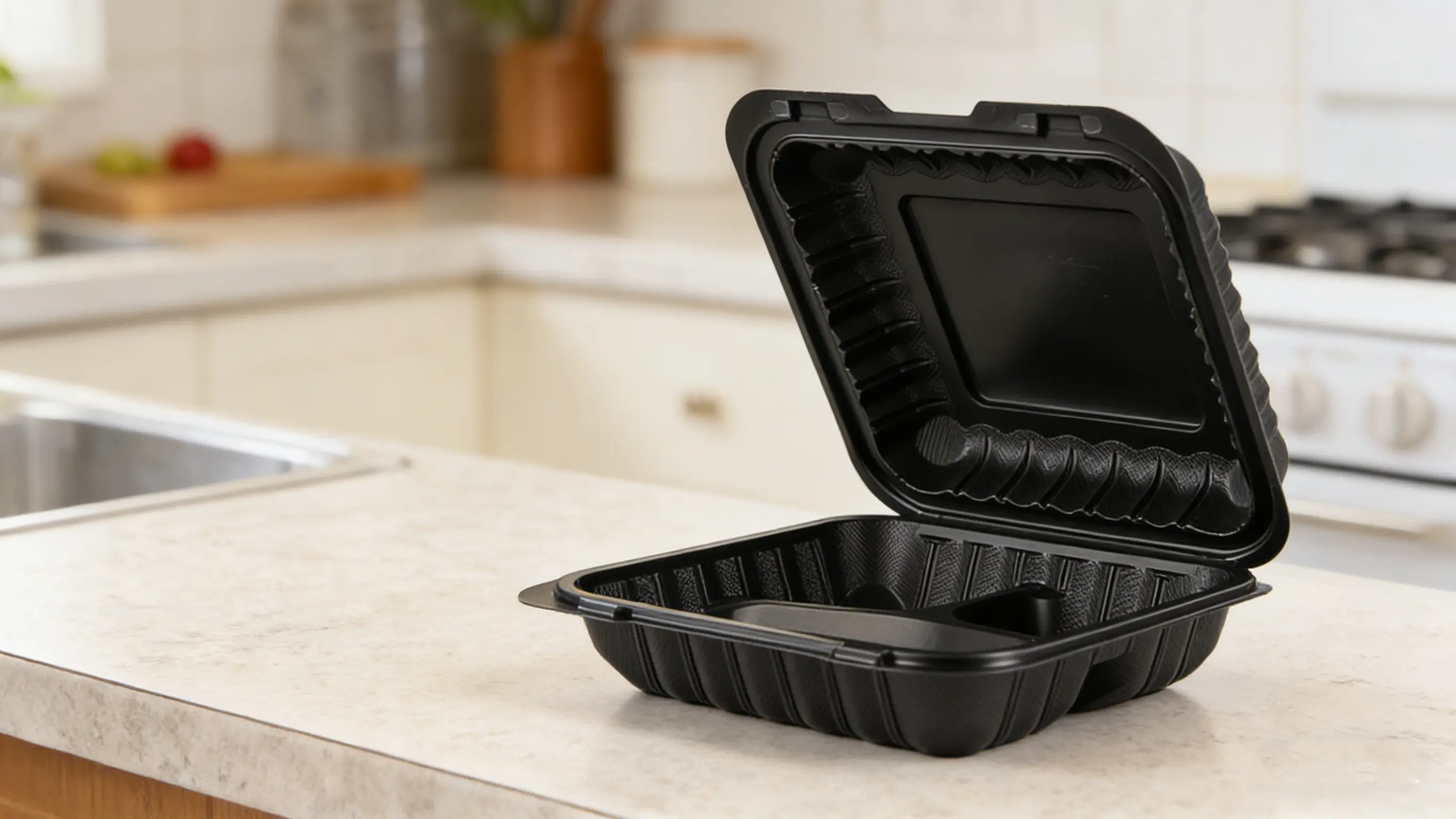
- Black PP Chinese take-out containers: Suitable for rapid heating needs (takeaway fast food, microwaveable foods), utilizing a high absorption rate to shorten heating time; suitable for products with a high-end appearance; note that it is not suitable for long-term heat preservation (fast heat dissipation).
- White PP Chinese take-out containers: Suitable for scenarios requiring visual protection (foods with sensitive ingredients, products requiring light-proof storage), and long-term storage (reflective properties reduce the impact of ambient temperature); suitable for unified brand appearance design (easy to print), and cost-effective.
- Transparent PP Chinese take-out containers: Primarily suitable for displaying contents (fresh produce, pastries, pre-cooked meals), allowing easy observation of food color and integrity; suitable for lightweight requirements (no large amount of fillers), lowest cost, and strong versatility.
5.2.3 General Recommendations
- Temperature Matching: For low-temperature storage, choose white/transparent; for high-temperature heating, choose black (for temperature control and preventing overheating); for room temperature, choose cost-effective transparent/white.
- Heating Method: For infrared heating, choose black; for microwave heating, any color is acceptable (transparent is preferred for easier observation); for traditional baking, choose white.
- Content Characteristics: For easily discolored foods, choose transparent/white; for light-sensitive foods, choose white/black; for heat-sensitive foods, avoid black (for temperature control).
- Compliance: Confirm that the material complies with GB 4806.7-2022 (Plastics for Food Contact), and conduct actual scenario tests before large-scale application (heat conduction, mechanical properties, safety).

VI. Summary
- Basic Thermophysical Properties: Pure PP has a thermal conductivity of 0.11-0.28 W/(m·K) (typical value 0.17-0.25 W/(m·K)), specific heat capacity of 1.8-2.3 J/(g·K) (increases with increasing temperature), density of 0.89-0.91 g/cm³, and thermal diffusivity of 0.17-0.183 mm²/s (26°C), with the thermal diffusivity showing a minimum at 60-80°C. These parameters provide a baseline for analyzing the impact of color.
- Color Impact Mechanism: Color changes heat conduction performance through thermal radiation characteristics—black PP contains carbon black, with a solar spectrum absorption rate of 95-96% and an infrared emissivity of 0.85-0.95, resulting in faster heating and cooling; white PP is colored with titanium dioxide, with a visible light absorption rate of <20% and an infrared emissivity of 0.80-0.93, exhibiting wavelength selectivity; transparent PP has a visible light transmittance of >90%, but strong infrared absorption, and its thermal performance is affected by thickness. Thermal property comparison: Under conventional conditions (20-40°C), the thermal conductivity of the three colors of PP is similar (0.20-0.22 W/(m·K)), as the low concentration of additives (<5 wt%) has limited impact on intrinsic heat conduction. However, in high-temperature (>80°C) or strong radiation scenarios, the color difference becomes significant. For example, black PP heats up significantly faster than white and transparent PP (heating time at the same temperature: 12 seconds vs. 40 seconds).
- Practical application suitability: Black PP is suitable for rapid heating scenarios (takeaway food, microwaveable meals), but has poor heat retention; white PP is suitable for light-shielded storage and long-term preservation, offering good cost-effectiveness; transparent PP is mainly used for displaying contents (fresh produce, pre-packaged meals), offering the lowest cost and allowing easy observation of food condition.
Plastic and Paper Cup Usage Guide
PP Plastic Compostable Take-Out Containers: One-Piece Molding vs. Separate Lid Design
Related Article

You searched for 4 oz Chinese take out boxes — but what you actually need may not be a paper box at all. The folded paper container with the wire handle looks iconic, but for 4 oz portions of sauce, dressing,
4 oz Chinese Take Out Boxes Alternative — Clear PP Portion Cups
Looking for plastic to-go containers with lids in bulk? Every container we ship includes a matching lid — not as an optional add-on,
Plastic To-Go Containers with Lids Wholesale | Bulk PP Food Boxes
SEND MESSAGE