



What Size of Portion Control Cups Works Best for Sauces and Samples?
author: Iris
2025-12-08
I. Analysis of Mainstream Sauce Cup Size Systems
1.1 Capacity Specification Distribution Characteristics
The current market for portion control cups exhibits both diversity and standardization. In terms of capacity range, it is mainly divided into three levels:
Small capacity series (1 ounce - 3 ounces, approximately 30-90 ml) are the most mainstream specifications on the market, including 0.75 ounces (approximately 22 ml), 1 ounce (approximately 30 ml), 1.5 ounces (approximately 45 ml), 2 ounces (approximately 60 ml), 2.5 ounces (approximately 75 ml), and 3 ounces (approximately 90 ml). Portion control cups in this capacity range dominate the market, especially the 1-2 ounce specifications, which are widely used for dipping sauces, condiments, and other applications.
Medium capacity series (3.25 ounces - 5.5 ounces, approximately 95-160 ml) includes 3.25 ounces (approximately 95 ml), 4 ounces (approximately 120 ml), 5 ounces (approximately 150 ml), and 5.5 ounces (approximately 160 ml). This size is mainly used in scenarios requiring larger quantities of sauce, such as main sauces in takeout meals or bulk sample packaging.
Large capacity series (over 100 ml) include 100 ml, 125 ml, 150 ml, 200 ml, 280 ml, 300 ml, and 450 ml specifications. These types of cups are mainly used for home storage, bulk distribution, or special purposes.
From the perspective of the international market, the European and American markets are dominated by the ounce system, with common specifications including 1 ounce, 1.5 ounces, 2 ounces, 2.5 ounces, 3 ounces, 4 ounces, 5 ounces, and 6 ounces. Among these, 1 ounce and 2 ounces are the most common specifications, and the 2-ounce size is considered the most commonly used size for portion control cups.
Medium capacity series (3.25 ounces - 5.5 ounces, approximately 95-160 ml) includes 3.25 ounces (approximately 95 ml), 4 ounces (approximately 120 ml), 5 ounces (approximately 150 ml), and 5.5 ounces (approximately 160 ml). This size is mainly used in scenarios requiring larger quantities of sauce, such as main sauces in takeout meals or bulk sample packaging.
Large capacity series (over 100 ml) include 100 ml, 125 ml, 150 ml, 200 ml, 280 ml, 300 ml, and 450 ml specifications. These types of cups are mainly used for home storage, bulk distribution, or special purposes.
From the perspective of the international market, the European and American markets are dominated by the ounce system, with common specifications including 1 ounce, 1.5 ounces, 2 ounces, 2.5 ounces, 3 ounces, 4 ounces, 5 ounces, and 6 ounces. Among these, 1 ounce and 2 ounces are the most common specifications, and the 2-ounce size is considered the most commonly used size for portion control cups.
1.2 Standardization of Size and Shape
The size of portion control cups is reflected not only in their capacity but also in their geometric shape characteristics. According to market research, portion control cups of different capacities have relatively fixed size ratios:
- The typical dimensions of a 25 ml sauce cup are: top diameter 3.9 cm, bottom diameter 3.3 cm, and height 3 cm. This size is suitable for small portions of condiments such as minced garlic and chopped green onions.
- The typical dimensions of a 50 ml sauce cup are: top diameter 5.5 cm, bottom diameter 3.15 cm, and height 4.5 cm. This is the most classic size, suitable for most sauce needs.
- The typical dimensions of a 75 ml sauce cup are: top diameter 7.3 cm, bottom diameter 3.2 cm, and height 5.4 cm. This size provides more capacity, suitable for situations requiring more dipping sauce.
- The typical dimensions of a 100 ml sauce cup are: top diameter 7.3 cm, bottom diameter 3.9 cm, and height 5.2 cm. This represents a large-capacity size, suitable for thick sauces or large quantities of dipping sauce.
- Standard sizes in the international market also show similar patterns, such as the 1.5-ounce (approximately 45 ml) stainless steel sauce cup with dimensions of: height 1 inch (2.54 cm), top diameter 2.4 inches (6.1 cm), and bottom diameter 1.4 inches (3.56 cm). The dimensions of a 2-ounce sauce cup are: top diameter 2.5 inches (6.35 cm), height 1.65 inches (4.19 cm).
1.3 Market Share and Price Distribution
According to the latest market research data, the Chinese sauce cup market is expected to reach approximately 50 billion RMB in 2025, representing a year-on-year growth of 12%. Domestic brands account for approximately 65% of the market share, while international brands hold the remaining 35%. In terms of brand distribution, Lay's, with its global brand influence and innovative product design, holds approximately 15% of the market share, while Master Kong occupies 20% through its extensive channel coverage and cost control capabilities.
From a pricing perspective, different capacities of portion control cups show a clear economies-of-scale effect. Small capacity portion control cups (1-3 ounces) have a unit price range of $0.005-$0.03 per piece, with lower prices for bulk purchases, such as prices as low as $0.001-$0.003 per piece for orders of 10,000 or more. Medium capacity (3-5 ounces) prices range from $0.01-$0.03 per piece, with bulk prices as low as $0.009 per piece. Large capacity (over 100 ml) prices range from $0.01-$0.06 per piece.
The price distribution in the Chinese domestic market shows that the price for a 25 ml size is approximately 0.07 RMB per piece, the 50 ml size is approximately 0.1 RMB per piece, and the 75-100 ml size is approximately 0.16-0.24 RMB per piece. This price gradient reflects the relationship between raw material costs and production scale, with larger capacity products having relatively lower unit costs.
From a pricing perspective, different capacities of portion control cups show a clear economies-of-scale effect. Small capacity portion control cups (1-3 ounces) have a unit price range of $0.005-$0.03 per piece, with lower prices for bulk purchases, such as prices as low as $0.001-$0.003 per piece for orders of 10,000 or more. Medium capacity (3-5 ounces) prices range from $0.01-$0.03 per piece, with bulk prices as low as $0.009 per piece. Large capacity (over 100 ml) prices range from $0.01-$0.06 per piece.
The price distribution in the Chinese domestic market shows that the price for a 25 ml size is approximately 0.07 RMB per piece, the 50 ml size is approximately 0.1 RMB per piece, and the 75-100 ml size is approximately 0.16-0.24 RMB per piece. This price gradient reflects the relationship between raw material costs and production scale, with larger capacity products having relatively lower unit costs.

II. Capacity Demand Analysis in Conventional Usage Scenarios
2.1 Characteristics of Demand in the Catering Industry
The catering industry is the largest application area for portion control cups, and its demand characteristics show clear scenario differentiation:
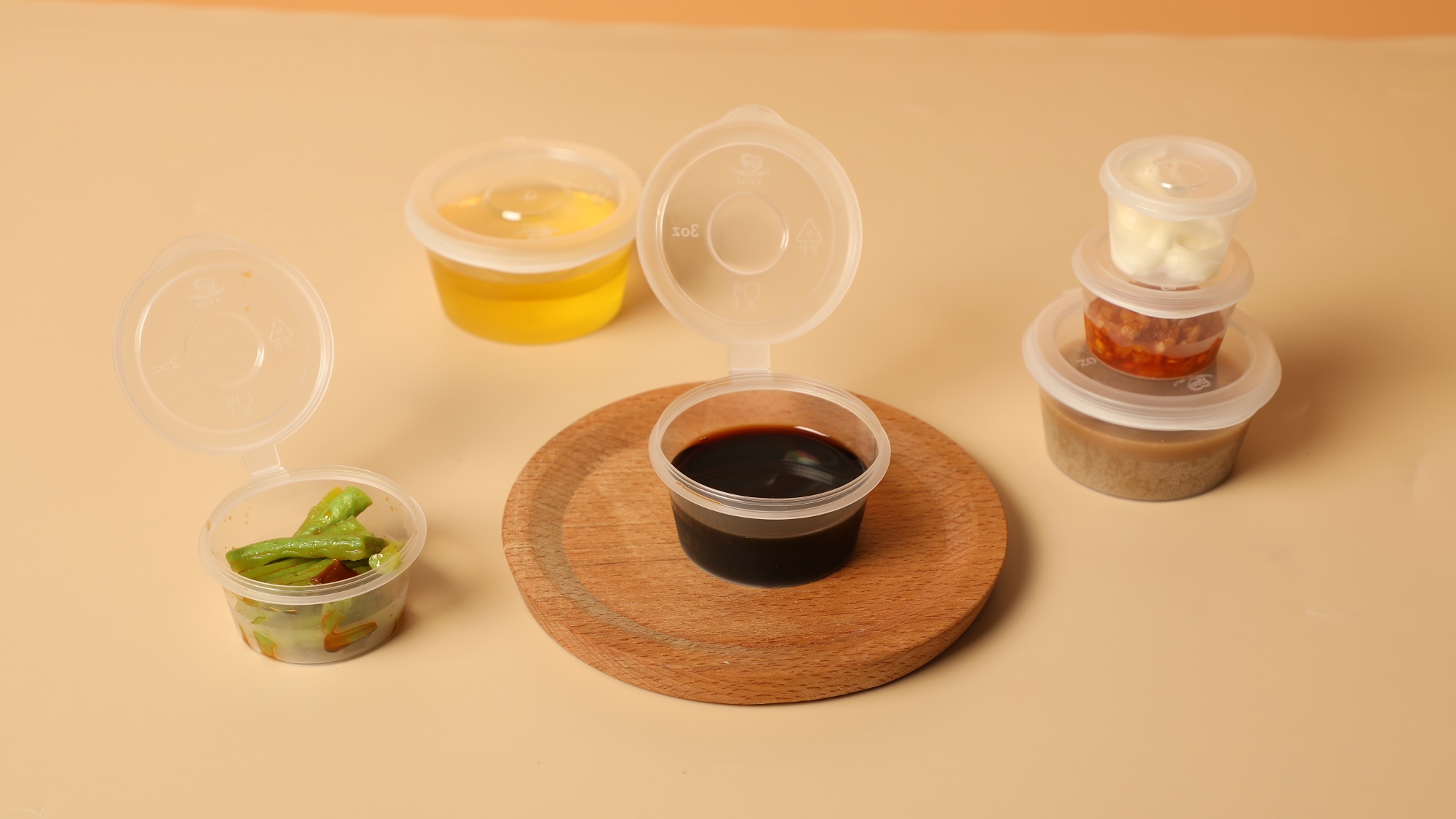
Takeaway food service is one of the most widely used scenarios for portion control cups. Based on actual operational data from a central kitchen in Shanghai, takeaway meals utilize standardized portion sizes for condiments: 25 ml for minced garlic, 50 ml for vinegar sauce, and 100 ml for sesame paste. This modular combination method triples the efficiency of condiment packaging for tens of thousands of takeaway orders daily. For noodle dishes, a 50 ml portion of chili oil is recommended; for dumplings, 25 ml of vinegar sauce; and for hot pot dipping sauces, a 100 ml combination pack is suggested.
The needs for dine-in restaurant settings are relatively more diverse. Restaurants and bistros primarily use these containers for condiments, butter portions, or side dish sauces. The 1-ounce (approximately 30 ml) size is particularly suitable for single servings of ketchup, mustard, or other condiments. The 2-ounce (approximately 60 ml) size is considered the most commonly used sauce cup size, widely used for various dips and sauces. The 3-4 ounce (approximately 90-120 ml) size is suitable for small portions of side dishes such as potato salad.
Hot pot dining scenarios have unique requirements. Hot pot restaurants, skewer stalls, and bento box vendors use these portion control cups as dipping sauce containers, small portion containers, or takeaway sauce containers. According to actual operational data from hot pot restaurants, a single table consumes an average of 8-10 packets of dipping sauce per day. A standard case (24 packs × 50 packets) can meet the daily needs of 25-30 tables. This indicates a high demand for portion control cups in hot pot settings, requiring consideration of bulk supply and cost control.
Fast food and chain restaurant scenarios prefer standardized small-capacity packaging. 1-ounce portion control cups are widely used in restaurants, food trucks, and other food service businesses to provide small portions of condiments, sauces, and seasonings. This size is particularly suitable for takeaway and delivery orders due to its small size and ease of transport.
The needs for dine-in restaurant settings are relatively more diverse. Restaurants and bistros primarily use these containers for condiments, butter portions, or side dish sauces. The 1-ounce (approximately 30 ml) size is particularly suitable for single servings of ketchup, mustard, or other condiments. The 2-ounce (approximately 60 ml) size is considered the most commonly used sauce cup size, widely used for various dips and sauces. The 3-4 ounce (approximately 90-120 ml) size is suitable for small portions of side dishes such as potato salad.
Hot pot dining scenarios have unique requirements. Hot pot restaurants, skewer stalls, and bento box vendors use these portion control cups as dipping sauce containers, small portion containers, or takeaway sauce containers. According to actual operational data from hot pot restaurants, a single table consumes an average of 8-10 packets of dipping sauce per day. A standard case (24 packs × 50 packets) can meet the daily needs of 25-30 tables. This indicates a high demand for portion control cups in hot pot settings, requiring consideration of bulk supply and cost control.
Fast food and chain restaurant scenarios prefer standardized small-capacity packaging. 1-ounce portion control cups are widely used in restaurants, food trucks, and other food service businesses to provide small portions of condiments, sauces, and seasonings. This size is particularly suitable for takeaway and delivery orders due to its small size and ease of transport.
2.2 Sample Packaging Scenario Requirements Analysis
Sample packaging is an important application area for portion control cups, covering multiple industries such as food, cosmetics, and pharmaceuticals:
The demand for food sample packaging is quite broad. 1-ounce portion control cups are mainly used for takeout food packaging and food storage, such as rice, vegetables, soup, condiments, sauces, nuts, and snacks. These cups are also widely used in restaurants, fast-food restaurants, fruit stores, snack shops, and supermarkets. Larger capacity cups (such as 4 ounces) are used for storing jelly, food samples, cosmetics, and medicines.
Cosmetic sample packaging has specific capacity requirements. According to industry standards, the inner packaging bags used for cosmetic samples have a small capacity, ranging from 0.5 ml to 5 ml. Medium-capacity products such as facial lotions and toners usually use 50-120 ml packaging. Sample packaging includes 5 ml perfume bottles and 10 ml cream tubes, as well as 50 ml jars. 20-gram jars are suitable for storing mineral cosmetics, eyeshadows, and lotions, and can also be used to store loose-leaf tea and spice samples.
The comprehensive sample applications show that portion control cups can be used for various food service and sample needs, ideally suited for salad dressings, condiments, sauces, soufflés, toppings, jellies, desserts, dips, salsa, small snacks, tea, crafts, medicines, food tasting, food samples, product samples, etc. This wide applicability makes portion control cups an ideal choice for sample packaging.
Cosmetic sample packaging has specific capacity requirements. According to industry standards, the inner packaging bags used for cosmetic samples have a small capacity, ranging from 0.5 ml to 5 ml. Medium-capacity products such as facial lotions and toners usually use 50-120 ml packaging. Sample packaging includes 5 ml perfume bottles and 10 ml cream tubes, as well as 50 ml jars. 20-gram jars are suitable for storing mineral cosmetics, eyeshadows, and lotions, and can also be used to store loose-leaf tea and spice samples.
The comprehensive sample applications show that portion control cups can be used for various food service and sample needs, ideally suited for salad dressings, condiments, sauces, soufflés, toppings, jellies, desserts, dips, salsa, small snacks, tea, crafts, medicines, food tasting, food samples, product samples, etc. This wide applicability makes portion control cups an ideal choice for sample packaging.
2.3 Household Use Scenario Requirements Characteristics
The demand for portion control cups in household use scenarios shows diverse and personalized characteristics:
For daily condiment storage, home users need containers of different sizes to store various condiments. Based on usage frequency, it is recommended that families who use condiments more than 3 times a week choose the 50-pack size, stored in airtight containers; low-frequency users can choose the 20-pack size to avoid spoilage. This on-demand selection method reflects the flexibility of household use.
Travel and portability needs have driven the development of small-capacity products. The 10-100 ml capacity dispensing bottles meet different needs: 10 ml bottles are suitable for short trips or trying new products, 30-50 ml bottles meet daily use needs, and 100 ml large-capacity bottles are suitable for long trips or frequent use.
Kitchen storage and organization needs have driven the development of reusable products. Home users use silicone condiment squeeze bottles to meet various travel needs, with different sizes making it easy to distinguish the contents. These bottles can meet different travel needs, and their different sizes allow users to easily distinguish the contents inside.
Multifunctional applications show that home users also use condiment cups to store items such as medicines and small crafts. 4-ounce leak-proof black plastic condiment cups can be used to store condiments and sauces such as ketchup, mayonnaise, and favorite sauces. Disposable containers can also be used to store jelly, food samples, cosmetics, and medicines.
Travel and portability needs have driven the development of small-capacity products. The 10-100 ml capacity dispensing bottles meet different needs: 10 ml bottles are suitable for short trips or trying new products, 30-50 ml bottles meet daily use needs, and 100 ml large-capacity bottles are suitable for long trips or frequent use.
Kitchen storage and organization needs have driven the development of reusable products. Home users use silicone condiment squeeze bottles to meet various travel needs, with different sizes making it easy to distinguish the contents. These bottles can meet different travel needs, and their different sizes allow users to easily distinguish the contents inside.
Multifunctional applications show that home users also use condiment cups to store items such as medicines and small crafts. 4-ounce leak-proof black plastic condiment cups can be used to store condiments and sauces such as ketchup, mayonnaise, and favorite sauces. Disposable containers can also be used to store jelly, food samples, cosmetics, and medicines.

III. Matching Size and Usability
3.1 The Impact of Geometric Proportions on User Experience
The height-to-diameter ratio of portion control cups directly affects the user experience, with different ratios suitable for different usage scenarios:
A short and wide design (relatively low height, larger diameter) offers excellent ease of scooping. According to research data from a hot pot ingredient supplier in Chengdu, after adjusting the angle of the cup rim from 15 degrees to 22 degrees, the amount of leftover sauce was reduced by 63%. This improvement significantly increased the efficiency of sauce use and reduced waste. A typical example of a short and wide cup is the 2-ounce sauce cup, with a top diameter of 2.5 inches (6.35 cm) and a height of 1.65 inches (4.19 cm), resulting in a height-to-diameter ratio of approximately 0.67:1.
A tall and narrow design (relatively high height, smaller diameter) offers better sealing and spill-proof performance. This design is suitable for holding highly fluid liquids such as vinegar and soy sauce. A representative example of a tall and narrow cup is the 1-ounce size, with a height of 1 inch (2.54 cm), a top diameter of 2.4 inches (6.1 cm), and a bottom diameter of 1.4 inches (3.56 cm).
The standard proportion design offers the best overall versatility. The 50 ml sauce cup uses a design with a top diameter of 5.5 cm, a bottom diameter of 3.15 cm, and a height of 4.5 cm, resulting in a height-to-maximum diameter ratio of approximately 0.82:1. This ratio achieves a good balance between ease of scooping, spill-proof performance, and visual aesthetics.
A tall and narrow design (relatively high height, smaller diameter) offers better sealing and spill-proof performance. This design is suitable for holding highly fluid liquids such as vinegar and soy sauce. A representative example of a tall and narrow cup is the 1-ounce size, with a height of 1 inch (2.54 cm), a top diameter of 2.4 inches (6.1 cm), and a bottom diameter of 1.4 inches (3.56 cm).
The standard proportion design offers the best overall versatility. The 50 ml sauce cup uses a design with a top diameter of 5.5 cm, a bottom diameter of 3.15 cm, and a height of 4.5 cm, resulting in a height-to-maximum diameter ratio of approximately 0.82:1. This ratio achieves a good balance between ease of scooping, spill-proof performance, and visual aesthetics.
3.2 Stackability and Storage Efficiency Analysis
The stackable design of disposable portion cups is a key factor affecting storage and transportation efficiency:
In terms of stackable structure design, high-quality portion control cups use a special edge design that allows them to be safely stacked with the same or specified products, facilitating transportation and saving storage space. This design not only improves warehousing efficiency but also reduces transportation costs. Stainless steel portion control cups usually have a stacking function; for example, the 2-ounce size is clearly labeled as a "stackable" product. Material and structural optimization have improved stacking performance. The PP material portion control cups feature safety, environmental friendliness, durability, crack resistance, compression resistance, stackability, washability, reusability, and good sealing properties. These material characteristics prevent deformation during stacking, ensuring stability and safety.
Stacking efficiency data shows that different sizes of cups have different stacking densities. According to actual test data, a box can hold 2000 lidded cups of the 25 ml size, while a box can hold 1000 cups of the 50 ml size. This difference in stacking density reflects the impact of size on storage efficiency.
Stacking efficiency data shows that different sizes of cups have different stacking densities. According to actual test data, a box can hold 2000 lidded cups of the 25 ml size, while a box can hold 1000 cups of the 50 ml size. This difference in stacking density reflects the impact of size on storage efficiency.
3.3 Handheld Comfort and Pouring Convenience
The ergonomic design of the sauce cup directly affects the user experience:
The handheld size design needs to consider the differences in hand sizes among different user groups. The 50 ml stainless steel sauce cup has an opening diameter of 6.5 cm (2.56 inches) and a height of 2.5 cm (0.98 inches), making it easy to operate and store with one hand. This compact size is particularly suitable for the hand characteristics of Asian users.
Optimized pouring angles are especially important for liquid sauces. Some portion control cups use a slanted rim or anti-spill edge design to reduce the possibility of spills. This design not only improves convenience but also reduces cleaning work.
Anti-slip and stability are important components of handheld comfort. High-quality portion control cups usually have anti-slip textures or a frosted surface on the cup body to ensure a secure grip even in wet environments. The base design is also optimized to provide stable support.
Optimized pouring angles are especially important for liquid sauces. Some portion control cups use a slanted rim or anti-spill edge design to reduce the possibility of spills. This design not only improves convenience but also reduces cleaning work.
Anti-slip and stability are important components of handheld comfort. High-quality portion control cups usually have anti-slip textures or a frosted surface on the cup body to ensure a secure grip even in wet environments. The base design is also optimized to provide stable support.

IV. Comprehensive Cost-Benefit Assessment
4.1 Unit Cost and Bulk Purchase Analysis
Small-capacity products have the lowest cost, with a unit price range of $0.005-0.03 per piece for 1-3 ounce sizes, and even lower prices for bulk purchases. When the purchase quantity reaches 10,000 units, the price can be reduced to $0.001-0.003 per piece. This extremely low unit price makes small-capacity products particularly suitable for large-scale applications.
Medium-capacity products have a relatively flat price gradient, with 3-5 ounce sizes ranging from $0.01 to $0.03 per unit, and bulk prices as low as $0.009 per unit. Bulk prices for 5-ounce products are $0.026-$0.03 per unit (minimum order of 50,000 units).
Large-capacity products have relatively higher unit costs, with sizes above 100 ml ranging from $0.01 to $0.06 per unit. Domestic market prices show that 25 ml sizes are approximately 0.07 RMB per unit, 50 ml sizes are approximately 0.1 RMB per unit, and 75-100 ml sizes are approximately 0.16-0.24 RMB per unit.
4.2 Transportation and Storage Cost-Effectiveness
Medium-capacity products have a relatively flat price gradient, with 3-5 ounce sizes ranging from $0.01 to $0.03 per unit, and bulk prices as low as $0.009 per unit. Bulk prices for 5-ounce products are $0.026-$0.03 per unit (minimum order of 50,000 units).
Large-capacity products have relatively higher unit costs, with sizes above 100 ml ranging from $0.01 to $0.06 per unit. Domestic market prices show that 25 ml sizes are approximately 0.07 RMB per unit, 50 ml sizes are approximately 0.1 RMB per unit, and 75-100 ml sizes are approximately 0.16-0.24 RMB per unit.
4.2 Transportation and Storage Cost-Effectiveness
The cost differences in the logistics of different sizes of plastic portion cups are significant:
Transportation cost analysis shows that small-capacity products have an advantage in terms of unit transportation costs. Due to their small size and light weight, more products can be loaded into the same transportation space. For example, a box can hold 2000 lidded 25 ml cups, while a box can only hold 1000 50 ml cups. This difference in loading density directly affects the unit transportation cost.
Storage efficiency comparisons show that reasonable size selection can significantly reduce warehousing costs. According to actual test data, 100 1-ounce square disposable chili cups cost $1.60-$2.40, while 50 sealed leak-proof disposable portion control cups cost $2.86. This price difference reflects the impact of different packaging specifications on costs.
Long-term storage costs need to consider product shelf life and inventory turnover rate. Small-capacity products, due to their low unit price and high usage frequency, usually have a faster inventory turnover rate, reducing capital occupation costs. While large-capacity products have lower unit costs, they may face shelf-life risks and inventory accumulation problems. 4.3 Comprehensive Cost-Effectiveness Assessment
Storage efficiency comparisons show that reasonable size selection can significantly reduce warehousing costs. According to actual test data, 100 1-ounce square disposable chili cups cost $1.60-$2.40, while 50 sealed leak-proof disposable portion control cups cost $2.86. This price difference reflects the impact of different packaging specifications on costs.
Long-term storage costs need to consider product shelf life and inventory turnover rate. Small-capacity products, due to their low unit price and high usage frequency, usually have a faster inventory turnover rate, reducing capital occupation costs. While large-capacity products have lower unit costs, they may face shelf-life risks and inventory accumulation problems. 4.3 Comprehensive Cost-Effectiveness Assessment
Based on a comprehensive analysis of cost and functionality, different sizes of portion control cups exhibit varying cost-effectiveness characteristics:
High cost-effectiveness sizes are mainly concentrated in the 25-100 ml range. Products in this range achieve a good balance in terms of unit price, ease of use, and application scope. The 50 ml size, in particular, has a moderate price (approximately 0.1 RMB/piece) and a wide range of applications, making it the preferred choice for most users.
Economical options are recommended in the 25-35 ml range. These products have extremely low unit prices (0.035-0.07 RMB/piece), making them particularly suitable for scenarios with high volume and price sensitivity, such as takeaway food packaging and sample distribution. Although the single-use quantity is limited, the low cost is a significant advantage.
Practical options are suggested in the 75-100 ml range. These products have slightly higher unit prices (0.16-0.24 RMB/piece), but offer larger capacity, suitable for situations requiring more sauce. The 100 ml size, in particular, can meet almost all conventional usage needs and is the most versatile option.
Economical options are recommended in the 25-35 ml range. These products have extremely low unit prices (0.035-0.07 RMB/piece), making them particularly suitable for scenarios with high volume and price sensitivity, such as takeaway food packaging and sample distribution. Although the single-use quantity is limited, the low cost is a significant advantage.
Practical options are suggested in the 75-100 ml range. These products have slightly higher unit prices (0.16-0.24 RMB/piece), but offer larger capacity, suitable for situations requiring more sauce. The 100 ml size, in particular, can meet almost all conventional usage needs and is the most versatile option.

V. Comprehensive Recommendation
5.1 Optimal Size Recommendation
Based on a comprehensive analysis of market data, usage scenarios, convenience features, and cost-effectiveness, the 50 ml (approximately 1.7 ounces) sauce cup is the most suitable choice for holding sauces and samples in most situations. This conclusion is based on the following core advantages:
- Widest range of applications: The 50 ml size can meet over 70% of conventional usage scenarios, including restaurant dipping sauces, takeaway food packaging, sample distribution, and home condiments. According to actual application data, the 50 ml capacity is just right for single servings of vinegar, chili oil, and other condiments, and can also meet the needs of cosmetic samples, food samples, etc.
- Optimal balance of cost-effectiveness: The unit price of the 50 ml size is approximately 0.1 RMB, and the price can be further reduced with larger quantity purchases (starting from 1000 pieces). This price level ensures controllable costs without compromising the user experience due to insufficient capacity. Compared to the 25ml size, the 50ml size offers double the capacity, but the price only increases by approximately 40%, offering a significant cost-effectiveness advantage.
- Optimal ease of use: The 50ml size features a well-designed geometric proportion, with a top diameter of 5.5 cm and a height of 4.5 cm, achieving the best balance between ease of scooping and spill prevention. The cup size is suitable for one-handed operation, making it easy to carry and store.
- Most abundant market supply: The 50ml size is the most widely available size on the market, with the largest selection of brands. Both domestic and international brands consider this size a flagship product, ensuring stable supply and quality assurance.
5.2 Size Combination Suggestions
To meet more diverse usage needs, a "1+1+1" size combination plan is recommended:
Main size: 50ml (1.7 oz) is the core size for daily use, accounting for 60-70% of total purchases. This size is suitable for:
- Regular condiments in restaurants and takeaways (vinegar, soy sauce, chili oil, etc.)
- Packaging of cosmetic and food samples
- Household daily condiment storage
- Dipping sauces for small gatherings
Auxiliary size one: 25ml (0.8 oz), accounting for 20-25% of total purchases, mainly used for:
- Packaging of fine condiments (garlic paste, chopped green onions, ginger paste, etc.)
- Small-dose samples (such as perfume, serums, etc.)
- Condiment packets for children's meals or small portions
- Trial product packaging
Auxiliary size two: 100ml (3.4 oz), accounting for 10-15% of total purchases, mainly used for:
- Large quantities of sauces (such as hot pot dipping sauces, salad dressings, etc.)
- Bulk household storage
- Centralized supply for special occasions
- Holding thick sauces
The advantage of this combination plan is that it covers more than 95% of usage scenarios while avoiding excessive inventory and capital tie-up. Through reasonable proportioning, it is possible to meet diverse needs while maintaining cost control.
5.3 Selection Decision Guide
When making your selection, it is recommended to consider the following factors:
- Usage Frequency-Oriented: If the usage frequency is high (e.g., restaurants, takeout), it is recommended to primarily use the 50 ml size, supplemented with 25 ml and 100 ml sizes. This combination can meet daily high-frequency needs while also handling special situations.
- Cost-Sensitive Oriented: If cost is a major concern (e.g., large-scale sample distribution), it is recommended to primarily use the 25 ml size, supplemented with a small number of 50 ml sizes. Although this requires more packaging, the overall cost is minimized.
- Functional Needs-Oriented: If you need to hold thick sauces or large amounts of liquid, it is recommended to primarily use the 100 ml size. These products usually have a larger opening and a deeper cup body, suitable for specific functional needs.
- Brand and Quality: When choosing a brand, it is recommended to prioritize well-known domestic brands, which account for 65% of the market share and offer good quality assurance and supply stability. You can also consider brands with innovative designs, such as products with improved cup rim angles and sealing capabilities.
VI. Final Results and Recommendations
Through comprehensive research and analysis of the plastic portion cups market, we conclude the following:
The 50 ml size is the most suitable choice in most cases, achieving the best balance in terms of application scope, cost-effectiveness, and ease of use. This size can meet the needs of various scenarios, such as restaurants, samples, and households, and also has good market supply assurance.
A size combination strategy can improve overall efficiency; it is recommended to adopt a combination of "50 ml as the main size, supplemented by 25 ml and 100 ml." This configuration can cover the widest range of needs with the fewest SKUs, maximizing efficiency.
A size combination strategy can improve overall efficiency; it is recommended to adopt a combination of "50 ml as the main size, supplemented by 25 ml and 100 ml." This configuration can cover the widest range of needs with the fewest SKUs, maximizing efficiency.
In practical applications, the following points should also be noted:
- Quality Control: Choose products made of food-grade PP material to ensure safety. Pay attention to checking key indicators such as sealing, transparency, and durability.
- Storage Management: Plan inventory rationally to avoid overstocking. Small-capacity products can be stocked in larger quantities, while large-capacity products should be purchased as needed. Pay attention to product shelf life to ensure freshness.
- Usage Optimization: Choose the appropriate size for different scenarios to avoid waste. For reusable products, establish cleaning and disinfection procedures to extend their lifespan. Supplier Selection: Prioritize suppliers with stable production capacity and excellent service. Consider establishing long-term partnerships to ensure supply stability and favorable pricing.
Through scientific selection and rational use, portion control cups can not only meet daily usage needs but also become an important tool for improving service quality and reducing costs.
Which Is Better for Disposable Plastic Juice Cups: PET or PP?
PET Vs. PP Sealing Disposable Plastic Bowls
Related Article

You searched for 4 oz Chinese take out boxes — but what you actually need may not be a paper box at all. The folded paper container with the wire handle looks iconic, but for 4 oz portions of sauce, dressing,
4 oz Chinese Take Out Boxes Alternative — Clear PP Portion Cups
Looking for plastic to-go containers with lids in bulk? Every container we ship includes a matching lid — not as an optional add-on,
Plastic To-Go Containers with Lids Wholesale | Bulk PP Food Boxes
SEND MESSAGE