



Which Plastic Take out Salad Containers Are Best for Packaging Salads?
author: Iris
2025-11-25
I. Analysis of Mainstream Take-Out Salad Container Material Properties
1.1 Traditional Plastic Materials
Among traditional plastic salad take-out containers, PET (polyethylene terephthalate), PP (polypropylene), and PS (polystyrene) are the three most common choices.
PET material has extremely high transparency and hardness, and strong impact resistance, making it very suitable for salad packaging where the contents need to be displayed. Its good chemical stability and good barrier properties against oxygen and moisture help extend the shelf life of salads. However, PET has poor heat resistance, only able to withstand temperatures of 60-70℃, and is prone to deformation at high temperatures. This characteristic makes it perfectly suitable for your needs, as salads do not contain hot food. Under refrigeration, PET performs excellently, having been tested to maintain structural stability without deformation or cracking for 72 hours at -20℃.
PP (polypropylene) is currently recognized as a relatively safe food-grade plastic and is widely considered the most mainstream and safest choice for takeout containers. Its melting point is as high as 167℃, and its typical operating temperature range is -6℃ to 120℃. Modified PP can even withstand extreme environments from -18℃ to 110℃. PP's chemical inertness ensures that its total migration is far below national standard limits, and it is completely stable within the 20-80℃ range with no substance migration. For salad packaging, PP material has strong chemical resistance, resisting the erosion of acids, alkalis, and oils. When containing corrosive foods such as soy sauce, vinegar, and cooking oil, it will not age or degrade, and no harmful substances will migrate into the food.
PS (polystyrene) material has good transparency, a hard and brittle texture, and relatively low cost. However, its heat resistance is poor; its continuous operating temperature can only be maintained at 60-70℃. Above this temperature, it will soften, deform, and even produce an odor. PS (polystyrene) exhibits excellent low-temperature performance, making it an ideal packaging material for refrigerated foods such as ice cream. However, its high hardness, coupled with its tendency to tear, requires special attention in salad packaging applications.
1.2 Bio-based Biodegradable Materials
Bio-based biodegradable materials are becoming the mainstream choice for environmentally friendly take-out salad containers, primarily including PLA (polylactic acid), PBAT (polybutylene adipate/terephthalate), and starch-based materials.
PLA is a biodegradable plastic polymerized from lactic acid extracted from corn starch or fermented sugarcane. It possesses good toughness and plasticity. In its pure state, PLA has poor heat resistance, with a softening temperature of approximately 55℃, requiring use below 50-60℃. However, through blending and modification with PBAT, its elongation at break can be increased from 5% to over 100%, and its temperature resistance is also significantly improved. PLA's greatest advantage lies in its biodegradability; in an industrial composting environment (58±2℃), it can achieve a biodegradation rate of over 90% within 180 days. However, PLA requires specific conditions to degrade. Its degradation rate is slow in ordinary environments or home composting, and can take four months or even longer in natural environments.
PBAT is a biodegradable polymer, often used in conjunction with PLA to improve its flexibility, strength, and durability. PBAT has good tensile strength, toughness, ductility, and heat resistance, and can be used alone to make garbage bags and shopping bags. Its degradation rate can reach 96.8% within 120 days in industrial composting environments, a faster rate than PLA. However, PBAT requires specific industrial composting conditions to degrade effectively; it degrades slowly in ordinary environments.
Starch-based materials are made from natural corn starch and plant fibers as a base, supplemented with biopolyesters, polyols, and other substances. These materials have good high and low temperature resistance (-18℃ to 120℃), and can be frozen, refrigerated, and preserved in refrigerators, and can be heated in microwave ovens without producing harmful substances. Starch-based materials can be decomposed by microorganisms in natural environments, typically degrading completely within 180-450 days. Under industrial composting conditions, the mass loss rate is typically between 50% and 80%.
1.3 Natural Materials
Natural materials include two main types: paper and bamboo fiber, both possessing unique environmental advantages.
Paper lunch boxes are primarily made from sugarcane pulp, bamboo pulp, or kraft paper. Sugarcane pulp lunch boxes offer excellent moisture resistance, maintaining dryness for extended periods and preventing softening and cracking due to moisture. Regarding oil resistance, sugarcane pulp lunch boxes exhibit good resistance to grease, preventing leakage even when holding highly oily foods. They can withstand boiling water at 100°C and hot oil at 120°C without leakage. Kraft paper lunch boxes are sturdy, oil- and water-resistant, suitable for storing both hot and cold foods. However, it's important to note that without a plastic film coating, kraft paper has relatively poor moisture resistance and hardness; while adding a film improves moisture resistance and hardness, it significantly reduces biodegradability.
Bamboo fiber lunch boxes are characterized by their high strength and short cultivation cycle. Bamboo's tensile strength is twice that of wood, and its compressive strength is also slightly higher. Bamboo fiber has a high content of pentoses and lignin, making it easy to form environmentally friendly bamboo fiber composite materials with high stiffness, strong impermeability, and good durability through high-temperature molding. Bamboo grows quickly, reaching maturity in 3-5 years, and once cultivated, it can be used sustainably, ensuring a sustainable source of raw materials. Bamboo fiber lunch boxes are microwaveable, refrigerated, non-toxic, odorless, and completely degrade in soil within 2 months.
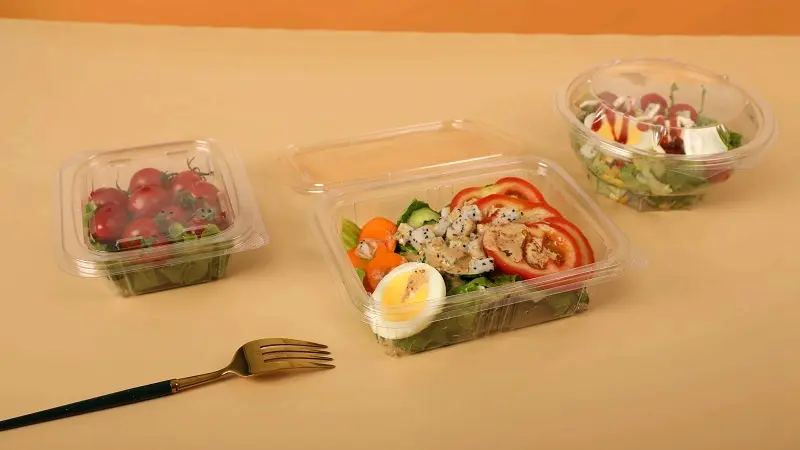
II. Functional Performance Evaluation
2.1 Sealing Design Analysis
Sealing is a core functional requirement for salad packaging lunch boxes, especially considering that salads may contain various sauces, including vinaigrette, mayonnaise, and other liquid components. Currently, lunch boxes on the market mainly use four sealing designs: snap-on, flip-top, screw-on, and sealing strip designs.
Snap-on sealing design is one of the most popular sealing methods currently available. According to actual test data, the snap-on sealing design offers approximately 20% better leak-proof performance than the screw-on design. This design achieves a seal by tightly fitting the lid's edge against the box's edge, and the friction between the lid and box prevents food from spilling. High-quality snap-on containers will not leak even when tilted at a 45-degree angle after being filled with soup, and are unaffected by commuting bumps. Xintianli's "Leak-Proof King" uses a powerful clamping technology for a tight seal, structurally solving the problem of soup leakage caused by vibration and tilting during takeout transportation.
The flip-top design uses the edge of the lid to snap into a groove in the box, providing a certain degree of sealing. This type of container is often used for foods with soup, such as rice bowls, and helps retain the soup inside during delivery and consumption. The advantage of the flip-top design is its ease of use, but its sealing effect is slightly inferior to the snap-on design.
The screw-on design, similar to a bottle cap, achieves a true seal by rotating and tightening, greatly improving impact resistance and leak-proof capabilities. Screw-top designs offer the best sealing, but are relatively complex to operate, requiring some skill and force to open.
Sealing strip designs involve installing a food-grade rubber or silicone sealing ring along the edge of the lid. When the lid is closed, the ring is compressed, filling the tiny gaps between the lid and the container, creating a tight seal. This type of take-out salad container can hold liquids such as soup and beverages, effectively preventing leakage even when the container is inverted or shaken. Silicone sealing strips offer good flexibility and temperature resistance, maintaining a tight seal under varying temperature conditions.
2.2 Cold/Heat Resistance Performance
Depending on your needs, since there's no hot food in the salad, the heat resistance requirements for the salad take-out containers are relatively low, but cold resistance and temperature stability remain important.
In terms of cold resistance, different materials show significant differences. PP material exhibits the best low-temperature performance, usable at -30℃ and maintaining structural stability below 0℃. PET material also performs well, tested to maintain structural stability without deformation or cracking for 72 hours at -20℃. PS materials exhibit excellent low-temperature performance, making them particularly suitable for packaging refrigerated foods.
Bio-based materials show varying degrees of cold resistance. PLA materials exhibit high low-temperature brittleness in their pure state, but by blending with PBAT, their toughness and impact resistance at low temperatures can be significantly improved. PBAT materials themselves possess good flexibility and maintain good performance even at low temperatures. Starch-based materials exhibit good low-temperature resistance and can be used normally at -18°C.
Paper and bamboo fiber materials perform well in refrigerated environments. Kraft paper take-out salad containers are suitable for refrigerated foods, and their structural stability is not affected by low temperatures. Bamboo fiber take-out salad containers are refrigerated, non-toxic, and odorless.
2.3 Tolerance to Salad Dressings
Common salad dressings include vinaigrette, mayonnaise, sesame paste, and Thousand Island dressing. These dressings may contain acidic components (such as vinegar and lemon juice) or oily components (such as olive oil and mayonnaise), placing special demands on the tolerance of take-out salad container materials.
PP materials perform best in this regard. Its chemical inertness ensures that its total migration is far below the national standard limit, and it is completely stable within the 20-80℃ range with no substance migration. PP material has strong chemical resistance, resisting the corrosive effects of acids, alkalis, and oils. When containing corrosive foods such as soy sauce, vinegar, and cooking oil, it will not age or degrade, nor will harmful substances migrate into the food.
PET material has a low migration rate and is relatively safe for packaging alcoholic beverages. It has good resistance to most sauce components (such as oils, acids, and salts).
However, it is important to note that all plastic materials may experience substance migration when in contact with high-fat and high-acid foods. Oily sauces such as salad dressings and vinaigrettes will experience "flavor migration" in plastic containers. The plasticizers in the plastic will gradually dissolve into the oil while simultaneously absorbing volatile flavor compounds such as vanilla extract and garlic from the sauce. The plastic material will absorb 3-5% of the oil from the sauce, leading to flavor loss. Acidic liquids such as vinegar and lemon juice can corrode the surface of plastic, causing substances like bisphenol A to leach out.
In contrast, natural materials such as paper and bamboo fiber have an advantage in this regard; they do not chemically react with food, nor do they cause the migration of harmful substances. Sugarcane pulp take-out salad containers have excellent oil resistance, preventing oil leakage even when holding oily foods. Bamboo fiber take-out salad containers are non-toxic and odorless, and will not affect the flavor of food.

III. Environmental Attribute Assessment
Environmental certification is a crucial basis for assessing the environmental performance of lunchboxes. Currently, the main international certifications are BPI and OK Compost.
BPI (Biodegradable Products Institute) certification is the only composting certification mark recommended by the US Environmental Protection Agency (EPA) in North America, based on ASTM D6400 or ASTM D6868 standards. BPI certification requires that over 90% of the material be converted into carbon dioxide, water, and minerals within 180 days. Ecotoxicity testing requires that degradation products not inhibit plant growth or soil microorganisms. The certification also includes fluoride (PFAS) limits, requiring no intentional addition of fluorides and a total organic fluoride content of less than 100 ppm.
OK Compost certification, issued by the Belgian certification body TÜV Austria, requires that the product achieve a biodegradability rate of over 90% within 180 days in an industrial composting environment at 58±2℃, and that heavy metal content comply with the limits of EN 13432. The EU OK Compost certification particularly emphasizes the complete mineralization capability of materials in specific facilities. China's relevant standards are also constantly being improved. The Chinese standard for paper tableware, GB/T 27591-2025, will be implemented on December 1st, adding requirements for the biodegradability of paper tableware that is explicitly labeled as biodegradable, and for the compostability of paper tableware that is explicitly labeled as compostable. Shanghai has introduced internationally advanced evaluation standards, adopting CEPI's "Laboratory Test Methods for Recyclability of Paper and Paperboard" and 4evergreen's "Protocol on Recyclability Assessment of Fiber-Based Packaging" as technical bases.

IV. Comprehensive Comparative Analysis
Based on the above analysis, I will conduct a comprehensive comparison of the performance of various take-out salad container materials in salad packaging scenarios:
| Material Type | Sealing Performance | Cold Resistance | Sauce Resistance | Biodegradability | Recyclability | Cost | Overall Rating |
| PP | ★★★★☆ | ★★★★★ | ★★★★★ | ★☆☆☆☆ | ★★★☆☆ | Low | ★★★☆☆ |
| PET | ★★★☆☆ | ★★★★★ | ★★★☆☆ | ★☆☆☆☆ | ★★★★☆ | Medium | ★★★☆☆ |
| PS | ★★★☆☆ | ★★★★☆ | ★★☆☆☆ | ★★☆☆☆ | ★★☆☆☆ | Low | ★★☆☆☆ |
| PLA | ★★★☆☆ | ★★★☆☆ | ★★★☆☆ | ★★★★☆ | ★★☆☆☆ | High | ★★★☆☆ |
| PBAT | ★★★☆☆ | ★★★☆☆ | ★★★☆☆ | ★★★★☆ | ★★☆☆☆ | High | ★★★☆☆ |
| Starch-based | ★★★☆☆ | ★★★★☆ | ★★★☆☆ | ★★★★☆ | ★★★☆☆ | Medium | ★★★☆☆ |
| Paper-based | ★★★☆☆ | ★★★☆☆ | ★★★★☆ | ★★★☆☆ | ★★★☆☆ | Medium | ★★★☆☆ |
| Bamboo fiber | ★★★☆☆ | ★★★☆☆ | ★★★★☆ | ★★★★★ | ★★☆☆☆ | High | ★★★★☆ |
Rating Explanation:
- ★★★★★: Excellent, fully meets requirements
- ★★★★☆: Good, basically meets requirements
- ★★★☆☆: Average, partially meets requirements
- ★★☆☆☆: Poor, needs improvement
- ★☆☆☆☆: Very poor, not recommended

V. Recommended Solution
Based on your needs, for those prioritizing environmental protection, considering biodegradable or recyclable materials, and with no specific budget constraints, I recommend the following options:
5.1 First Choice: Bamboo Fiber Lunch Containers
Bamboo fiber take-out salad dressing containers excel in environmental friendliness, making them your best choice.
Reasons for Recommendation:
- Superior Biodegradability: Bamboo fiber lunch containers completely degrade in soil within 2 months, the fastest degradation rate of any material. This natural, rapid degradation characteristic makes them a truly environmentally friendly option.
- Superior Material Properties: Bamboo fiber boasts high toughness and twice the tensile strength of wood. The containers are microwaveable, refrigerated, non-toxic, and odorless, perfectly meeting the functional requirements for salad packaging.
- Sustainable Raw Materials: Bamboo grows rapidly, maturing in 3-5 years. Once cultivated, it can be used sustainably, ensuring a sustainable source of raw materials.
- Sauce-Friendly: Bamboo fiber does not chemically react with food, preventing the migration of harmful substances, making it particularly suitable for salads containing various sauces.
- Precautions: Bamboo fiber lunch boxes have slightly inferior sealing performance compared to traditional plastic ones; it is recommended to choose products with a sealing strip.
The price is relatively high; a single 1000ml capacity lunch box with a lid costs approximately 0.82 yuan.
It is necessary to choose products from reputable manufacturers to avoid odors during use.
5.2 Cost-Effective Choice: Starch-Based Lunch Boxes
If you want to strike a balance between environmental friendliness and cost, starch-based lunch boxes are an ideal choice.
Reasons for Recommendation:
- Good Environmental Performance: Starch-based materials can be decomposed by microorganisms in the natural environment, typically completely degrading within 180-450 days. Under industrial composting conditions, the performance loss rate can reach 50%-80%.
- Excellent Temperature Adaptability: Starch-based lunch boxes have good high and low temperature resistance (-18℃ to 120℃), and can be frozen, refrigerated, and kept fresh in the refrigerator, and can also be heated in a microwave oven (although you don't need the heating function).
- Cost Advantage: A single 1000ml capacity starch-based lunchbox with a lid costs approximately 0.71 yuan, about 13% cheaper than bamboo fiber lunchboxes.
- High Safety: Made from natural cornstarch, it is non-toxic and harmless, and will not contaminate food.
- Precautions: Relatively poor oil resistance; prolonged contact with high-oil foods may cause oil seepage. Moisture resistance is not as good as sugarcane pulp material; it may soften in high-humidity environments.
When choosing, check for BPI or OK Compost certification.
5.3 Upgrading from Traditional Materials: PP Lunchboxes
If you still need traditional plastic lunchboxes, you can choose high-end products made of PP material.
Reasons for Recommendation:
- Superior Overall Performance: PP material performs excellently in terms of chemical resistance, temperature adaptability, and sealing performance, making it the safest food-grade plastic currently available.
- Good Recyclability: The recycling rate of PP lunchboxes reached 29.6% in 2023, close to the national average recycling rate for waste plastics, indicating a relatively complete recycling system.
- Moderate Cost: PP lunchboxes are relatively inexpensive, suitable for large-scale use. Wide Brand Selection: Numerous well-known brands such as Lock & Lock, Chahua, and ASVEL are available on the market.
Important Notes:
- PP lunch boxes are non-biodegradable and less environmentally friendly than bio-based materials.
- When choosing, check if it is made of food-grade PP material and avoid using recycled materials.
- Pay attention to the correct recycling method: wash and dispose of in the recycling bin.
5.4 Innovative Solution: Reusable Lunch Boxes
Considering your emphasis on environmental protection, I would also like to recommend an innovative solution—high-quality reusable lunch boxes.
Recommended Products:
Glass take-out salad containers: Such as Glasslock and Lock & Lock's glass food storage containers, offering the following advantages:
- Completely non-toxic, will not chemically react with food
- Resistant to temperatures from 400℃ to -20℃
- Good sealing, suitable for refrigeration and microwave heating
- Reusable, significantly reducing single-use waste
- Stainless Steel take-out salad containers: Such as Taifugao and Thermos's stainless steel lunch boxes, offering the following advantages:
- Safe material, will not produce harmful substances
- Highly durable, can be used for a long time
- Good sealing, suitable for carrying liquid foods
- High recyclability
Reasons for Recommendation:
- Fundamentally solves the environmental problem of disposable take-out salad containers
- Lower long-term usage costs, although the initial investment is higher
- High quality enhances the dining experience
- In line with the circular economy concept, the most environmentally friendly choice
Are Sugarcane Pulp Eco Friendly Take Out Containers Safe for Microwave Use?
Will Plastic Personalized Take out Containers Affect the Taste of Takeout?
Related Article

You searched for 4 oz Chinese take out boxes — but what you actually need may not be a paper box at all. The folded paper container with the wire handle looks iconic, but for 4 oz portions of sauce, dressing,
4 oz Chinese Take Out Boxes Alternative — Clear PP Portion Cups
Looking for plastic to-go containers with lids in bulk? Every container we ship includes a matching lid — not as an optional add-on,
Plastic To-Go Containers with Lids Wholesale | Bulk PP Food Boxes
SEND MESSAGE