



Do Portion Cups with Lids Need to Be Food Grade?
author: Iris
2025-12-16
1. Regulatory Requirements and Standards System
1.1 Special Regulations for Single-Use Food Contact Materials
Although there is no specific definition for "Portion cup" in current regulations, these small, disposable containers used for sauces fall under the category of plastic materials and products for food contact. According to the "General Technical Requirements for Plastic Products for Food Contact" implemented by the State Administration for Market Regulation in 2021, disposable tableware must be certified according to the GB 4806.7 food safety standard, and 23 technical parameters, including microbial indicators, total migration, and specific substance residues, must be tested by a third-party institution.
It is worth noting that GB 4806.10-2025 "National Food Safety Standard for Coatings and Coatings for Food Contact Materials and Products," published on September 25, 2025, added the definition of "disposable food contact coated products," explicitly including disposable paper cups, paper bowls, milk tea sealing gaskets, and other coated products within the scope of regulation, which will be implemented from September 2, 2026. Although portion cups with lids usually do not involve coatings, this change reflects the increasing importance that regulatory authorities place on disposable food contact materials.
It is worth noting that GB 4806.10-2025 "National Food Safety Standard for Coatings and Coatings for Food Contact Materials and Products," published on September 25, 2025, added the definition of "disposable food contact coated products," explicitly including disposable paper cups, paper bowls, milk tea sealing gaskets, and other coated products within the scope of regulation, which will be implemented from September 2, 2026. Although portion cups with lids usually do not involve coatings, this change reflects the increasing importance that regulatory authorities place on disposable food contact materials.
1.2 International Standards Comparison (FDA, EU, etc.)
In the international market, different countries and regions have different standard requirements for food contact materials. The US FDA (Food and Drug Administration) requires food contact materials to comply with FDA standards and use FDA-approved materials. FDA-certified portion cups with lids usually bear the words "FDA approved" or "food contact safe."
In the European Union, on February 24, 2025, the European Commission published Regulation (EU) No. 2025/351, revising the regulations on plastic food contact materials. The new regulations came into effect on March 16, 2025. EU regulations impose stricter requirements on the purity and migration limits of plastic food contact materials. In addition, from January 20, 2025, the EU completely banned the use of bisphenol A (BPA) in food contact materials. These international standards are basically consistent with Chinese standards, both emphasizing the safety of food contact materials and the control of chemical migration.
In the European Union, on February 24, 2025, the European Commission published Regulation (EU) No. 2025/351, revising the regulations on plastic food contact materials. The new regulations came into effect on March 16, 2025. EU regulations impose stricter requirements on the purity and migration limits of plastic food contact materials. In addition, from January 20, 2025, the EU completely banned the use of bisphenol A (BPA) in food contact materials. These international standards are basically consistent with Chinese standards, both emphasizing the safety of food contact materials and the control of chemical migration.
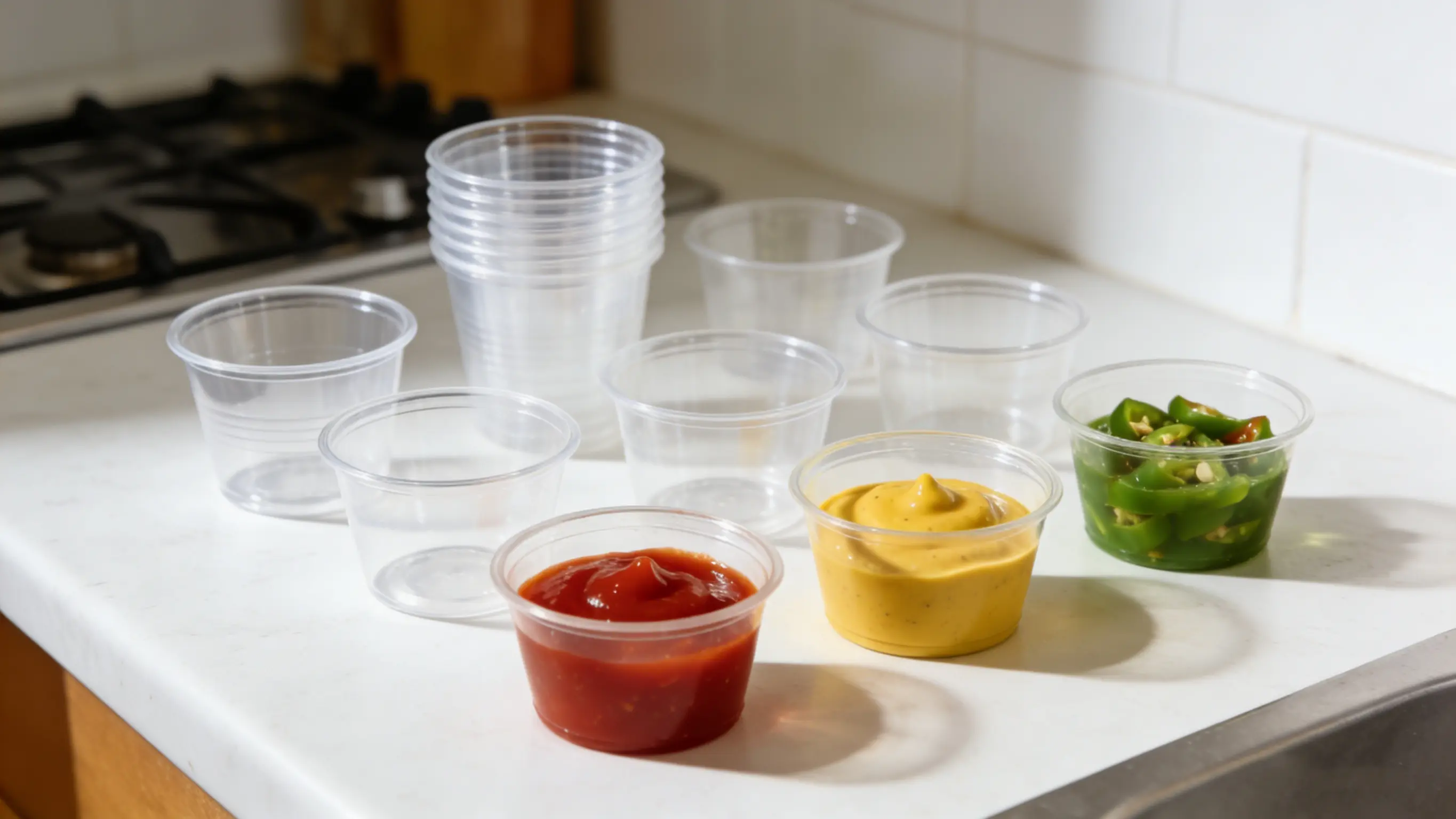
2. Material Safety and Suitability Analysis
2.1 Common Material Types and Characteristics of Portion Cups with Lids
The main materials commonly used for disposable portion cups with lids include the following:
- Polypropylene (PP, Plastic #5): PP material has excellent temperature resistance and can withstand high temperatures of 130℃, making it the only plastic container material that can be used in a microwave oven. PP material is resistant to temperatures above 100 degrees Celsius, can be microwaved, is soft and not easily broken, and is a cost-effective choice for bento boxes and flip-top lunch boxes. In terms of chemical stability, PP material has good resistance to acids, bases, and salts.
- Polystyrene (PS, Plastic #6): PS material has high hardness and good transparency, and can be used for both hot and cold applications, often used in catering and other occasions. However, PS material can only withstand temperatures of around 60-70 degrees Celsius, and its texture is relatively hard and easily broken, starting to soften at temperatures reaching 75℃.
- Polyethylene terephthalate (PET, Plastic #1): PET material has very high transparency and good hardness, but it is only suitable for cold drink cups and cannot be heated. PET is commonly used in mineral water bottles, various beverage bottles, and cold drink cups.
- Polylactic acid (PLA): PLA material is derived from plant-based raw materials, is biodegradable and compostable, and is currently recognized as a relatively environmentally friendly material for sustainable development. It is resistant to temperatures of 60-80 degrees Celsius and is recommended for cold drink cups.
2.2 Special Requirements for Sauces
Sauces, as a special type of food, have specific requirements for packaging materials. According to the GB 4806 standard system, food is classified into categories such as aqueous, acidic, alcoholic, and oily based on its contact characteristics. Sauces usually fall into the following categories:
High-fat foods: Many sauces, such as sesame paste, peanut butter, and salad dressing, contain a large amount of oil. High-oil sauces have a dissolving effect on plastic containers, which may lead to the migration of plastic components. Studies have shown that oil can increase the migration of plasticizers in plastics by nearly 20 times.
Acidic foods: Sauces such as ketchup and vinegar-based sauces are usually acidic (pH<4.5). Acidic environments promote the migration of metal catalysts (such as antimony) from plastics. When PET bottles come into contact with acidic liquids, metal catalyst residues from the manufacturing process, such as antimony, are more likely to leach out.
Complex food characteristics: Many sauces have both acidic and oily characteristics. These foods require the "most stringent" testing, requiring separate tests with 3% acetic acid and oil simulant.
High-fat foods: Many sauces, such as sesame paste, peanut butter, and salad dressing, contain a large amount of oil. High-oil sauces have a dissolving effect on plastic containers, which may lead to the migration of plastic components. Studies have shown that oil can increase the migration of plasticizers in plastics by nearly 20 times.
Acidic foods: Sauces such as ketchup and vinegar-based sauces are usually acidic (pH<4.5). Acidic environments promote the migration of metal catalysts (such as antimony) from plastics. When PET bottles come into contact with acidic liquids, metal catalyst residues from the manufacturing process, such as antimony, are more likely to leach out.
Complex food characteristics: Many sauces have both acidic and oily characteristics. These foods require the "most stringent" testing, requiring separate tests with 3% acetic acid and oil simulant.
2.3 Compatibility Assessment of Materials and Food Components
According to data from the State Administration for Market Regulation in 2022, chemical migration problems accounted for 35% of the unqualified rate in random inspections of condiment packaging, with excessive migration of plasticizers (such as phthalates) being the most significant. A third-party testing agency's testing of 200 commercially available plastic condiment bottles showed that 30% of the products had phthalate migration levels exceeding the EU No 10/2011 standard limit.
The compatibility of different materials with sauces varies significantly:
PP material compatibility: Due to its excellent chemical stability, PP material has good compatibility with most sauces. It is the preferred material, especially for sauces that require microwave heating.
Limitations of PS material: PS material may crack when in contact with high-fat sauces and is not suitable for high-temperature use.
Risks of PET material: PET material is not suitable for containing acidic or oily sauces, as it can lead to a significant increase in the migration of harmful substances.
Applicability of PLA material: Although PLA material is environmentally friendly, due to its temperature resistance limitations (60-80 degrees Celsius), it is mainly suitable for sauces stored at room temperature or refrigerated.
The compatibility of different materials with sauces varies significantly:
PP material compatibility: Due to its excellent chemical stability, PP material has good compatibility with most sauces. It is the preferred material, especially for sauces that require microwave heating.
Limitations of PS material: PS material may crack when in contact with high-fat sauces and is not suitable for high-temperature use.
Risks of PET material: PET material is not suitable for containing acidic or oily sauces, as it can lead to a significant increase in the migration of harmful substances.
Applicability of PLA material: Although PLA material is environmentally friendly, due to its temperature resistance limitations (60-80 degrees Celsius), it is mainly suitable for sauces stored at room temperature or refrigerated.

3. Food-Grade Certification and Testing Requirements
3.1 Necessity of Food-Grade Certification
According to Chinese regulations, the production of food-related products should comply with laws, regulations, and national food safety standards. Food-related products with higher risks, such as packaging materials that directly contact food, are subject to production licensing in accordance with national regulations on industrial product production licenses.
For disposable portion cups with lids, although regulations do not explicitly require specific food-grade certification, as packaging containers that directly contact food, they must comply with the requirements of GB 4806.7-2023 standard. This means that the product must pass relevant tests and meet standard requirements before it can be used for food packaging.
Regular portion cup products on the market usually bear labels such as "for food contact" or "food grade," and some products use a cup and fork symbol (a graphic combination of a glass and a fork). These markings indicate that the product meets food safety requirements.
For disposable portion cups with lids, although regulations do not explicitly require specific food-grade certification, as packaging containers that directly contact food, they must comply with the requirements of GB 4806.7-2023 standard. This means that the product must pass relevant tests and meet standard requirements before it can be used for food packaging.
Regular portion cup products on the market usually bear labels such as "for food contact" or "food grade," and some products use a cup and fork symbol (a graphic combination of a glass and a fork). These markings indicate that the product meets food safety requirements.
3.2 Test Items and Standard Limits
According to GB 4806.7-2023 standard, plastic materials and products for food contact require multiple tests:
Basic physical and chemical indicators:
- Overall migration: should not exceed 10 mg/dm²
- Potassium permanganate consumption: should not exceed 10 mg/kg
- Heavy metal (calculated as Pb) migration: should not exceed 0.01 mg/kg
Specific substance migration limits:
- Bisphenol A (BPA): The migration limit has been reduced from 0.6 mg/kg to 0.05 mg/kg, and its use in infant products is prohibited.
- Total migration of aromatic primary amines: detection limit 0.01 mg/kg, mainly for high-risk products such as azo dyes and nylon kitchenware.
- Phthalates: The limit varies depending on the specific substance, ranging from 0.1% to 1.5%.
Microbiological indicators:
- Coliforms: should not be detected
- Pathogenic bacteria (Salmonella, Shigella, Staphylococcus aureus): should not be detected
3.3 Differences in Requirements of Different Certification Bodies
In China, the certification of food contact materials is mainly carried out by third-party testing institutions accredited by the State Administration for Market Regulation. Companies need to send their products to qualified testing institutions for testing, and a test report will be issued after passing the test.
International certifications mainly include:
International certifications mainly include:
- US FDA certification: FDA testing of food contact materials includes three main categories: migration testing (simulating different food environments such as acidic and oily conditions to detect the migration of heavy metals and harmful substances), component analysis (strictly limiting the use of more than 2,000 chemical substances), and physical testing (including temperature resistance testing from -20℃ to 220℃ and mechanical strength testing). EU Certification: EU standards are renowned for their risk prevention approach. Key testing features include comprehensive overall migration testing (OML) requiring the total migration of all substances to be ≤10mg/dm², specific migration limits (SML) setting individual limits for 38 substances, including lead and mercury, and nickel release testing for metal tableware requiring nickel release to be <0.5μg/cm²/week.
- German LFGB Certification: LFGB certification requires sensory testing to ensure plastics do not alter the smell or taste of food, overall migration testing with food simulants requiring total migration ≤10mg/dm², primary aromatic amines ≤0.01mg/kg, and bisphenol A ≤0.05mg/kg.

4. Market Practices and Risk Assessment
4.1 Actual Usage of Portion Cups with Lids in the Market
According to market research data, the global Portion Cup market size reached US$1.35 billion in 2022 and is expected to reach US$2.18 billion by 2030, with a compound annual growth rate of 6.14%. Disposable clear plastic portion cups dominate the market, mainly due to their convenience and widespread use in the food service industry.
In the Chinese market, the penetration rate of PLA (polylactic acid) in the disposable tableware sector reached 18.7% in 2023, with a market size exceeding 2.35 billion RMB, of which approximately 34% is accounted for by noodle cups. This indicates a growing demand for environmentally friendly portion cups with lids.
In terms of product certification, legitimate Portion Cup products usually bear labels such as "for food contact" or "food grade," and may include relevant certification marks, such as FDA certification and EU food safety standards. Some high-end products also indicate "BPA-free" to enhance product safety.
In the Chinese market, the penetration rate of PLA (polylactic acid) in the disposable tableware sector reached 18.7% in 2023, with a market size exceeding 2.35 billion RMB, of which approximately 34% is accounted for by noodle cups. This indicates a growing demand for environmentally friendly portion cups with lids.
In terms of product certification, legitimate Portion Cup products usually bear labels such as "for food contact" or "food grade," and may include relevant certification marks, such as FDA certification and EU food safety standards. Some high-end products also indicate "BPA-free" to enhance product safety.
4.2 Risk Analysis of Using Non-Food-Grade Products
Using non-food-grade portion cups with lids to hold sauces poses multiple risks:
- Legal risks: According to Article 125 of the "Food Safety Law of the People's Republic of China," producing or selling food or food additives contaminated by packaging materials, containers, or transportation tools will result in confiscation of illegal gains and illegal food and food additives by the food safety supervision and management department of the people's government at or above the county level. Tools, equipment, and raw materials used in illegal production and operation may also be confiscated; if the value of the illegally produced or sold food or food additives is less than 10,000 RMB, a fine of 5,000 to 50,000 RMB will be imposed; if the value is 10,000 RMB or more, a fine of five to ten times the value will be imposed; in serious cases, production and business operations will be ordered to cease, and the license may be revoked.
- Health risks: Non-food-grade plastics may contain a large number of harmful substances, such as heavy metals, plasticizers, and formaldehyde. These substances can migrate into food when in contact with it, and long-term ingestion may cause chronic harm to the human body. In particular, phthalate plasticizers may interfere with the human endocrine system. Product Quality Risks: Non-food-grade products often have poor quality and may exhibit problems such as softening, deformation, and leakage. For example, a consumer purchased "disposable airline plastic cups" that immediately deformed and emitted an odor when hot water was added. During a load-bearing performance test, when a 3KG weight was placed on the tested plastic cup, the cup immediately collapsed and flattened.

5. Judgment Standards and Selection Suggestions
Identifying food-grade portion cups with lids requires evaluation from multiple aspects:
Product Labeling:
- Must be labeled with "Food Contact Use" or "Food Packaging Use."
- Should have a clear production license number (format: "SC + Province Abbreviation + Number")
- Should indicate product name, material, implementation standard number, production date, etc.
Material Identification:
- Regular products will clearly indicate the specific material name, such as "PP Polypropylene," "PE Polyethylene," etc.
- Check the plastic recycling symbol; choose materials numbered 1, 2, 4, and 5, and avoid using materials numbered 3, 6, and 7.
- PP material (number 5) is the safest choice and can withstand temperatures up to 130℃.
Certification Marks:
- Domestic products should have the QS mark (which is gradually transitioning to the SC mark)
- International certified products may have FDA, LFGB, CE, etc. marks
- Some products will be labeled "BPA-free" (Bisphenol A-free)
Appearance Inspection:
- Uniform color, no obvious damage or impurities
- Smooth and flat surface, smooth edges, no burrs
- No pungent plastic smell
Based on the above analysis, disposable portion cups with lids used for holding sauces must meet food-grade standards. Why?
Firstly, according to the "Food Safety Law of the People's Republic of China" and relevant national standards, packaging materials that directly contact food must be non-toxic, clean, and meet food safety standards. Disposable portion cups with lids, as containers that directly contact sauces, are high-risk food-related products and must comply with the requirements of GB 4806.7-2023 "National Food Safety Standard for Plastic Materials and Products for Food Contact."
Secondly, sauces, as a special type of food, have high oil content and acidity, which places special requirements on packaging materials. Studies show that oils can increase the migration of plasticizers in plastics by nearly 20 times, and acidic environments can promote the leaching of metal catalysts. Using non-food-grade materials can lead to a large amount of harmful substances migrating into food, posing serious health risks.
Furthermore, from a legal perspective, using non-food-grade clear plastic portion cups will result in severe legal consequences. According to the Food Safety Law, illegally using packaging materials that do not meet food safety standards will result in penalties including confiscation of illegal gains, fines (5-10 times the value of the goods), and revocation of licenses.
Finally, market practice shows that legitimate portion cup products undergo rigorous testing and obtain relevant certifications. The rapid growth of the global portion cup market (expected annual growth rate of 6.14%) also reflects the market's demand for safe and compliant products.
Firstly, according to the "Food Safety Law of the People's Republic of China" and relevant national standards, packaging materials that directly contact food must be non-toxic, clean, and meet food safety standards. Disposable portion cups with lids, as containers that directly contact sauces, are high-risk food-related products and must comply with the requirements of GB 4806.7-2023 "National Food Safety Standard for Plastic Materials and Products for Food Contact."
Secondly, sauces, as a special type of food, have high oil content and acidity, which places special requirements on packaging materials. Studies show that oils can increase the migration of plasticizers in plastics by nearly 20 times, and acidic environments can promote the leaching of metal catalysts. Using non-food-grade materials can lead to a large amount of harmful substances migrating into food, posing serious health risks.
Furthermore, from a legal perspective, using non-food-grade clear plastic portion cups will result in severe legal consequences. According to the Food Safety Law, illegally using packaging materials that do not meet food safety standards will result in penalties including confiscation of illegal gains, fines (5-10 times the value of the goods), and revocation of licenses.
Finally, market practice shows that legitimate portion cup products undergo rigorous testing and obtain relevant certifications. The rapid growth of the global portion cup market (expected annual growth rate of 6.14%) also reflects the market's demand for safe and compliant products.
Are Black Chinese Take-Out Containers Less Safe?
Are PLA Small Take-Out Containers a Type of Plastic?
Related Article

You searched for 4 oz Chinese take out boxes — but what you actually need may not be a paper box at all. The folded paper container with the wire handle looks iconic, but for 4 oz portions of sauce, dressing,
4 oz Chinese Take Out Boxes Alternative — Clear PP Portion Cups
Looking for plastic to-go containers with lids in bulk? Every container we ship includes a matching lid — not as an optional add-on,
Plastic To-Go Containers with Lids Wholesale | Bulk PP Food Boxes
SEND MESSAGE